
Apple Vision Pro vs Meta Quest for Live Music: An Honest Comparison
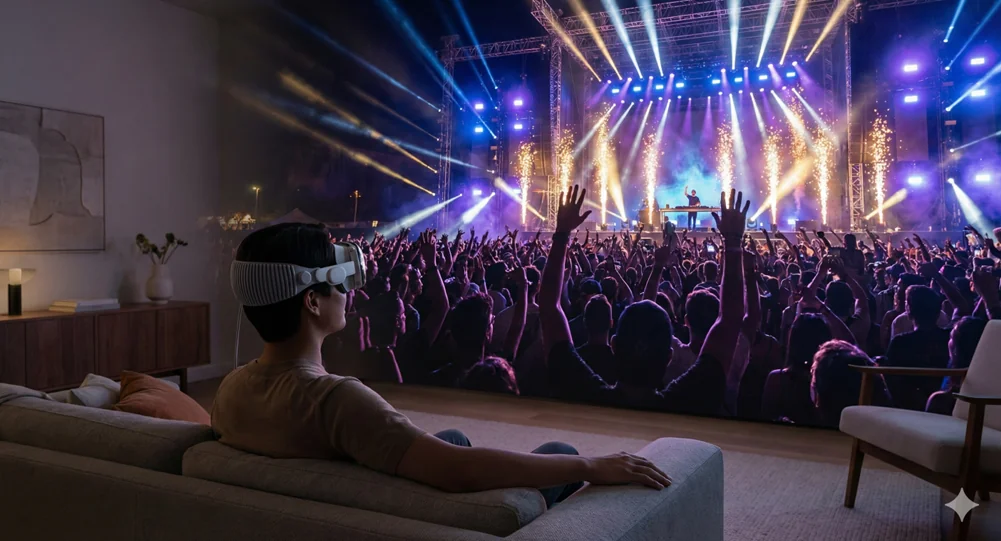
You want to watch a concert in a headset. You have two real options in 2026: Apple Vision Pro and Meta Quest 3. Both will play video. Both will put sound in your ears. Both will make you look a little ridiculous to anyone walking past your couch.
But they are not the same experience. Not even close.
This is not a spec-sheet race. It is a guide for someone who actually cares about music and wants to know which headset will make a Friday night set feel like more than a glorified YouTube video. We will cover displays, audio, content, comfort, price, and the stuff that is coming next. No spin. If Quest wins a category, we will say so.
If you want the fuller picture first, our VR concerts definitive guide covers what VR concerts actually are and how spatial video capture works before you pick a headset.
Screen and Display
The screen is the stage. If it falls short, nothing else matters.
Apple Vision Pro uses dual micro-OLED panels running at roughly 23 million pixels total. That works out to about 34 pixels per degree (PPD). For context, the threshold where most people stop noticing individual pixels sits around 60 PPD, so Vision Pro is not truly "retina" in the way Apple uses the term for iPhones. But it is the highest-resolution consumer headset you can buy right now, and for concert footage the difference is tangible. You can read text on a banner behind the DJ booth. You can see individual faces in the crowd.
Meta Quest 3 uses pancake-optic LCD panels at roughly 2064 x 2208 per eye, landing around 25 PPD. That is a meaningful step down. Fine detail softens. At a distance it looks solid, but close-up shots of an artist's hands on a mixer or the grain of a wooden stage lose definition.
Where the gap really widens is in dark scenes, and concerts are mostly dark scenes. OLED panels produce true blacks because each pixel turns off individually. When the stage lights cut and a single spotlight hits the vocalist, Vision Pro renders that moment with cinematic contrast. Quest's LCD panels cannot fully shut off their backlight, so dark scenes carry a faint grey wash. It is the same reason movie theaters dim the house lights. Black matters.
Winner: Vision Pro. The OLED advantage alone is decisive for live music, where darkness is half the atmosphere.
Spatial Audio and the Soundstage
A concert is at least fifty percent sound. Arguably more.
Vision Pro's audio pods sit outside the ear, firing directional sound toward your ear canal. They support head-tracked spatial audio, meaning the soundstage stays anchored to the virtual environment as you turn your head. If the bass stack is to your left and you turn right, the low end shifts. It is subtle but it does something important: it tricks your brain into believing the room is real. Apple's implementation also supports personalized spatial audio profiles based on ear scans, which tightens the imaging further.
Quest 3 also has built-in speakers with spatial audio support, and Meta's spatializer has improved substantially. For stereo music playback, Quest sounds respectable. But the drivers are smaller and the frequency response rolls off earlier at both ends. Bass presence, in particular, is thinner.
Here is the honest take, though: both headsets lose to a decent pair of headphones. If you plug wired IEMs or high-quality over-ears into either device, the built-in speaker comparison becomes irrelevant. VPORT content ships with professional-grade spatial audio mixes captured at the source, so the quality of what reaches your ears depends heavily on whether you are using the built-in speakers or your own gear.
If you are using built-in speakers only, Vision Pro wins on richness and spatial accuracy. If you are plugging in headphones, the gap shrinks to near zero.
Winner: Vision Pro on built-in speakers. Near tie with headphones.
Content Libraries - What You Can Actually Watch
Hardware is a doorframe. Content is the room you walk into.
VPORT on Vision Pro is available now. The library includes professionally captured 8K 360-degree performances, spatial video sets, and exclusive behind-the-scenes footage from top-tier venues and festivals. Every piece of content on the platform comes from verified professional capture rigs, not audience phone clips. If you care about fidelity and curation, this is currently the richest immersive concert library on any headset.
VPORT on Quest is on the roadmap. We are targeting Phase C availability in Summer 2026. We want to be upfront about this: if you buy a Quest 3 today expecting VPORT, you will be waiting a few months. We are not going to pretend otherwise.
Apple Immersive Video offers a growing library of spatial content through Apple TV+. Several concert-adjacent experiences exist, though the library skews toward documentary and cinematic formats rather than raw live performances. The production quality is extraordinary, but the catalog is still small.
Meta Horizon has hosted periodic concert drops and live events, and the Quest ecosystem has a broader range of social VR music experiences, including VRChat music worlds, Beat Saber (different category, but worth noting), and various third-party apps. Meta's advantage is volume and variety. If you want casual, social, lower-fidelity music experiences alongside the occasional premium drop, Quest has more surface area to explore.
There is an important nuance here. Quest's content library is wider but shallower when it comes to professional live concert footage. Vision Pro's library is narrower but deeper in production quality. Which matters more depends on whether you want to browse casually or sit down for an intentional, front-row-caliber experience.
Winner: Vision Pro for premium concert content today. Quest for variety and social experiences.
Comfort for a 2-Hour Set
A concert is not a five-minute demo. You are wearing this thing for the duration of a full set, maybe two hours, maybe longer if you are deep in an afterparty replay.
Vision Pro weighs approximately 600-650 grams on the front assembly, depending on the light seal and headband configuration. The dual-loop headband distributes weight better than the solo knit band, but the device is still front-heavy. After an hour, most people feel pressure on the forehead and cheeks. Apple's thermal management is reasonable; the aluminum frame acts as a heat sink and the external battery pack means less heat on your face. That battery pack is both a blessing and a nuisance. It offloads weight from your head but introduces a tethered cable that you will step on or yank at least once per session.
Battery life is roughly 2 to 2.5 hours for media playback. That is tight for a long set. You can plug the battery into a wall outlet for continuous use, which mostly solves the problem but further tethers you.
Quest 3 weighs about 515 grams. It is meaningfully lighter. The strap system is less premium out of the box, but aftermarket elite straps with rear battery packs bring the balance closer to neutral and extend battery life. Speaking of battery: Quest 3's internal battery lasts roughly 2 to 2.5 hours under media playback, which is about the same as Vision Pro's external pack. The difference is that Quest generates all its heat on your face since there is no external compute unit. During graphically demanding content, the front of the headset gets warm. Not hot, but noticeable across a full set.
For sessions longer than two hours, both headsets need to be plugged in. Quest's on-head weight advantage makes it more comfortable for extended wear. Vision Pro's external battery helps with thermals but adds a cable.
Winner: Quest 3 for raw comfort and weight. Vision Pro if thermals matter more to you than grams.
Price, Accessories, and Total Cost
This is where the conversation gets uncomfortable.
Apple Vision Pro: $3,499 USD for the base unit. You will likely want AppleCare+ ($499 for two years) because a single lens scratch is catastrophic. If you wear prescription lenses, add ZEISS optical inserts ($99-$149). A carrying case runs $199. Total realistic out-the-door cost: roughly $4,100-$4,250.
Meta Quest 3: $499 USD for the 128GB model, $649 for 512GB. An elite strap with battery runs about $130. A carrying case is $50-$80. Total realistic out-the-door cost: roughly $680-$860.
That is a 5x price difference. There is no way to sugarcoat this.
Vision Pro is a premium device aimed at early adopters, professionals, and people who view spatial computing as a long-term investment. Quest 3 is a consumer device designed for mass adoption. Both price points are honest reflections of what each company is trying to do.
If you are deciding purely on music-watching value per dollar, Quest wins by a landslide. If you are deciding on absolute experience quality and you have the budget, Vision Pro delivers more.
Winner: Quest 3 on value. Vision Pro on absolute quality. Your wallet decides.
Which Should You Buy?
There is no universal answer. But here are three honest recommendations.
Get Vision Pro if...
- You want the highest-fidelity concert experience available in consumer VR today.
- You are already invested in the Apple ecosystem and want spatial computing for more than just music, such as productivity, spatial photos, or cinematic viewing.
- You treat this as a long-term platform purchase, not a single-use gadget.
- Budget is secondary to experience quality.
- You want access to VPORT's full library right now.
Get Quest 3 if...
- You want a great VR music experience without spending $3,500.
- You care about social features and want to watch with friends in shared virtual spaces.
- Comfort for long sessions matters more than peak visual fidelity.
- You are interested in the broader VR ecosystem beyond just concerts: gaming, fitness, social.
- You are comfortable waiting until Summer 2026 for VPORT's Quest release.
Wait 6 months if...
- You suspect Apple will announce a more affordable Vision Pro variant (the rumor mill is loud).
- You want VPORT available on Quest before committing to Meta's hardware.
- You prefer to buy when the content libraries on both platforms are more mature.
- You are not in a rush and want to see where spatial audio standards land by late 2026.
Waiting is a legitimate strategy. The headset market is moving fast, and six months from now the calculus may look different.
What's Coming That Will Change This Comparison
Both platforms have significant updates on the horizon, and either one could shift this comparison meaningfully.
On the Apple side, visionOS updates continue to expand developer APIs for immersive media. Better capture tools mean more content creators can produce for the platform. Rumors of a lighter, more affordable Vision headset persist. If Apple delivers a $1,999 device with similar display quality and reduced weight, the value proposition changes overnight.
On the Meta side, Quest hardware iterations are moving toward higher-resolution displays and improved audio. The Quest ecosystem's sheer install base means more developers building music and event experiences. When VPORT arrives on Quest in Summer 2026, it will bring the same professional capture quality to a device that five times more people own. That is not a small thing.
On the content side, the next twelve months will see a significant expansion of professionally captured spatial concerts. Both platforms will benefit. The headset you buy today will have a substantially richer library by the time you have owned it for a year.
The real shift will not come from one headset beating the other on specs. It will come from the moment when spatial concert content becomes as routine as pulling up a playlist on Spotify. We are building toward that. Both Apple and Meta are building toward that. The trajectory matters more than today's snapshot.
Pick Your Seat
Here is the thing about live music: the best concert you have ever attended probably was not in the best venue with the best sound system. It was the one where something clicked. The energy, the timing, the unexpected moment where the crowd and the artist locked in together.
Both of these headsets can deliver that feeling. Vision Pro delivers it with more visual precision and richer built-in audio. Quest 3 delivers it with more accessibility, comfort, and a lower barrier to entry. Neither is the wrong choice. They are different seats in the same room.
The room is what matters. And the room is filling up.
Pick your seat. We will save you a spot in the front row.