
The 10 Greatest Electronic Sets of 2025, Reimagined for Immersive Video
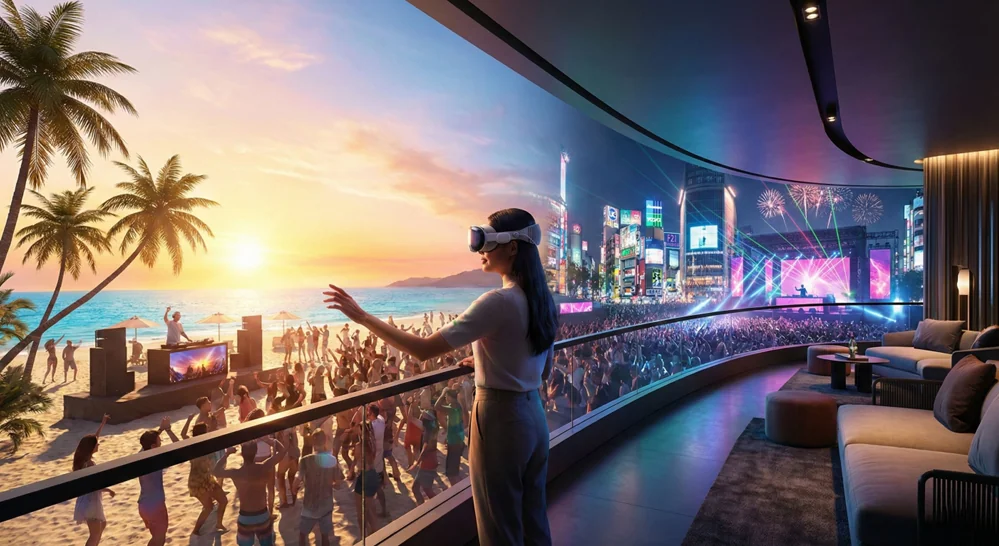
2025 was the year of the long set. The two-hour headline slot. The sunrise marathon. The three-hour back-to-back that nobody on the livestream wanted to end. Across desert main stages and crumbling Mediterranean amphitheaters and fog-choked Berlin basements, electronic music stretched out, breathed deeper, and reminded everyone why people still fly halfway around the world just to stand in a field.
But standing in that field was the problem. You could only be in one place. One timezone. One crowd. The rest lived on your phone as a cropped, compressed, vertically-filmed souvenir that captured maybe five percent of what it actually felt like.
We spent the year watching differently. We spent it thinking about which of these sets - these specific nights - would be transformed most completely by professional spatial video. Not just documented. Transformed. The kind of 360° capture where you turn your head and suddenly the whole room makes sense: the lights, the bodies, the geometry of sound bouncing off walls. The kind of presence we have been building toward since we launched VPORT on VisionOS.
This is our list. Ten sets. Ten arguments for why the best music of 2025 deserves a second life in immersive video.
How We Picked
Three criteria. No exceptions.
Cultural moment. The set had to mean something beyond the tracklist. A headline debut. A reunion nobody expected. A location that elevated the music into something mythological. If it did not generate conversation for at least a week after it happened, it was not in contention.
Spatial suitability. This is the filter that separates a great DJ set from a great immersive DJ set. We looked at venue architecture, lighting design, crowd density, camera-placement potential, and the visual dynamism of the performance itself. A dark booth with a laptop is a wonderful thing. It is not spatial-video gold. We needed sets where the environment was as much a character as the artist.
Replay value. Some sets peak in a single moment. The best ones build arcs. They reward a second pass. A third. You catch something new each time - a transition you missed, a crowd reaction that ripples outward, a lighting cue that only lands when you are looking in the right direction. In 360°, replay value multiplies. Every angle is a different film.
With that lens, here is the list.
#10 - #6
#10: Peggy Gou - DC-10, Ibiza (Circoloco Opening)
The Circoloco opening at DC-10 is always a litmus test. The terrace. The jet engines overhead. The sweat. Peggy Gou took the mid-afternoon slot and turned it into a masterclass in groove construction - three hours of deep house and disco edits that kept the floor locked at a rolling boil without ever reaching for a cheap peak.
Why it belongs in 360°: DC-10's terrace is one of the most photographed rooms in electronic music, and yet no photograph has ever captured what it feels like to stand in it. The low ceiling. The way the light cuts in from the open side and paints one half of the crowd gold while the other half stays in shadow. A spatial capture would let you feel the claustrophobia and the euphoria simultaneously. You would understand, finally, why people keep coming back to that concrete box.
#9: Four Tet - Printworks London (Final Run)
Printworks announced its closure and then announced one more run. Four Tet was the obvious headliner. The set leaned ambient for the first forty-five minutes - long drones, field recordings, patient builds - before cracking open into a relentless second half of breakbeat and UK garage that shook the industrial hall to its bones.
Why it belongs in 360°: Printworks was built for immersive documentation. The press hall's sheer scale, its parallel columns of light, and its industrial ceiling make it a spatial cinematographer's dream. Capturing Four Tet's set in that space would preserve not just the music but the architecture of a venue London is about to lose forever. This is what we mean by immortalizing the night - some rooms deserve to be stepped inside long after the doors close for good.
#8: Boris Brejcha - Tomorrowland Main Stage (Friday Sunset)
Boris Brejcha in his Joker mask, silhouetted against the Tomorrowland main stage at golden hour, playing high-tech minimal to 60,000 people. The production team matched every drop with synchronized pyro bursts that arced over the crowd in a way that felt genuinely dangerous. The set ran ninety minutes. It felt like twenty.
Why it belongs in 360°: Tomorrowland's main stage is the most over-the-top production in festival history, and that is exactly why it works in immersive. The scale only makes sense when it surrounds you. Flat video compresses those pyrotechnics into a rectangle and kills the depth. In spatial video, the fireworks would explode above your head. The crowd - that endless sea of flags and hands - would extend to every horizon. You would finally understand why people weep at Tomorrowland. It is the scale. It overwhelms.
#7: Bonobo - Cercle at the Alhambra, Granada
Cercle continued its tradition of pairing world-class artists with world-class backdrops. Bonobo at the Alhambra was the standout: a two-hour live set performed at dusk in the Nasrid Palace courtyard, with the Sierra Nevada behind him turning from orange to deep purple as the set progressed. The music was patient. Layered. Intricate. He brought a string quartet.
Why it belongs in 360°: Cercle already shoots for visual spectacle, but their standard output is still a flat rectangle. The Alhambra set demands periphery. The Moorish arches. The reflecting pools catching the stage lights. The string players tucked into an alcove to the left that you would never see in a standard broadcast frame. A 360° capture would turn this from a concert film into a spatial memory of one of the most beautiful buildings on Earth.
#6: Charlotte de Witte - Zamna Tulum (New Year's Day)
Charlotte de Witte opened 2025 the way she opens everything: with unrelenting techno and zero sentimentality. The Zamna jungle stage in Tulum - open sky, ancient stone, tropical canopy - gave her sound an almost archaeological weight. The crowd danced in cenote light. The bass disturbed birds from the treeline.
Why it belongs in 360°: Zamna is already one of the most spatially dramatic venues in the world. The jungle wraps around you. The stone ruins frame the stage like a portal. A professional immersive capture would do what no aftermovie has managed: let you feel enclosed by nature and bass simultaneously. This is the promise of spatial video - not a screen, but a place.
#5 - #2
#5: Fred Again.. & Skrillex - Coachella (Sahara Tent, Weekend 2)
The rumors started on Thursday. By Friday morning, it was confirmed. Fred Again.. and Skrillex would reunite in the Sahara Tent for a surprise back-to-back, their first joint appearance since the legendary 2023 trilogy of shows that essentially rewired what a DJ set could be.
This was a different beast. Looser. Dirtier. Fred Again.. spent the first thirty minutes playing unreleased vocal cuts - raw, emotional, barely finished - while Skrillex layered increasingly unhinged bass underneath. Then they swapped roles. Then they stopped pretending there were roles at all. The crowd density was borderline unsafe. The energy was nuclear.
Why it belongs in 360°: The Sahara Tent is a sensory assault by design. LEDs on every surface. A crowd that extends so far back it becomes abstract. The energy in that room during Weekend 2 was reportedly the most intense Coachella has seen since Daft Punk in 2006. You cannot convey that energy in a flat frame. You need the full sphere. You need to be able to turn around and see the faces of 40,000 people losing their minds in unison. That is the footage that becomes a digital twin of an event - a living archive, not a clip.
#4: Bicep - Live at Alexandra Palace, London
Bicep have quietly become one of the best live electronic acts on the planet. The Alexandra Palace show in October was the culmination of a two-year tour cycle: a three-hour performance incorporating new material from their third album alongside reworked classics. The production was staggering - a 360-degree LED cylinder that wrapped the stage and pulsed with generative visuals responding to the music in real time.
Why it belongs in 360°: This is the rare case where the artist's own production design is already begging for immersive treatment. Bicep's visual language - those geometric patterns, those slow color shifts - was designed to envelop. In the room, the LED cylinder already created a sense of being inside the music. In spatial video, you would not be watching the visuals. You would be living inside them. The symmetry between Bicep's artistic intent and the immersive format is almost too perfect.
#3: Amelie Lens - Berghain (Klubnacht, March)
Nobody talks about what happens inside Berghain. That is the rule. But let us talk about it anyway, because the March Klubnacht featuring Amelie Lens on the main floor was, by most whispered accounts, one of the defining techno sets of the decade.
She played for seven hours. The set moved through phases - cold, minimal, industrial openings gave way to acid-drenched peaks before pulling back into deep, hypnotic grooves that made people forget what time zone they were in. Berghain's Funktion-One system did what it always does: turned bass into something architectural.
Why it belongs in 360°: Berghain is the single most requested venue in any conversation about spatial video. The room is mythological. The light - those brutal concrete columns, the occasional shaft of sun through the industrial windows - is impossible to replicate. The problem is that Berghain does not allow cameras. That is also what makes it the ultimate immersive white whale. If spatial video could ever be sanctioned inside that room, even once, the result would be the most sought-after piece of immersive music content ever produced. Access the Unaccessible - that is the entire thesis of VPORT, and Berghain is the ultimate test case.
#2: Anyma - Cercle at Petra, Jordan
Anyma does not perform. Anyma constructs realities. The Cercle set at Petra - played at the foot of Al-Khazneh, the Treasury, one of the New Seven Wonders of the World - was the most visually ambitious electronic music event of 2025 and possibly the decade.
The production team projected generative AI visuals onto the 40-meter sandstone facade. The music moved through cinematic melodic techno, building slowly, almost reverently, as if the set itself were a conversation with the architecture. When the main drop hit during "Eternity," the entire cliff face appeared to fracture and dissolve into particles of light. Twelve thousand people stood in stunned silence before the bass brought them back.
Why it belongs in 360°: This set is the single strongest argument for why spatial video exists. Every element - the carved stone, the projected visuals, the crowd arranged on the ancient steps, the desert sky shifting overhead - occupies a different point in the sphere. A flat camera captures maybe one-tenth of the visual information. A 360° rig captures the entire cathedral of it. You could watch this set fifty times in immersive and notice something new each time: the shadow play on the columns to your right, the way the projections reflect off the canyon walls behind you, the faces in the crowd above. This is not content. This is spatial history.
#1 - The Set That Defined the Year
#1: Tale Of Us - Afterlife at Coachella (Sahara Tent, Weekend 1)
You knew it was coming.
Afterlife's Coachella takeover had been rumored for years. In 2025, it finally happened. Tale Of Us curated an entire Sahara Tent experience - a four-hour Afterlife showcase that featured guest appearances from Anyma, Argy, and Kevin de Vries, all building toward a Tale Of Us closing set that ran past midnight and officially violated curfew by eleven minutes.
The Afterlife visual identity - that austere, monochrome, neo-classical aesthetic - was translated into a full-tent immersive installation. Holographic projections floated above the crowd. The lighting rig was the most complex Coachella had ever deployed. And the music - patient, melodic, building across hours rather than minutes - turned the Sahara Tent into something closer to a cathedral than a festival stage.
The moment that defined 2025 landed at approximately 11:47 PM. Tale Of Us dropped an unreleased collaboration with a full orchestral arrangement. The strings swelled. The tent went quiet. Then the kick hit and the room detonated.
That was the moment. That was the year.
Why it belongs at #1 - and why 360° changes everything: The Afterlife experience was designed from the ground up as total environment. Every surface was a canvas. The visuals were omnidirectional by design. The crowd - 45,000 people inside and outside the tent - was part of the installation. This is the rare case where flat video does not just fail to capture the event; it actively misrepresents it. You cannot understand Afterlife at Coachella through a rectangle. You have to be surrounded by it.
This is the set that proves the thesis. The live experience was so spatially complex, so architecturally ambitious, so dependent on the relationship between sound and environment, that only professional 360° capture can do it justice. In spatial video, you would not watch Afterlife. You would be inside it. And you would finally understand why every single person who was there called it the greatest electronic music event they had ever attended.
That is what we are building toward. That is the future of music documentation. That is VPORT.
What the List Tells Us About 2026
Look at what connects these ten sets. It is not genre. It is not BPM. It is environment.
Every entry on this list is defined as much by where it happened as by who played. Petra. The Alhambra. Berghain. Tomorrowland's main stage. Zamna's jungle. These are not interchangeable venues. They are characters in the story. The music would be different - fundamentally different - in a different room.
That is the signal for 2026. The electronic music industry is investing more heavily in site-specific production than ever before. Artists are choosing locations not just for capacity but for visual and spatial impact. The stage design budgets are climbing. The venue partnerships are getting more ambitious. The entire scene is building experiences that demand more than a flat camera to document.
Which means the gap between "being there" and "watching the recap" is about to get wider. Unless the capture technology evolves to match the ambition of the production.
That is where spatial video steps in. That is where VPORT's mission - removing the barrier between the fan and the moment - stops being aspirational and starts being necessary.
2026 will be the year immersive capture becomes standard practice at the world's biggest electronic events. Not a novelty. Not a side project. The primary archival format. Because the shows themselves now demand it.
The Ones That Got Away
No list is complete. These are the sets that hurt to leave off.
Richie Hawtin - ENTER. Closing Party, Space Ibiza Residency Pop-Up. The minimal techno pioneer returned to his Ibiza roots for a one-night-only event in a temporary recreation of the old Space terrace. The nostalgia alone would have justified inclusion. The nine-hour set justified everything else.
RAYE - Glastonbury Other Stage. Not strictly electronic, but RAYE's performance blurred every genre line and the crowd response was seismic. The confetti drop during "Escapism" in the rain would have been extraordinary in spatial video.
Dixon - Diynamic Festival, Amsterdam. A five-hour set in an old shipyard. Slow-burn deep house. The kind of set that changes the way you think about tempo. The venue's corrugated steel walls created natural reverb that would have translated beautifully into spatial audio.
Caribou - Sónar, Barcelona. Live performance at its most intricate. Caribou's one-man-band approach - triggering samples, playing keys, singing - would have made for an intimate and technically fascinating immersive capture.
Kevin de Vries - Afterlife Tulum. The jungle. The smoke machines. The melodic techno precision. It nearly cracked the top ten. On another day, in another list, it would have.
Which of These You Have Seen. Which of These You Have Not.
That is the real question. Not whether these sets were great. Everyone agrees they were great. The question is whether you were there.
Because if you were not - if you watched the livestream, if you caught the 30-second clip on social media, if you read the review and tried to imagine it - then you already know the frustration. You know what it feels like to look at a flat rectangle and think: this is not it. This is not what it was.
You are right. It is not.
What it was - the heat, the light, the peripheral chaos, the feeling of bass in your sternum and strangers pressed against your shoulders - that is spatial information. It lives in three dimensions. It requires three dimensions to be communicated honestly.
That is the future we are building. Not a better livestream. Not a fancier camera angle. The actual, full-sphere, turn-your-head-and-it-is-all-there recreation of what it felt like to stand in that room on that night.
Ten sets. Ten arguments. One question.
Which one goes next?