
CES 2026 and the Spatial Computing Turn: Why Live Music Is the First Killer App
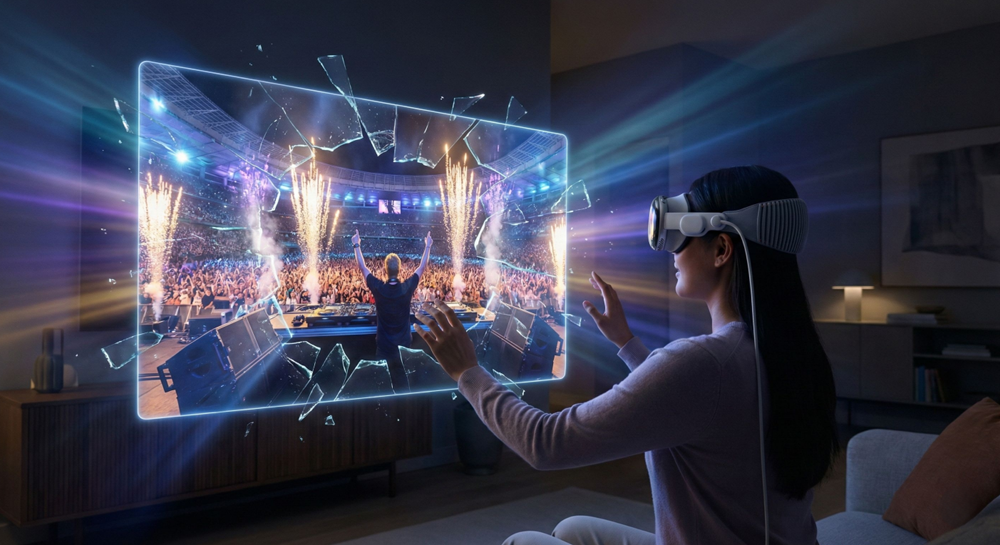
Every year CES promises the future. Most years the future arrives as a press release and a locked demo booth. This year was different. The week of January 7, spatial computing stopped being a concept and started being a supply chain. Real headsets with real ship dates. Real cameras with real specs. Real software with real users. The conversation shifted from "will this work" to "what do we build on it."
We spent the week on the ground in Las Vegas. Not to gawk at concept cars or translucent TVs. We went because CES 2026 was the first trade show where the entire capture-to-playback pipeline for immersive content was represented under one roof. And the category that kept coming up in every backroom meeting, every panel sidebar, every late-night conversation at the Wynn? Live music.
What Actually Shipped at CES 2026 (and What Didn't)
Let's separate signal from noise. CES floors are designed to overwhelm. Here's what actually matters for anyone building in spatial media.
Headsets and Companion Hardware
The headline is volume. Apple Vision Pro is no longer alone at the high end. Samsung's headset — built on Android XR with Qualcomm's Snapdragon XR2+ Gen 3 — showed up with a real demo, a real price tier, and a real release window. Sony teased deeper PlayStation VR2 integration with spatial video playback. Meta kept pushing the Quest line with a lighter, sharper Quest 3S refresh and a surprising enterprise play around spatial video archives.
What this means: the installed base for high-quality spatial playback is about to multiply. Not by a little. By multiples. When you go from one premium headset on the market to three or four credible options in a twelve-month window, content becomes the bottleneck. Not hardware.
The thing that did not ship? A true standalone competitor to Vision Pro's display fidelity. Samsung got close. But Apple's micro-OLED stack and R1 chip latency pipeline remain best-in-class for the kind of presence that makes you forget you're wearing a headset. That gap matters enormously for long-form content like a 90-minute concert. Comfort and clarity compound over time.
Cameras and Capture
This was the real story of CES 2026. The capture side of the equation has been the bottleneck for two years. You could play back gorgeous spatial video — if someone had shot it. The problem was always "who's shooting it, with what, and at what cost?"
Canon announced a dual-lens spatial video module for the EOS R system. Insta360 unveiled the X5 with native Apple spatial video export and 8K per eye. RED showed a prototype MV mount rig designed explicitly for immersive live event capture. And the biggest signal of all: Blackmagic announced the URSA Cine Immersive is shipping Q2, with a cinema-grade spatial pipeline that plugs directly into DaVinci Resolve.
Two years ago, shooting professional spatial video required a custom rig, a six-person crew, and a post-production workflow held together with gaffer tape and prayer. Today the toolchain looks like any other professional camera ecosystem. That is a phase change.
Software and Ecosystem Plays
Apple did not have a booth at CES. Apple never has a booth at CES. But Apple's presence was everywhere — in the SDKs running on partner hardware, in the spatial video format that has become the de facto standard, and in the visionOS 3.0 developer preview that dropped the same week.
visionOS 3.0 brings two things that matter for us: expanded SharePlay for spatial video (more on that below) and a new Performer Mode API that allows content creators to define interactive spatial layers inside a video stream. Think of it as chapters, hotspots, and branching viewpoints — native to the OS.
Qualcomm made noise about Snapdragon Spaces getting tighter integration with Unity and Unreal, which matters for the Android XR side. Google announced spatial audio improvements in Android XR that bring it closer to Apple's head-tracked spatial audio quality. Not there yet. But closer.
The software story at CES 2026 is convergence. Two years ago, every headset had its own proprietary format, its own spatial audio spec, its own distribution channel. We are now watching a standards war settle into something more like a standards agreement. For content creators — and for platforms like VPORT that sit between creator and fan — this is the best possible outcome.
Why Live Music Is Eating Spatial Computing First
Here is the question we kept hearing in Vegas: "What's the killer app?"
Everyone at CES had a different answer. Fitness. Real estate walkthroughs. Remote surgery training. Corporate collaboration. All valid use cases. None of them are pulling first.
Live music is. And the reasons are structural, not sentimental.
Presence, Scale, and Novelty
Spatial computing's superpower is presence — the neurological sensation that you are there. Not watching. Not viewing. There. We've written about this before. The brain processes high-fidelity spatial video differently than flat video. It creates spatial memories. It triggers emotional responses that a 16:9 rectangle cannot.
Now ask: which content category benefits most from presence?
Not fitness. A Peloton instructor is effective on a flat screen. The marginal value of spatial presence is real but incremental. Not enterprise collaboration. Nobody wants to feel more present in a meeting. Not gaming — gaming already has presence through interactivity and game engines. VR gaming is great. But it's not new. It's not a phase change in what gaming can be.
Live music is the phase change. Because the entire value proposition of a live show is presence. It's the reason people pay $400 for a festival ticket instead of streaming the same set on SoundCloud for free. The bass in your chest. The crowd around you. The lighting rig above you. The sweat and the smoke and the moment the DJ drops the track you've been waiting three hours to hear. That is presence. And for the first time, it can be captured and transported.
The addressable audience is massive. There are roughly 32 million live music events globally per year. Only a tiny fraction of fans can attend any given show. The demand for presence at events that are sold out, overseas, or simply too expensive has always existed. The technology to deliver it has not. Until now.
Why Gaming and Fitness Aren't Pulling First
This isn't a knock on VR gaming or fitness. Both categories will be enormous. But they face a cold-start problem that live music doesn't.
VR gaming requires developers to build entirely new content from scratch. The best VR games take years and tens of millions of dollars to produce. The content pipeline is slow by definition.
VR fitness requires behavioral change. You need someone to replace a habit — going to the gym, going for a run — with a new habit that involves strapping a headset to their face and sweating into it. It's happening. But habit replacement is slow.
Live music requires neither. The content already exists — it's being performed on stages around the world every single night. The audience already wants it — they've been buying tickets and watching livestreams for decades. What spatial computing adds is fidelity. It upgrades "watching a livestream" into "being teleported to the venue." That's not a new behavior. It's a better version of an existing behavior. And better versions of existing behaviors adopt faster than entirely new behaviors. Every time.
The Capture Pipeline Is Finally Mature
We've been saying for a year that capture was the bottleneck. CES 2026 is where that bottleneck broke.
iPhone, Insta360, and the 8K Pro Tier
The capture ecosystem now has three clear tiers, and all three shipped real products at CES.
Consumer tier: iPhone 16 Pro spatial video is already in millions of pockets. Apple quietly improved the spatial video recording quality in iOS 19.3, and the rumored iPhone 17 ultra-wide stereo baseline will push consumer spatial capture closer to "good enough for social sharing." This tier seeds the format. It gets people comfortable with spatial video as a concept. It does not produce concert-quality content.
Prosumer tier: Insta360 X5 and Canon's spatial module live here. These are cameras that a skilled one- or two-person crew can deploy at a mid-size venue and walk away with genuinely compelling spatial footage. 8K per eye. Solid stabilization. Direct export to Apple's spatial format. For indie artists, small venues, and underground scenes, this tier is a game-changer. The cost of entry for professional-grade spatial capture just dropped by an order of magnitude.
Cinema tier: Blackmagic URSA Cine Immersive. RED's MV prototype. The multi-camera rigs that companies like us deploy for VIP-level capture at global festivals. This tier produces the reference-quality content that defines what spatial video can be at its best. The kind of content where you forget the headset and simply exist inside the performance.
What matters is that all three tiers now exist, all three are shipping, and all three produce content that plays back on the same devices through the same pipelines. That is an ecosystem. Two years ago it was a science project.
What Blackmagic URSA Cine Immersive Signals
The Blackmagic announcement deserves its own moment. Blackmagic is not a hype company. They don't announce products they can't ship. They don't chase trends. When Blackmagic builds a camera for a format, it means that format has crossed from experimental to professional. Full stop.
The URSA Cine Immersive shoots stereoscopic 8K at 90 fps with Blackmagic RAW. It integrates with DaVinci Resolve's spatial video editing tools — which are, as of version 20, genuinely usable. The camera is priced for professional production companies, not hobbyists. And the fact that it exists tells you everything you need to know about where the industry is heading.
When the camera company that democratized cinema (the original Pocket Cinema Camera was $995) decides to build a spatial video cinema camera, the format is no longer speculative. It's infrastructure.
The Signals We're Watching for Q2
CES sets the agenda. The real work happens in the quarters that follow. Here's what we're tracking.
Social Viewing and SharePlay
The visionOS 3.0 SharePlay expansion is, for us, the most important announcement of the entire show. Not because it's technically flashy. Because it solves the loneliest problem in spatial computing.
Right now, watching immersive content is a solo experience. You put on a headset. You're transported to the venue. The performance is incredible. But the person sitting next to you on the couch has no idea what you're seeing. That isolation is the single biggest friction point for adoption.
SharePlay for spatial video changes the equation. Two, four, eight people — each in their own headset, potentially in different cities — watching the same performance together. Reacting in real time. Feeling co-present not just with the artist but with each other. This is what transforms spatial video from a novelty into a social platform.
We've been building toward social watch experiences since day one. The OS-level support coming in visionOS 3.0 validates the thesis and dramatically accelerates the timeline. Expect VPORT to be among the first platforms to ship a full social spatial concert experience. We are not waiting.
Pro Capture Partnerships
The other signal we're watching: who partners with whom. CES is a mating ritual for the hardware and content industries. The camera manufacturers need content platforms to give their hardware a reason to exist. The platforms need camera manufacturers to feed the pipeline.
We saw early moves in Vegas. Camera companies talking to live event promoters. Headset manufacturers courting music labels. Venue groups exploring spatial capture as a new revenue stream — not a cost center, but a profit center. The economics of spatial concert capture are shifting from "experimental marketing budget" to "new distribution channel with its own P&L."
This is the transition from early adopter to early majority. It doesn't happen because the technology improves. It happens because the business model clicks.
What This Means for Fans
If you're reading this and you don't care about camera specs or developer APIs — fair. Here's what CES 2026 means for you.
More content, faster. The capture bottleneck is breaking. More cameras in more venues means more shows captured in spatial. The library of immersive concerts available on platforms like VPORT is about to grow significantly. Not incrementally. Significantly.
Better quality. The Blackmagic and RED cameras shipping this year will produce spatial video at a fidelity level that makes today's best content look like an early prototype. The jump from current capture quality to what's coming is comparable to the jump from DVD to Blu-ray. You will notice.
More ways to watch together. SharePlay and social viewing features mean you won't have to choose between immersion and connection. Bring your friends. Different cities, same show, same moment. The era of "Access the Unaccessible" extends to shared access.
More headset choices. If Apple Vision Pro's price point has kept you on the sideline, Samsung and others are entering with lower-cost options. The floor is dropping. The quality threshold for a "good enough" spatial experience is rising. These two curves are converging fast.
Live spatial concerts. This is the horizon line. Everything discussed above — better cameras, faster pipelines, social features, more headsets — converges toward one inevitable outcome: real-time spatial broadcasting of live events. Not recorded. Not on-demand. Live. You, in your living room, teleported to a stage in Berlin, at the exact moment the music is happening. We're not there yet. But after CES 2026, the path is visible and the timeline is compressed.
Presence Is a Product Category Now
Here's the takeaway from a week in Vegas.
For years, "presence" was a word that VR evangelists used and everyone else politely ignored. It sounded abstract. Theoretical. Nice-to-have. CES 2026 was the week presence became a product category. Cameras that capture it. Headsets that display it. Software that distributes it. Business models that monetize it.
Live music is the tip of the spear because music was always about presence. Every other entertainment category adapted to the screen. Music never fully did. The gap between a live show and a recorded video of that show has always been enormous — larger than the gap in film, in sports, in gaming. Spatial computing closes that gap for the first time.
We're not building for a future that might arrive. We're building for a future that showed up at the Las Vegas Convention Center with a shipping date and a spec sheet.
The frame is gone. The teleportation is real. And the music is just getting started.