vport

34 posts tagged with "Spatial Video"

Spatial video capture, playback, and technology

View All Tags

Montreal Electronic Music: What an After-Hours Room Actually Is

· 5 min read
VPORT Team

Montreal electronic music rewards a little patience. A long DJ set can change gradually, giving a rhythm time to settle before the next turn. That is one reason an after-hours room deserves more than a listing of opening times: the duration is part of the experience.

Tourisme Montréal's nightlife guide, updated September 24, 2026, describes Stereo as an after-hours destination for extended house and techno sets and notes that it does not serve alcohol. Stereo's own ticketing page also identifies house and techno as its main musical focus. Those descriptions offer a starting point for understanding one room, not a timetable for every electronic night in the city.
Vancouver Electronic Music: A Scene Built Around Last Call

· 7 min read
VPORT Team

Fortune Sound Club's current event page lists weekly nights in Vancouver's Chinatown from 10pm to 3am. The City of Vancouver, meanwhile, says liquor-primary venues are eligible to apply for different closing times depending on their location. That distinction is the useful starting point for understanding Vancouver electronic music: the city sets a ceiling, but the venue's approved hours and published event schedule determine the night in front of you.

Most city guides begin with genre labels. This guide begins with a clock, then asks what that clock changes for a fan, a promoter, and a spatial-video crew.

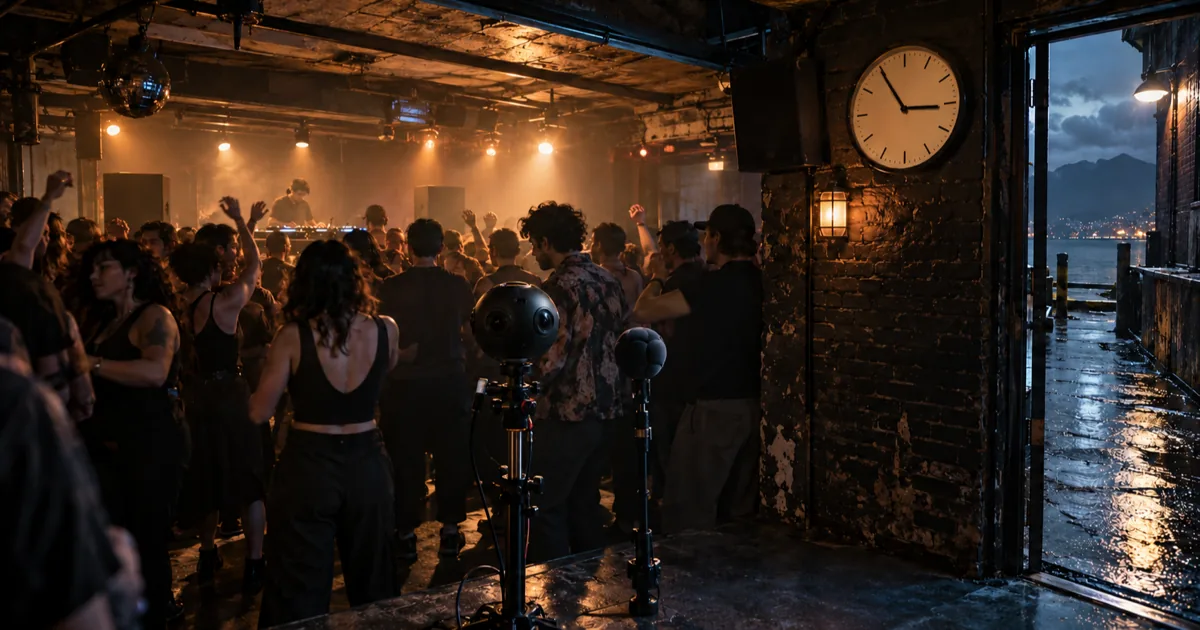
A fictional Vancouver club near 3am with a spherical camera, ambisonic microphone, rain-lit coastal doorway, and low-ceiling room

AI-generated editorial image of a fictional Vancouver club and capture setup. It does not depict Fortune Sound Club, another real venue, an event, an artist, a VPORT production, or a partnership.

London Electronic Music Clubs: What Three Rooms Teach Spatial Video

· 6 min read

fabric's current accessibility guide describes a historic, multi-level building with three main rooms, corridors, stairs, narrow routes, low light and high crowd density. Room One contains the main dancefloor. Room Two is reached by a steep ramp. Room Three is reached by stairs and has no lift access. For a capture crew, that is not one club with three playlists. It is three routing, sightline and equipment-placement problems under one roof.

Room One adds a physical variable. fabric says its haptic floor, rooted in the original Bodysonic system installed when the venue opened in 1999, now uses 36 moving-magnet units to turn low frequencies into tactile feedback. A microphone can record the sound in the room, but it cannot reproduce what that floor delivers through a viewer's feet. That gap is exactly why the room matters as much as the camera.

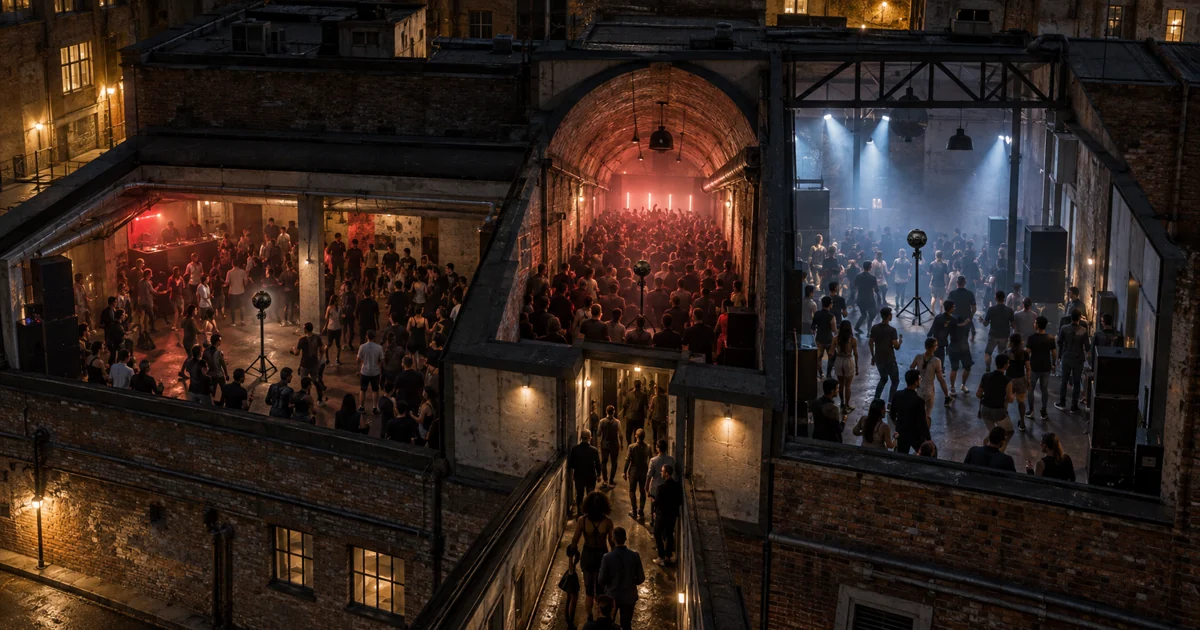
Cutaway of a fictional three-room London club showing a low basement, a narrow brick vault, a tall warehouse room, three spatial-camera positions and the corridor between them

AI-generated editorial image of a fictional multi-room venue. It does not depict fabric, another real London venue, an event, an artist, a VPORT production or a product interface.

Berlin Techno Clubs: A Spatial Video Fan Guide

· 5 min read
CEO

Berlin's techno culture is larger than a list of club names. The German Commission for UNESCO describes it as a living cultural practice built around music, dance events, fashion, technology, and community. Its 2024 recognition belongs to Germany's nationwide inventory of intangible cultural heritage. It is not a UNESCO World Heritage designation for particular buildings.

The rooms still matter. A former power station, a compact basement, and an outdoor area produce different sightlines, movement patterns, and recording constraints. This guide helps fans read those differences and helps production teams identify the evidence they would need before proposing a spatial-video shoot. It does not claim that VPORT has content, a relationship, or recording access at any venue named here.

How to Check a Concert Video's Format Before You Watch

· 6 min read
CEO

"Spatial," "360," "3D," and "VR" are not interchangeable labels. A listing can use one of those words accurately and still leave out the fact that matters most to a viewer: what will the player actually let you see and hear?

This checklist is for the moment before you start a concert. It helps you verify whether the source is framed or panoramic, monoscopic or stereoscopic, compatible with your player, and paired with ordinary or spatial audio. For the underlying definitions, start with our technical guide to spatial video, 360 video, and VR.

Barcelona Electronic Music: A 2026 Nightlife Guide for Spatial Video Fans

· 5 min read
VPORT Team

Barcelona's electronic-music map is useful because it puts very different room types in one city. Razzmatazz publishes club programs across several numbered rooms. Sala Apolo runs electronic nights through Nitsa and Astin in distinct halls. Macarena operates at a much smaller scale near La Rambla. The 2026 edition of Sónar added another comparison point by combining open-air and covered stages at Fira Gran Via.

For a fan, those differences shape the night. For a production team, they change the scouting questions: where can a camera stand, what does the microphone hear there, and what permissions are actually available? This is a public planning guide, not a concert listing or partnership announcement. VPORT has no confirmed production, catalogue title, venue relationship, or recording access tied to the places named here.

Music Rights for Spatial Video: A Clearance Map Before You Publish

· 8 min read
VPORT Team

A finished spatial concert video is not automatically ready to publish. The camera operator may own the footage file while other people still control the performance, the music, recognizable appearances, or the ways the recording may be distributed.

The useful question is not "Who owns the video?" It is "Which permissions does this exact release need?" This guide turns that question into a clearance map for promoters, venue teams, and independent producers.

This is a production checklist, not legal advice. Copyright, performer, privacy, and personality-rights rules vary by country and by the facts of a project. Use a qualified lawyer for the territories where you will record and distribute.

Immersive Concerts in Tokyo: A Spatial Capture Planning Guide

· 6 min read
CEO

Tokyo after dark offers dense streets, small rooms, large stages, careful lighting, and audiences gathered around many kinds of music. Those qualities can make the city compelling material for immersive concerts, but they do not make a production automatic. A credible spatial recording starts with a specific event, a suitable room, a clear technical plan, and permission from everyone responsible for the performance and venue.

This guide explains what a production team should verify before describing a Tokyo concert as a spatial experience. It does not announce a VPORT capture, partnership, or content release.

How to Film a Club Night for Spatial Video: A Promoter Guide

· 10 min read
CEO

De School ran its closing night in November 2022. The venue is gone. What remains is a handful of clips on YouTube, shot from the crowd on phones, audio peaking into distortion. If you were there, you know what the room felt like. If you were not, you have no way to find out.

That gap is closing, but slowly. Promoters and venue operators are starting to film their nights in spatial video, and most of them are learning the same things in the wrong order: the camera choice comes first in their heads, the audio planning comes last, and the rights question shows up the morning after. This guide works through all three in the order that actually matters, from format decision through to distribution.

How Electronic Music Found Its Home in Spatial Video

· 6 min read
VPORT Team

When a producer starts a track, they are not writing a song. They are building a room. The kick drum tells you where the floor is. The reverb on the hi-hat suggests how high the ceiling sits. The sidechain compression is what the air does when a bass frequency moves through speakers that cost more than most people's cars.

The producer's goal has always been to put you inside a sound that does not exist in your body yet. For four decades, the only reliable delivery method was the room: the club, the festival, the warehouse, the concrete basement that holds 300 people and a sound system that was not designed to hold its shape on any recording format available before now.

Spatial video is the first consumer format that carries the room with it.