vport

6 posts tagged with "360° Video"

360-degree video production and viewing

View All Tags

How to Check a Concert Video's Format Before You Watch

· 6 min read
CEO

"Spatial," "360," "3D," and "VR" are not interchangeable labels. A listing can use one of those words accurately and still leave out the fact that matters most to a viewer: what will the player actually let you see and hear?

This checklist is for the moment before you start a concert. It helps you verify whether the source is framed or panoramic, monoscopic or stereoscopic, compatible with your player, and paired with ordinary or spatial audio. For the underlying definitions, start with our technical guide to spatial video, 360 video, and VR.
Your Room Is the Asset: The Business Case for Filming Your Nights in Spatial Video

· 6 min read
CEO

Last call lands at 4am. The lights come up on 600 people who have been inside a 3 hour closing set, and 20 minutes later the room is a floor covered in cups. Whatever happened in there now exists as maybe 40 vertical phone clips, shot at chest height, audio clipped into distortion. The promoter paid the booking, the rider, the security, the sound engineer. What they own the next morning is a bank transfer and a hangover.

That is the part of this business I keep coming back to. A venue builds a night for months. It runs once. Then it is gone, and the only durable record belongs to whoever held their phone up. Spatial video changes what a room walks away with, and the argument for it is not a romantic one. It is an asset argument.

Spatial Video Concerts: Spatial Video vs 360 vs VR

· 5 min read
CEO

It is 1am in a fictional basement venue. The lights are low, the booth is close, and the crowd extends behind the camera. If you want to preserve that room, should you shoot spatial video, 360 video, or VR?

The question sounds simple because those terms are often used as substitutes. They are not. They describe different parts of the experience, and they can overlap in the same piece of media.

Audio Sync in 360° Video: Why Soundstage Matters More Than Camera Resolution

· 18 min read
Head of Legal

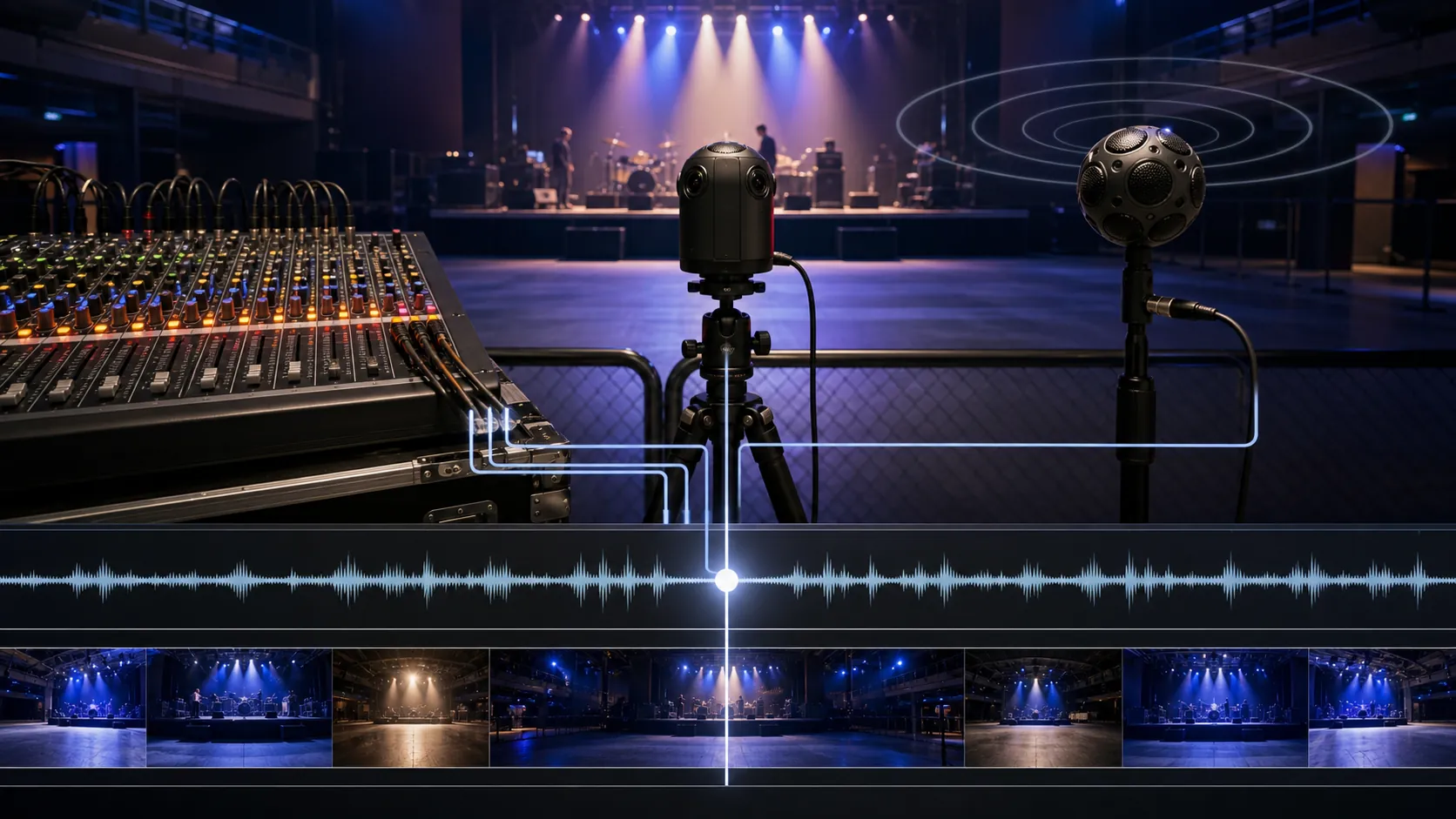
A fictional soundcheck workflow aligning a mixing-console feed, a 360 camera, and an ambisonic microphone on one timeline

Here is something nobody talks about at trade shows or in camera review videos: the reason most 360-degree concert footage falls apart has nothing to do with the camera. Not the resolution. Not the stitching. Not the codec. It is the audio. Always the audio.

You can shoot 8K stereoscopic 360 with a rig that costs more than a used car, stitch it perfectly, encode it flawlessly, and deliver it to Apple Vision Pro through VPORT's pipeline at maximum fidelity - and if the audio is a tinny, phase-smeared recording from a mic sitting on top of the camera, the entire experience collapses. The viewer's brain trusts sound before it trusts vision. Always has. When the visual says "you are standing in a warehouse club at 2 AM" but the audio says "you are listening to a phone recording in a parking lot," the brain sides with the audio. Every time.

How to Film Your First Immersive Concert: A Practical 360° Production Guide

· 14 min read
Head of Legal

Your first 360-degree concert capture will have one great minute and eleven you will re-edit forever. That is not pessimism. That is pattern recognition. We have watched it happen dozens of times - a creator nails the camera position for the drop, the lighting lands perfectly for sixty glorious seconds, and then they spend the next two weeks in post trying to salvage the rest. Stitch lines through the guitarist's face. Audio that sounds like it was recorded inside a washing machine. A twenty-minute stretch where the stage lights went UV and the footage turned into purple soup.

A New Standard for Presence: Why Professional 360 Degrees Is the Final Frontier of Media

· 4 min read
CEO

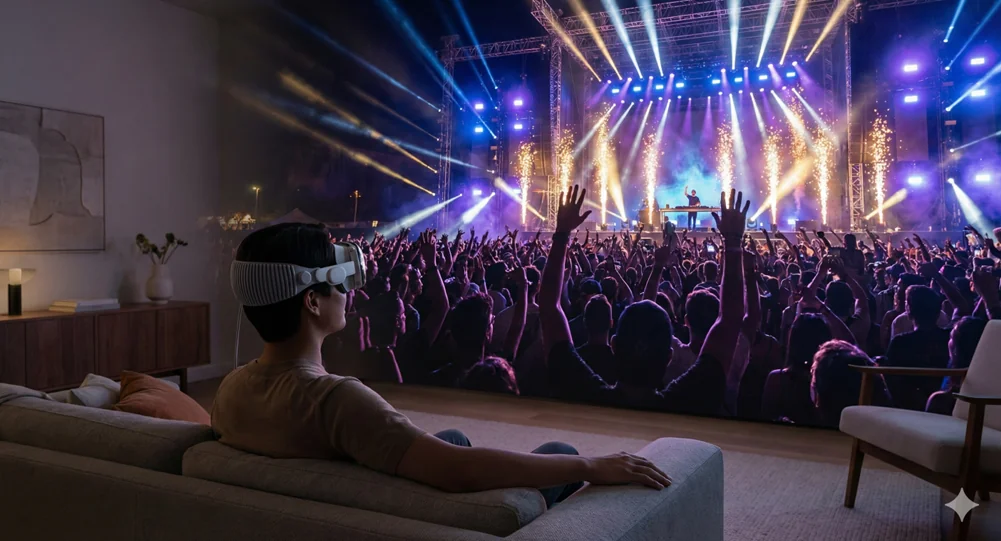
Professional 360-degree spatial video capture of a live concert on Apple Vision Pro via VPORT

For the better part of a century, our relationship with recorded media has been defined by containment. We watch history unfold within the safety of a rectangle. Whether it is a cinema screen, a television, or the smartphone in your hand, there has always been a frame separating the viewer from the moment. You were an observer, peering through a window at an event that happened somewhere else, to someone else.

With the arrival of Vport on VisionOS, we are shattering that glass. We are moving beyond the concept of viewing and entering the era of inhabiting. This shift represents more than just a technological upgrade; it is the final frontier of media consumption. We are no longer capturing just the visuals of an event. We are capturing the presence, the atmosphere, and the electricity of the night itself.