vport

34 posts tagged with "Spatial Video"

Spatial video capture, playback, and technology

View All Tags

VR Concerts: The Definitive 2026 Guide

· 6 min read
VPORT Team

Awakenings sells out two months before the lineup drops. Tomorrowland's 400,000 wristbands go in a day against 233 million people who want to be there. The math does not close. It never has.

VR concerts are the answer to that math. Not a consolation prize, not a preview mode, not footage you squint at on a phone. A spatial recording of the actual room, captured in 360 degrees, played back in a headset that puts you inside the frame. The crowd behind you, the booth ahead of you, the bass moving through a space that feels like a space.

Here is how the format works, what it requires, and how to teleport into a set from wherever you are.
Your Room Is the Asset: The Business Case for Filming Your Nights in Spatial Video

· 6 min read
CEO

Last call lands at 4am. The lights come up on 600 people who have been inside a 3 hour closing set, and 20 minutes later the room is a floor covered in cups. Whatever happened in there now exists as maybe 40 vertical phone clips, shot at chest height, audio clipped into distortion. The promoter paid the booking, the rider, the security, the sound engineer. What they own the next morning is a bank transfer and a hangover.

That is the part of this business I keep coming back to. A venue builds a night for months. It runs once. Then it is gone, and the only durable record belongs to whoever held their phone up. Spatial video changes what a room walks away with, and the argument for it is not a romantic one. It is an asset argument.

How to Watch Your First Concert on Apple Vision Pro: The 2026 Beginner's Guide

· 17 min read
CPO

The first sixty seconds inside a VPORT show will ruin flat video for you forever. That is not hyperbole. It is a warning. You put on Apple Vision Pro, you open the app, you tap a show - and then you are standing inside the room. The bass is in your chest. The lights are above you. And there is no screen. There is just... the venue.

The Set Is the Album: Why On-Demand VR Concerts Beat Live for Electronic Music

· 6 min read
CEO

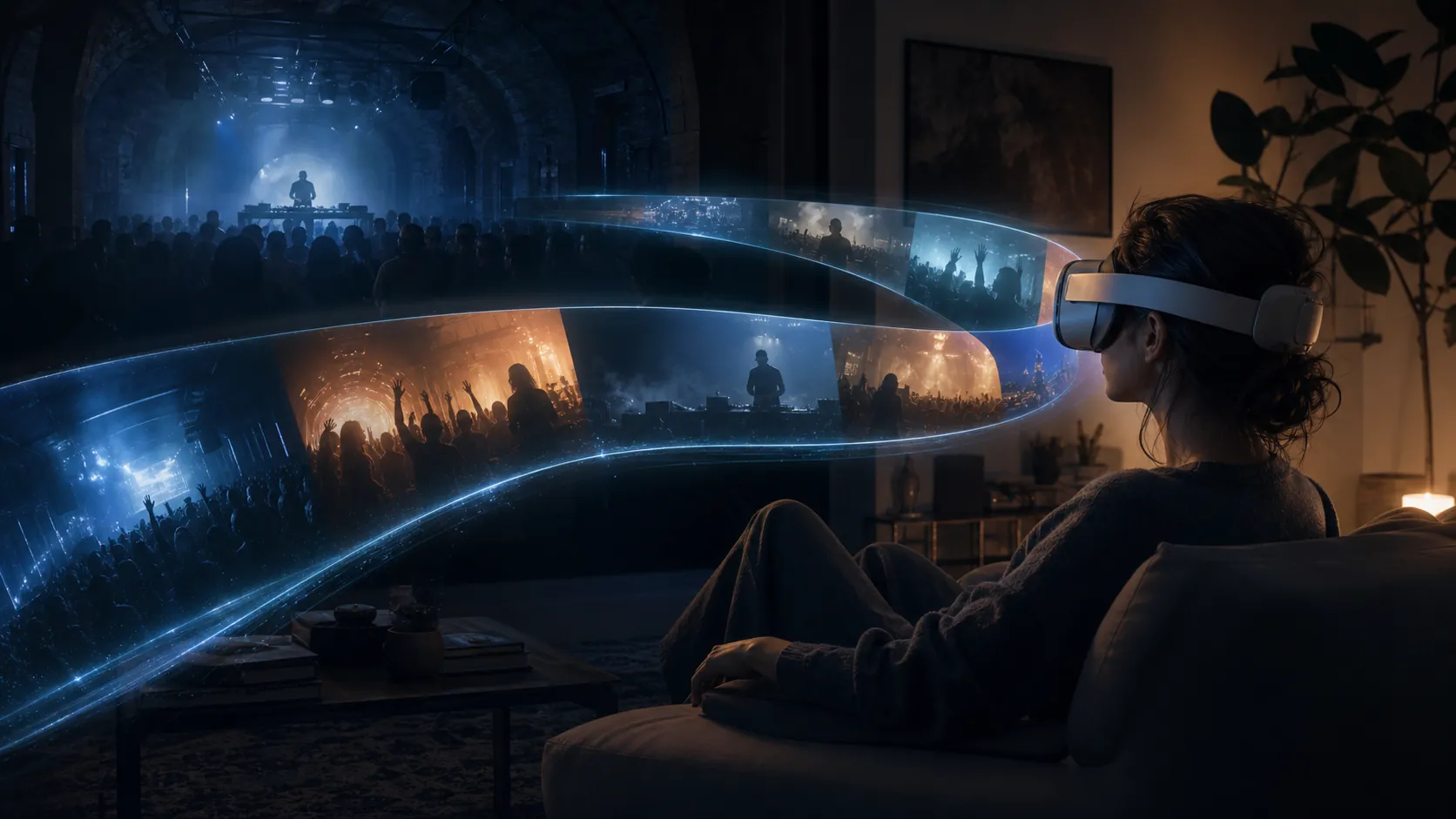
A fictional underground electronic set preserved as a replayable visual timeline for a headset listener at home

Somewhere around the fourth hour, a good techno set stops being a sequence of tracks. The kick has been running so long your body has filed it under weather. A hi-hat opens half a step. Two hundred people who have not looked at a phone since 1am feel the room tilt before they hear why. That moment is not a song. It is the payoff of three hours of setup, and it lands only because of everything stacked underneath it.

Now try to deliver that live to someone in Los Angeles. It is 7pm on a Friday there. The buffer stutters at the exact bar the build resolves. The bitrate collapses into the strobe and the picture turns to porridge. They catch nineteen minutes and go make dinner.

This is the case for on demand VR concerts, and it is not a consolation prize for platforms that cannot do live yet. For electronic music, the recorded set is the better product.

Awakenings Festival 2026: What Outdoor Techno Teaches Us About Spatial Video

· 5 min read
CEO

Awakenings Festival 2026 took place in Hilvarenbeek from July 10 through 12. The official event page listed the three-day festival as sold out and published a program spread across multiple outdoor areas.

That combination makes Awakenings a useful case study for spatial video. An open field, a large crowd, daylight, multiple stages, and architecture built to be seen from many angles all create information that a single camera frame cannot fully preserve.

Spatial Video Concerts: Spatial Video vs 360 vs VR

· 5 min read
CEO

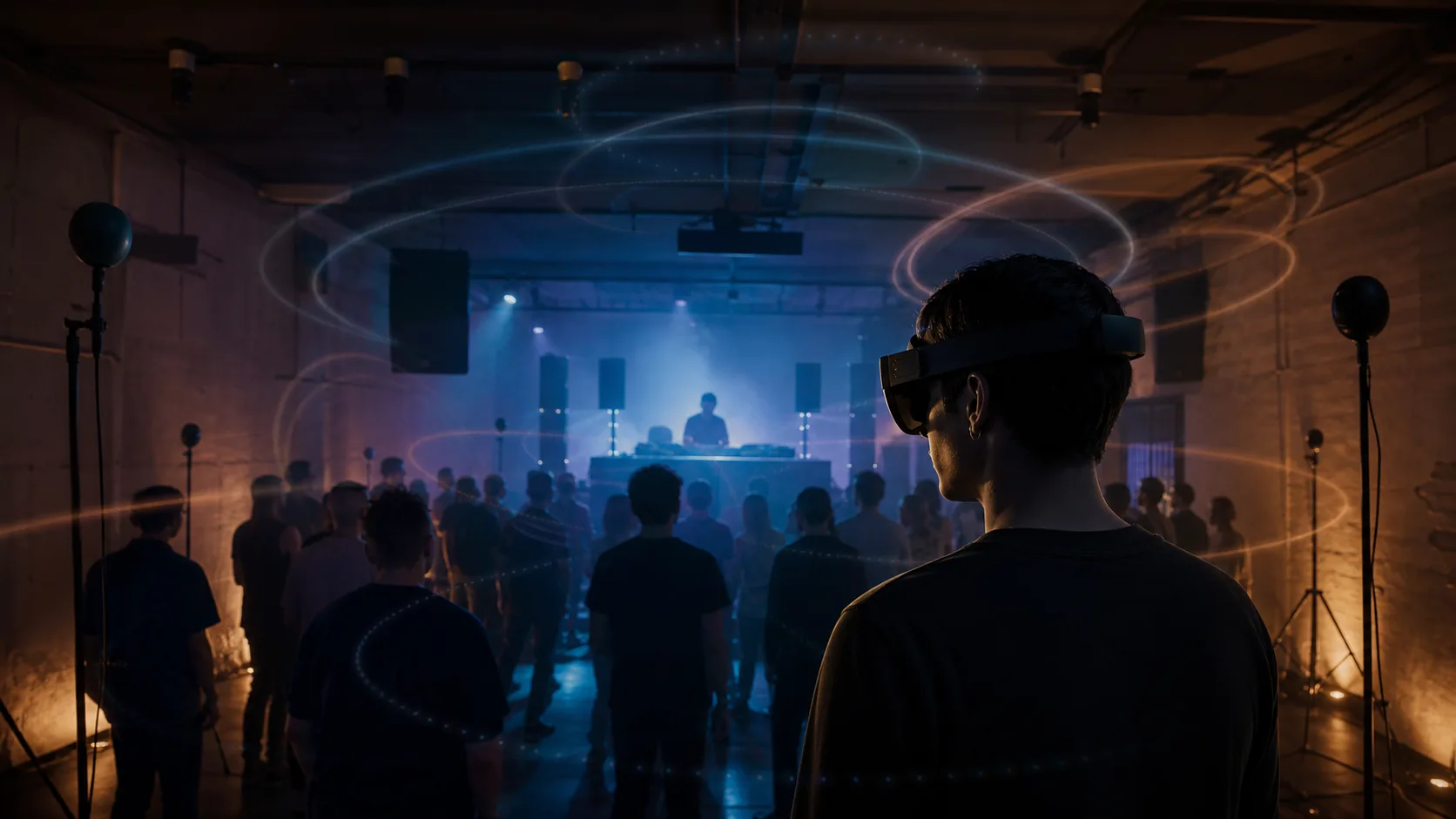
It is 1am in a fictional basement venue. The lights are low, the booth is close, and the crowd extends behind the camera. If you want to preserve that room, should you shoot spatial video, 360 video, or VR?

The question sounds simple because those terms are often used as substitutes. They are not. They describe different parts of the experience, and they can overlap in the same piece of media.

Spatial Video for Events: A Promoter's Production Checklist

· 7 min read
CEO

Spatial video for events can preserve parts of a room that a conventional edit leaves outside the frame. It can also multiply a production's complexity. The format, camera position, audio workflow, performer permissions, audience notices, post-production path, target device, and distribution plan all affect whether the finished recording is useful.

That makes the first question less exciting than choosing a camera, but more important: what should the audience be able to experience when the project is finished?

This checklist helps promoters, venue teams, and production partners answer that question before doors open. It does not assume a particular camera, platform, business model, or VPORT feature.

Getting Paid to Teleport Fans: How Artists and Creators Earn on VPORT

· 7 min read
CEO

The live music industry has a capacity problem it does not like to talk about. Pollstar has reported for years that physical capacity is the binding constraint on the majority of headlining tours. A room holds what it holds. When a set sells out, every fan past the last ticket is simply told no, and the artist earns nothing more from a night that could have reached ten times the crowd. The electronic music economy alone is worth around $12.9 billion and still growing, and almost all of it is capped by the size of a room.

That cap is the opportunity. If a captured set can be teleported to anyone with a Vision Pro, the ceiling on a single night moves from the fire-code number to the size of the internet. The question every serious creator asks next is the honest one: how do I actually get paid for that? This is the breakdown.

Tomorrowland 2026 Is 90 Days Away: Experience It Without Flying to Belgium

· 14 min read
COO

Tickets sold out in under an hour. The waitlist is deeper than the lineup. If you are reading this, you either did not get tickets to Tomorrowland 2026, or you did and you are already planning how to be in two places at once. Both are valid. Both have the same question: how do you experience the biggest electronic music festival on the planet when you cannot physically stand on every stage at the same time?

The answer used to be the livestream. A flat rectangle. A fixed camera angle chosen by someone who is not you. A YouTube chat scrolling faster than you can read. It was better than nothing. It was not remotely close to being there.

The answer is changing. Spatial video on Apple Vision Pro is closing the gap between the flat replay and the lived experience. Not all the way. Not yet. But enough that the question is no longer "should I watch from home" but "how should I watch from home." That is a different question. A better one. One with real answers.