
Spatial Audio for Live Concerts: What Changes Beyond Stereo
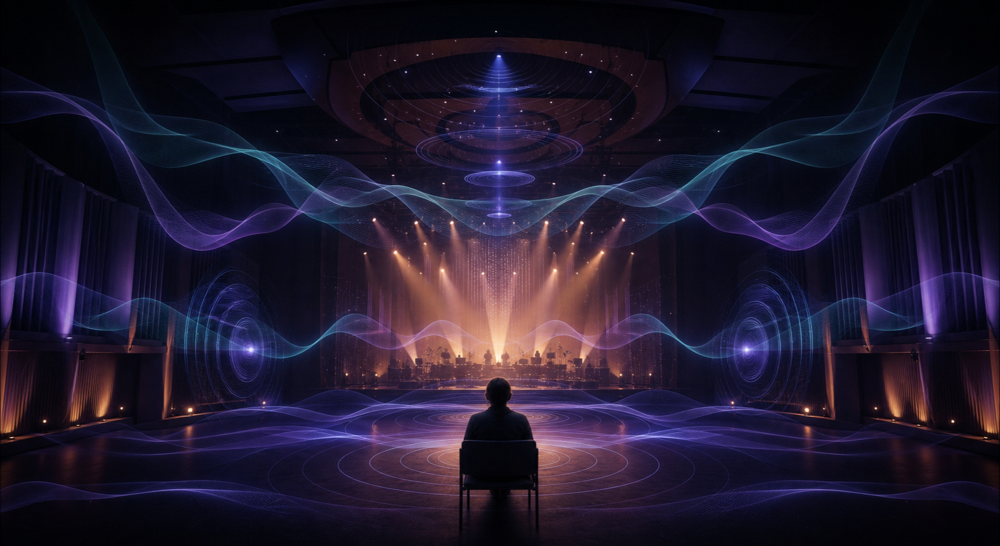
Spatial audio for live concerts can preserve direction and room ambience in ways that a conventional stereo release may not. It can place sound beside, above, or behind a listener, and head tracking can update that presentation as the listener moves.
That does not make every spatial mix more accurate or more enjoyable than stereo. “Spatial audio” describes a family of production and playback methods, not a single quality standard. The recording, mix, metadata, renderer, device, and listening environment all affect the result.
Spatial audio is more than wider stereo
Stereo normally delivers two channels, left and right. Engineers can create a wide and detailed soundstage between them, but the release is still built around those two channels.
Spatial audio can describe a fuller sound scene. The ITU-R BS.2051 recommendation recognizes channel-based, object-based, and scene-based approaches to advanced sound:
- Channel-based audio assigns signals to a defined speaker layout.
- Object-based audio stores sound elements with metadata that describes where they belong.
- Scene-based audio represents a sound field that a renderer can reproduce for the available playback setup.
A concert release might use one of these approaches or a combination. On headphones, a renderer can produce a binaural output, which uses two ear signals to create directional cues. On a speaker system, the same programme may be rendered for the installed layout.
The practical lesson is simple: a “spatial” label alone does not tell you the source format, speaker layout, headphone behavior, or whether head tracking is available.
How your hearing estimates direction
Human hearing uses several overlapping cues to estimate where a sound came from. A review indexed by the US National Library of Medicine explains that horizontal localization relies heavily on interaural timing and level differences. In plain language:
- a sound from one side reaches the nearer ear slightly earlier;
- the head changes the level and frequency balance reaching the farther ear; and
- the outer ears filter sound differently depending on whether it arrives from above, below, in front, or behind.
The combined direction-dependent filtering is commonly described with a head-related transfer function, or HRTF. Binaural renderers use these cues to present a spatial scene over headphones.
People do not all have identical head and ear geometry, so the same generic rendering will not localize equally well for everyone. Room acoustics, source material, playback level, and visual information can also change what a listener perceives. That is why spatial audio should be evaluated by listening, not by format name alone.
What head tracking changes
Without head tracking, a binaural sound field may rotate with the listener's head. With head tracking, the renderer can update the listener orientation so a sound appears to remain associated with a location in the scene.
Apple's developer documentation describes head tracking as an orientation update that can make virtual speaker positions appear stationary while the listener moves. Apple also provides a head-tracked spatial-audio experience whose behavior depends on an anchoring strategy and sound-stage size.
For concert video, stable audio and visual direction can help the scene remain coherent. If a visible source is on the left, the audio should not appear to move to the right merely because the listener turned their head. This still depends on correct authoring and playback. Head tracking cannot repair an unclear recording, a poor mix, or audio that is out of sync with the picture.
A concert mix needs both clarity and context
A clean feed from the mixing console is valuable because it contains direct microphones, instruments, and the production mix. By itself, however, it may not describe the audience or acoustic character of the room.
Ambient microphones can add applause, reflections, and other environmental sound. The challenge is to combine those sources without creating phase problems, distracting localization, or a mismatch between the sound and the visible scene.
There is no universal recipe. An intimate seated performance, a club set, and an outdoor festival have different acoustics and different audience expectations. Production teams also need the necessary performance, recording, and distribution rights before publishing any concert audio.
The same venue-specific questions matter for video. Our guide to Amsterdam electronic music venues explains why room layout, lighting, audience movement, permissions, and safe camera placement need to be considered together.
Six things to verify in a spatial concert recording
1. What is the delivered audio format?
Look for a specific format or listening requirement rather than a general “immersive” badge. Ask whether the release is stereo, binaural, multichannel, object-based, scene-based, or available in more than one version.
2. Does it require headphones or a speaker layout?
A headphone render and a multichannel speaker mix are different deliverables. Check what the publisher recommends and whether the service provides a compatible fallback for other devices.
3. Is head tracking supported?
Head tracking is a playback behavior, not a guarantee attached to every spatial file. Confirm the supported device, operating-system requirements, and whether the listener can turn the feature off.
4. Do sound and picture stay aligned?
Watch a visible transient such as a drum hit, clap, or spoken consonant. The sound should correspond with the action. Also turn toward a visible sound source and check whether its direction remains plausible.
5. Is the audience part of the mix?
Room sound can provide context, but more ambience is not automatically better. Listen for whether applause and reflections support the scene or mask the performance.
6. Is there a reliable stereo fallback?
A spatial mix should be checked on the devices people will actually use. Publishers should identify available versions clearly, and listeners should not have to guess whether they are hearing the intended render.
What this guide does not announce
This article explains public audio concepts. It does not announce:
- a VPORT spatial-audio format or capture workflow;
- support for head tracking on a particular VPORT app or device;
- a VPORT partnership with an artist, venue, promoter, or festival;
- the availability of a specific concert recording; or
- a future VPORT feature or release date.
For content that is actually available, browse VPORT's current catalogue and check the individual listing and device requirements.
Spatial audio is most useful when the technology supports the recording rather than becoming the story. Clear format information, careful alignment, and an honest fallback are better indicators of a good concert release than the word “spatial” by itself.