
What Spatial Audio Really Does to a Live Set
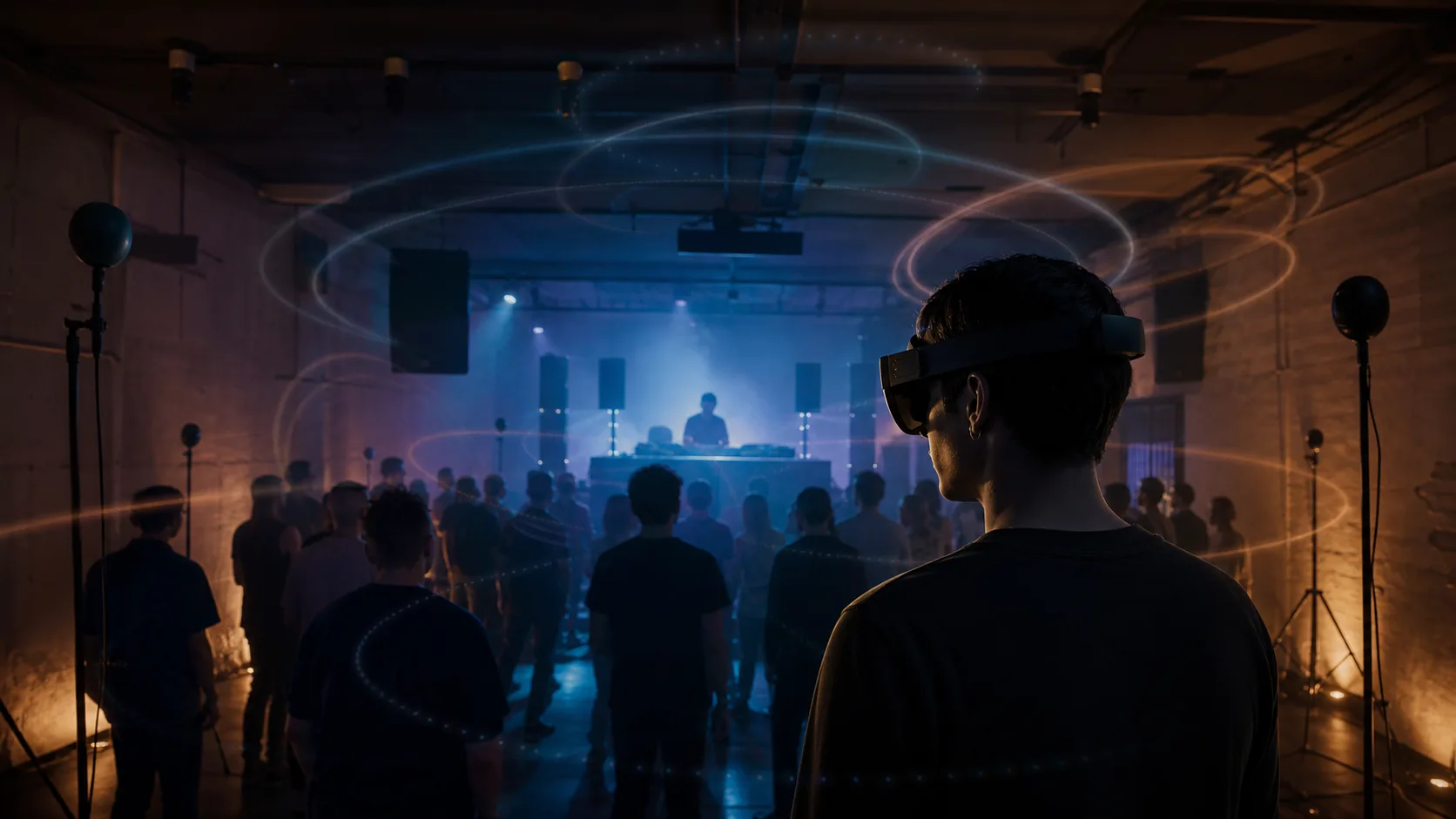
Picture a club terrace with the booth ahead of you and the crowd behind. The kick arrives from the sound system. A reaction rises over your shoulder. Reflections reveal the size and shape of the room. Live sound is not a wall in front of your face. It is a scene around your body.
Most conversations about immersive music get stuck on the picture: resolution, frame rate, and how many degrees the camera sees. Sound is the other half of a coherent experience. If audio and video disagree about where the booth, performer, or crowd is, even a sharp picture can feel detached.
What Spatial Audio Actually Is
Stereo normally delivers two channels, left and right. A good stereo mix can still create convincing width, depth, and movement through panning, level, timing, and reverberation. Spatial audio extends the production and playback vocabulary by describing a fuller sound scene. Depending on the format, that scene may be channel-based, object-based, scene-based, or rendered binaurally for headphones.
That distinction matters because the label spatial audio does not guarantee one format, one speaker layout, or one headphone experience. The source mix, metadata, player, device, output, and listening environment all influence what reaches you.
What head tracking changes
When a compatible source, player, and device support head tracking, the renderer can update as you turn so a sound appears to remain associated with a location in the scene. Turn toward the booth and the booth should not rotate with your head. Look back toward the crowd and the ambience should respond smoothly rather than jump or drift.
Apple lists Spatial Audio with dynamic head tracking for Apple Vision Pro, but hardware support alone does not prove that a particular app or title provides head-tracked audio. Check the current listing and device requirements for the release you want to hear.
Why It Matters More for Electronic Music
Electronic music often makes space part of the arrangement. A techno track can stack a centered kick, a wide pad, dry percussion, reflected room sound, and a vocal element that moves through the mix. Spatial production gives engineers more ways to separate those elements, but more separation is not automatically better. The rhythm still needs focus, and movement should support the set rather than distract from it.
Low frequencies need especially careful language. Club bass is heard and felt, but the deepest frequencies are difficult to localize precisely, and headphones cannot reproduce the physical air and body vibration of a venue sound system. A spatial release can preserve useful directional and room cues around the low end. It cannot recreate every physical property of standing beside a large speaker array.
The crowd is not merely background noise either. Applause, movement, and reflections help identify the room and the scale of the event. That context is part of why melodic techno can work well in spatial video. The production challenge is to retain that sense of place without masking the artist's mix.
How Spatial Audio Pairs With Spatial Video
Audio and video need to agree about direction and timing. If a visible booth is ahead of you while a clear booth sound appears far to the right, the mismatch can pull attention away from the performance. The same is true of sync: a clap or drum hit that arrives late is noticeable even when the image and mix are strong on their own.
A common concert workflow combines a clean feed from the mixing console with ambient or spatial microphones that capture the audience and room. Those sources must be aligned, mixed, and tested for the intended playback systems. There is no universal blend that works for every club, warehouse, festival, or headset.
Production teams also need permission to record and distribute the performance, composition, audience, and venue sound. Technical quality does not replace music, privacy, or location rights.
What to listen for
Use one short passage and compare only the modes the current app, title, and device actually support:
- Does a visible source stay in a plausible direction when you turn?
- Do crowd sound and room reflections add context without covering the music?
- Do kicks, claps, vocals, and lighting cues stay synchronized?
- Does the stereo fallback remain clear?
- Is the playback comfortable at a moderate volume?
Our spatial audio concert setup guide turns those questions into a repeatable listening test. For production troubleshooting, see audio sync in 360 video.
What It Means for the Person in the Headset
The payoff is attention. A coherent spatial mix can let you choose where to look without losing the musical center. You can follow the booth, turn toward a crowd reaction, or notice the acoustic character of the room while the set remains clear.
It is still a mediated recording, not a substitute for physically attending a show. The experience depends on the source and playback path, and some listeners may prefer the stereo mix. The useful question is not whether the spatial label sounds impressive. It is whether the release keeps the music focused, the room believable, and the sound consistent with the picture.
To explore what is currently available, browse VPORT and check each title's format and device requirements before listening.