
Awakenings Festival 2026: What Outdoor Techno Teaches Us About Spatial Video
Awakenings Festival 2026 took place in Hilvarenbeek from July 10 through 12. The official event page listed the three-day festival as sold out and published a program spread across multiple outdoor areas.
That combination makes Awakenings a useful case study for spatial video. An open field, a large crowd, daylight, multiple stages, and architecture built to be seen from many angles all create information that a single camera frame cannot fully preserve.
Editorial note: VPORT is not affiliated with Awakenings. This article does not claim that Awakenings Festival was captured for, partnered with, or is available on VPORT.
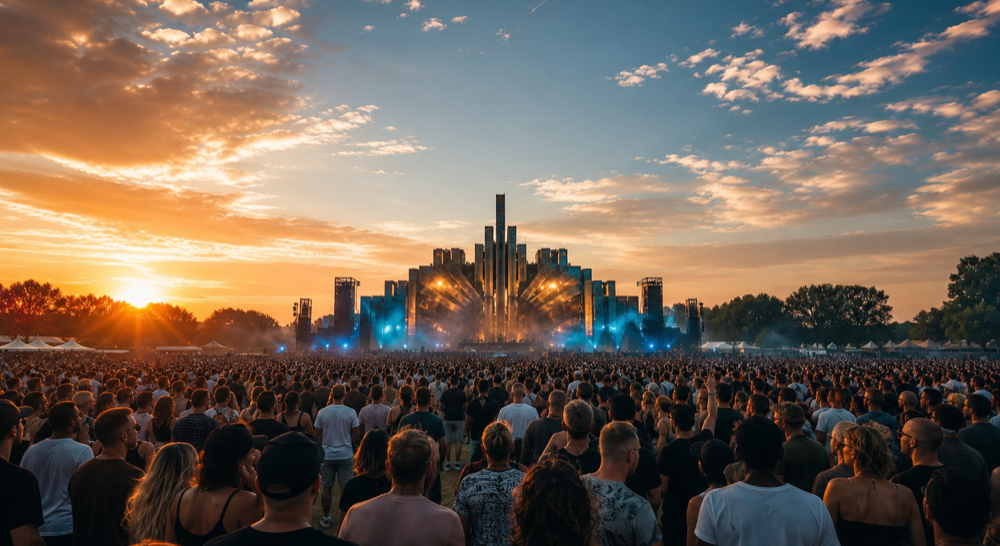
Original editorial artwork. It does not depict Awakenings Festival or a VPORT production.
What Happened at Awakenings Festival 2026?
Awakenings held its 2026 summer festival at the Beekse Bergen recreation area in Hilvarenbeek, near Tilburg. The organizer's practical information lists festival hours from Friday afternoon through Sunday evening, with later programming on Friday and Saturday.
The official program also shows why a large festival is difficult to summarize with conventional video. Several areas ran at the same time. A broadcast can cut between stages, but every cut replaces one point of view with another. A 360-degree recording can preserve more of a single location: the stage, the audience, the sky, and the movement happening beside and behind the camera.
That does not make immersive capture automatically better. It gives a production team a different set of creative choices.
Why Daylight Helps Immersive Festival Video
Low-light concert filming is demanding. Bright screens and lasers can sit beside deep shadows, while fast crowd movement puts pressure on exposure and compression. Daytime does not remove those problems, but it can give a camera more usable detail across the scene.
For an outdoor techno festival, that extra detail matters in three places:
- Depth: people close to the camera, the stage in the distance, and the landscape between them help a viewer understand scale.
- Peripheral action: dancing, lighting, and movement across the field are part of the experience, even when they are outside a traditional frame.
- The environment: sky, weather, trees, and temporary structures help distinguish an outdoor festival from a club recording.
Spatial video works best when the surroundings contribute to the story. A wide festival site is a strong candidate because there is meaningful visual information in many directions.
The Camera Position Is the Editorial Decision
A 360-degree camera records every direction, but it still records from one position. Put it too far from the stage and the performance can feel small. Put it in a congested walkway and the audience becomes an obstruction. Raise it too high and the viewer may feel detached from the crowd.
The strongest position depends on the intended experience. A place near front-of-house can balance stage scale with audience context. A position within the crowd can feel immediate but needs careful safety planning. A stage-side position can reveal production detail while losing the perspective of the floor.
This is why immersive concert production is not simply a matter of placing a camera and pressing record. Camera height, sightlines, stabilization, spatial audio, and safe cable routing all shape the result. Our practical guide to filming a 360 concert covers those production fundamentals in more detail.
Audio Matters as Much as the Image
An outdoor recording can look expansive and still feel flat if the sound does not match the scene. A clean mix from the soundboard preserves musical detail. Ambient microphones preserve the crowd, reflections, and sense of place. A thoughtful immersive mix uses both.
The goal is not maximum loudness. It is a stable relationship between what the viewer sees and what the viewer hears when looking around. If the room and crowd disappear from the audio, much of the reason to use an immersive format disappears with them.
Permission Comes Before Production
A festival ticket is not permission to make a professional recording. Immersive capture can include performers, copyrighted music, stage designs, staff, and thousands of attendees. Any commercial production needs approval from the event organizer and the relevant rights holders, plus a plan for safety, releases, and audience notice.
That work has to happen before a camera enters the site. Technology does not bypass music, image, or venue rights.
Can You Watch Awakenings Festival 2026 on VPORT?
VPORT's public catalog does not currently advertise Awakenings Festival 2026 content. This post is an independent editorial analysis, not an availability announcement. For official recordings or festival updates, use Awakenings' own channels.
What Awakenings demonstrates is the creative potential of the format: daylight, scale, crowd movement, and a landscape that matters as much as the stage. Those ingredients make outdoor techno a compelling subject for spatial video when the organizers and rights holders choose to produce it.