
Built for Presence: Afro House and Tech House in Immersive Video
Picture a fictional open-air room at blue hour. The booth is visible, but it is not the only thing worth watching. A percussion pattern moves through the mix while the crowd forms smaller scenes across the floor. The interesting question for an immersive recording is not whether one genre is "better for VR." It is which details make a particular set feel like itself, and whether the production preserves them.
Afro house and tech house can both reward wide room coverage, long-form editing, and spatially authored sound. They do not reward those choices in exactly the same way. Their labels also cover broad, changing scenes, so this is a production guide rather than a claim that every track or event follows one formula.
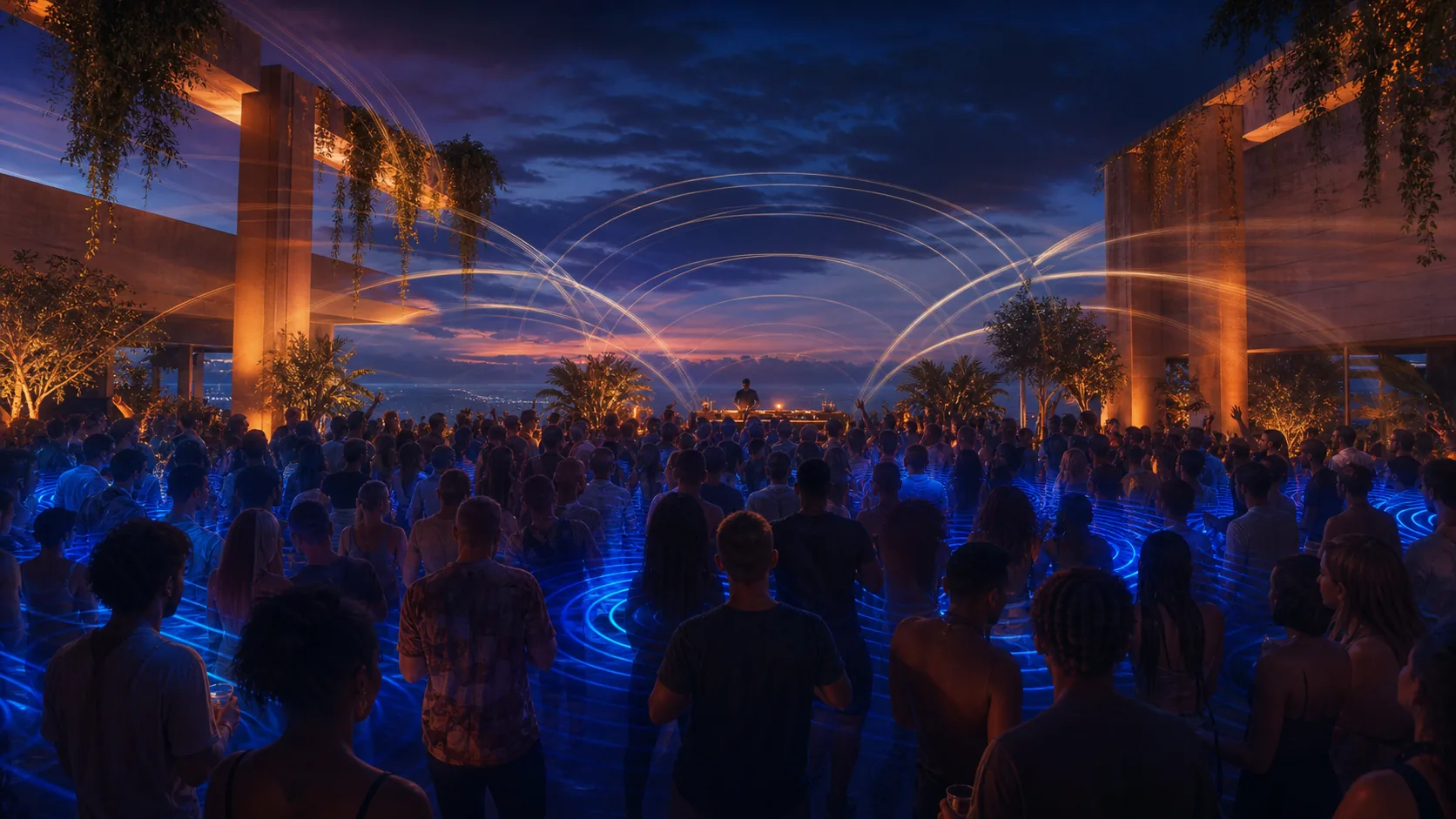
The image above is an original conceptual illustration. It does not depict a real event, venue, artist, VPORT production, or product interface.
Start With the Room, Not the Genre Label
A flat concert edit usually directs attention by choosing a frame. An immersive live music experience can give the viewer more agency, but only if the source actually records useful detail outside that frame.
For a groove-led electronic set, that detail might include the crowd behind the camera, a percussionist beside the booth, the lighting above the floor, or the transition from an enclosed room to an open horizon. None of those views is automatically valuable. Camera position, permissions, lighting, stitching, and the final edit still determine whether looking around reveals context or empty space.
The same caution applies to sound. A spatial mix can place or anchor elements around a listener, and head-tracked playback can help those relationships remain stable as the listener turns. Apple documents spatial audio sources and head-tracked playback in its visionOS spatial audio guidance. That capability does not turn an ordinary stereo recording into an accurate map of a venue. The recording and mix need spatial intent from the start.
Afro House: Preserve Layering and Human Detail
Afro house often foregrounds layered percussion, vocals, and long transitions. Those are tendencies, not entry requirements. For an immersive production, the useful question is where those layers come from and what the audience can see while they hear them.
If live percussion is part of the performance, a single booth-facing frame may hide the player and flatten the exchange between performers. Wider coverage can keep that relationship visible. If the arrangement is entirely electronic, the room may still provide meaningful detail through crowd movement, lighting, and the way a transition builds over time.
Audio choices matter just as much. Separating musical elements into arbitrary directions would be a gimmick. A stronger mix preserves intelligibility and uses direction only when it supports the performance or the recorded room. The goal is not to make every shaker appear behind the listener. It is to keep the mix coherent while retaining more of the space than a phone recording normally carries.
Open-air locations can also give the viewer a useful sense of scale, but a horizon is not evidence of immersion by itself. Exposure needs to hold both the stage and sky. The camera position needs safe sightlines. People in view need appropriate notice and consent. The production still has to earn the scene.
Tech House: Preserve Continuity and Crowd Response
Tech house often leans on repeated rhythmic patterns, bass movement, and gradual changes across a mixed set. Again, those are common traits rather than universal rules. They suggest a different editorial priority: continuity.
A fast sequence of highlight cuts can erase the timing that makes a transition work. A longer take can show how the floor responds before and after a change, while an immersive view lets the audience choose between the booth, nearby dancers, and the wider room. That can make the crowd part of the record without pretending every person or every direction is equally important.
The booth perspective can be useful when it reveals the relationship between performer and audience. It should not be sold as access that every recording can provide. Placement depends on venue permission, safety, sightlines, and the production design. A camera in the wrong place can obstruct the room, expose private areas, or create stitching problems that are more distracting than a conventional edit.
Low frequencies need honest treatment too. Headphones and headset speakers cannot reproduce the physical pressure of a club sound system. An immersive mix can preserve timing, balance, ambience, and direction, but it cannot recreate the body-level impact of the room. That limitation is worth saying plainly. The medium can extend access to a documented performance; it does not replace attendance.
What the Format Can Preserve
Spatial video, 360 video, and VR describe different parts of an experience. Choosing among them should follow the production goal.
- A framed stereoscopic view can preserve depth in front of the viewer when the performance has a clear focal area.
- A 360 view can preserve the wider room when several directions contain meaningful action.
- Stereoscopic 360 can combine surrounding coverage with depth, but it raises capture, stitching, bandwidth, and viewing-comfort demands.
- Spatial audio can preserve directional relationships when the capture and mix were designed for them.
No format can restore a missed angle, unclear rights, clipped audio, poor lighting, or a room that was never recorded. Resolution and immersion are not substitutes for production planning.
A Better Test for Presence
Instead of asking whether Afro house or tech house is more immersive, ask what a viewer should be able to notice after the recording begins:
- Can they understand where the performance is happening?
- Does turning reveal relevant context rather than visual filler?
- Does the audio remain clear and believable as they move?
- Does the edit preserve the pace of the set?
- Are the people, music, venue, and artwork cleared for the intended release?
If those answers hold, both genres can produce a convincing immersive live music experience for different reasons. Layering may lead one recording. Continuity and crowd response may lead another. The format works when it serves those differences instead of flattening them into the same marketing promise.
VPORT supports different ways to present media on Apple Vision Pro, described in the playback modes overview and the Vision Pro media player guide. Availability still depends on the source format and the content actually offered in the service.
The groove was already in the room. Immersive production is the work of deciding which parts of that room can be recorded, licensed, mixed, and shared honestly.
Browse VPORT when you are ready to see which experiences are currently available.