
The Set Is the Album: Why On-Demand VR Concerts Beat Live for Electronic Music
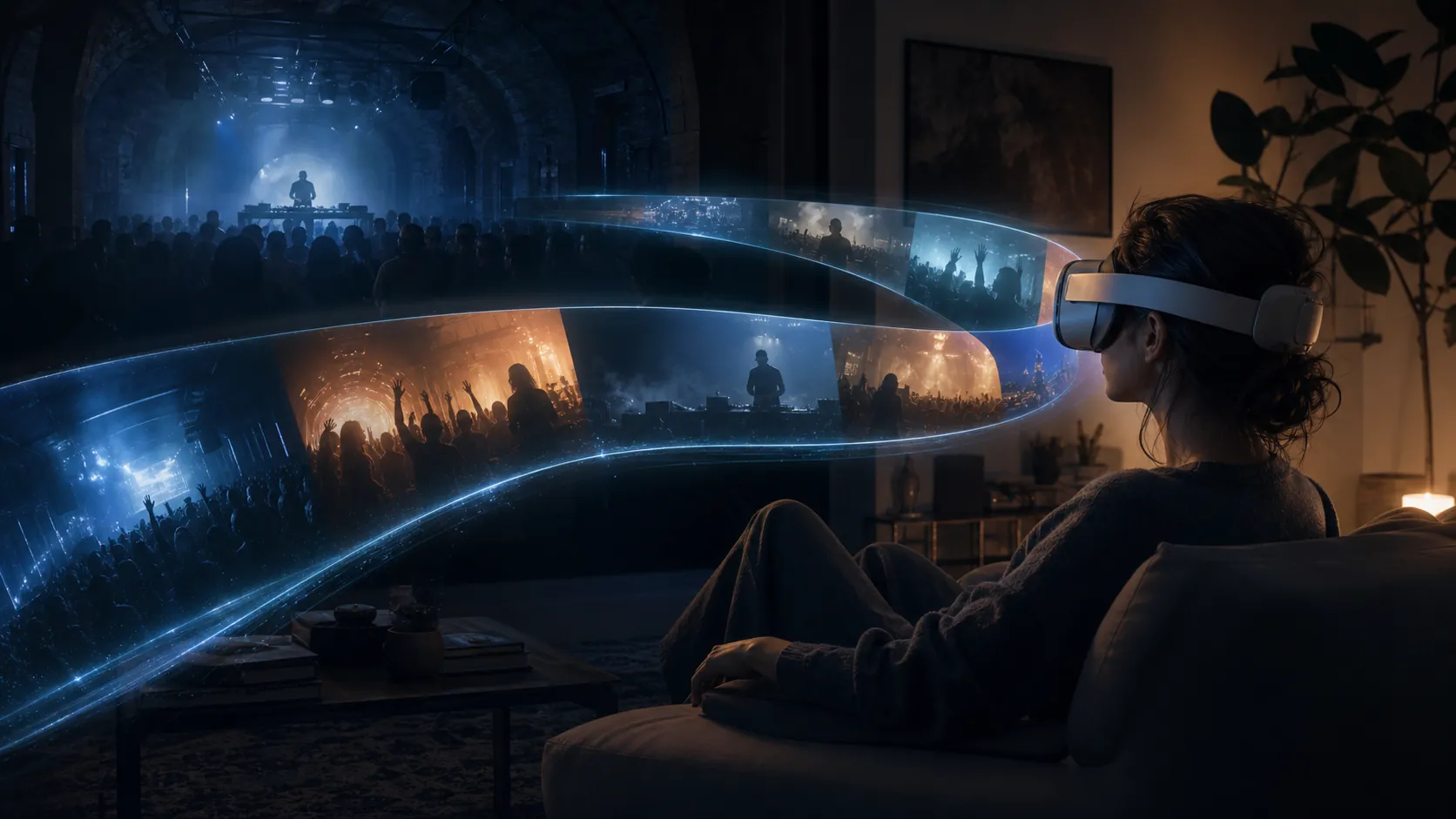
Somewhere around the fourth hour, a good techno set stops being a sequence of tracks. The kick has been running so long your body has filed it under weather. A hi-hat opens half a step. Two hundred people who have not looked at a phone since 1am feel the room tilt before they hear why. That moment is not a song. It is the payoff of three hours of setup, and it lands only because of everything stacked underneath it.
Now try to deliver that live to someone in Los Angeles. It is 7pm on a Friday there. The buffer stutters at the exact bar the build resolves. The bitrate collapses into the strobe and the picture turns to porridge. They catch nineteen minutes and go make dinner.
This is the case for on demand VR concerts, and it is not a consolation prize for platforms that cannot do live yet. For electronic music, the recorded set is the better product.
A DJ Set Is a Structure, Not a Playlist
Pop concerts are made of songs. You can join one late, catch the single, and leave having got the thing you came for. Electronic music does not work that way. A closing set at Awakenings or a long night at Watergate is one continuous piece of writing, and the tension is built out of duration. The producer spends forty minutes withholding something so that the release means anything at all.
Live delivery is hostile to that shape. It assumes the audience arrives at minute zero, stays awake through the middle, and never loses a frame. Real audiences do none of this. They join at minute fifty because that is when they got home, they lose the stream during the one passage that needed continuity, and they never find out what the first hour was for.
On-demand inverts the whole problem. The set arrives complete. You start at the top, you keep the thread, and when you come back the following Tuesday the architecture is still there waiting for you. If you want to study the transition at 1:47, you can sit on it. Underground techno producers already treat their recorded sets as a body of work rather than a broadcast, and the format should respect that.
Live Encoding Spends the Bitrate You Need for Presence
There is a harder constraint underneath the craft argument, and it is arithmetic.
Presence in spatial video is expensive. VPORT captures across three tiers: iPhone spatial at 1080p in MV-HEVC, Insta360 X4 and X5 for 360 mono, and the Insta360 Pro 2 for 8K 360 3D. On Apple Vision Pro that resolves to 4K spatial playback. Those numbers are what make a room feel like a room instead of footage of a room, and they are also what a live encoder cannot afford.
A live pipeline has to make every decision inside a few milliseconds. It cannot look ahead, it cannot take a second pass, and when the lighting rig strobes it burns its entire bitrate budget on noise it will never get back. Recorded delivery has no such deadline. The encoder can spend as long as it needs deciding where the detail goes, which means the detail actually survives to the headset.
You hear this before you see it. Compression takes the low end first, and the low end is the whole point. We wrote separately about why a spatial mix hits different, and the short version is that the spatial field collapses the moment you starve it. Sub-three-second latency for live delivery is a real engineering milestone on our roadmap rather than something shipping today, and we would rather say that plainly than ship a degraded picture and call it presence.
The Timezone Problem Nobody Actually Solves
Berlin at 4am on a Saturday is 7pm on Friday in Los Angeles. Ibiza's best hour lands in the middle of a Vancouver workday. Amsterdam closing time is breakfast in Montreal.
This is not a scheduling inconvenience to be engineered around. It is the defining fact of a global audience for a genre whose best moments happen when most of the planet is asleep or at work. Every live-first platform quietly solves it the same way, by posting the recording afterwards, which is an admission that the recording was the durable artifact all along.
So build for the artifact. An on-demand catalogue means a house DJ in Berlin and a listener in San Diego are on equal terms, and neither has to set an alarm. It also means the set keeps earning after its first night, which matters more to a working artist than a single concurrent-viewer number ever did. If you are trying to judge whether a given recording is worth your time, we published a checklist on what to verify before you press play.
Recorded Music Already Settled This Argument
Recorded music is a $29.6 billion market with 752 million paid streaming subscribers behind it. The electronic music economy alone runs about $12.9 billion. Almost none of that is live transmission. It is people returning to fixed recordings, repeatedly, on their own schedule.
Nobody frames an album as a lesser version of a concert. The recording is its own object, made with care that a single night cannot support, and the culture around electronic music has understood this since the first mixtape got passed around. The archive is where a scene keeps its memory.
Spatial capture just extends that logic into the room itself. Instead of a stereo document of what the night sounded like, you get the geometry of where you were standing, which angle the booth was at, how far the ceiling was. That is an object worth owning rather than an event worth catching.
What We Are Building, and What We Are Not
VPORT is a music experience company. We ship on Apple Vision Pro first and on the web at thevport.com, and the model is pay-per-minute credits rather than a subscription. You teleport into a set, you pay for the minutes you are actually there, and you come back to it whenever you want.
Playback adapts to how present you want to be. Window, Spatial, and Immersive are three different relationships to the same recording, and smart defaults pick for you before you override them. We broke those down in detail in the three playback modes, and the practical controls are documented in the Vision Pro media player guide. Apple's own guide to viewing media on Vision Pro covers the device-level basics if you are new to the headset.
What we are not building right now is live streaming at scale. That is on the roadmap, not in the product, and we are not going to pretend otherwise to sound more complete than we are. When it arrives it will be an addition to the catalogue rather than a replacement for it, because the catalogue is the part that keeps working at 3am in one timezone and lunchtime in another.
The set was always the album. Teleport into one at portal.thevport.com/signup.