
Amsterdam Electronic Music Venues: Why the Room Matters in Spatial Video
Amsterdam's electronic music identity is tied to its rooms. A circular former gasworks, an industrial shipyard, a basement under a waterfront tower, and temporary spaces across the city can each make the same track feel different.
That is why Amsterdam is an interesting subject for spatial video. The format can preserve more than a view of the performer. It can record how architecture, lighting, audience movement, and sound work together inside a venue.
Editorial note: VPORT is not affiliated with Amsterdam Dance Event, Awakenings, DGTL, or any venue named in this article. This post does not announce a capture, partnership, or content release.
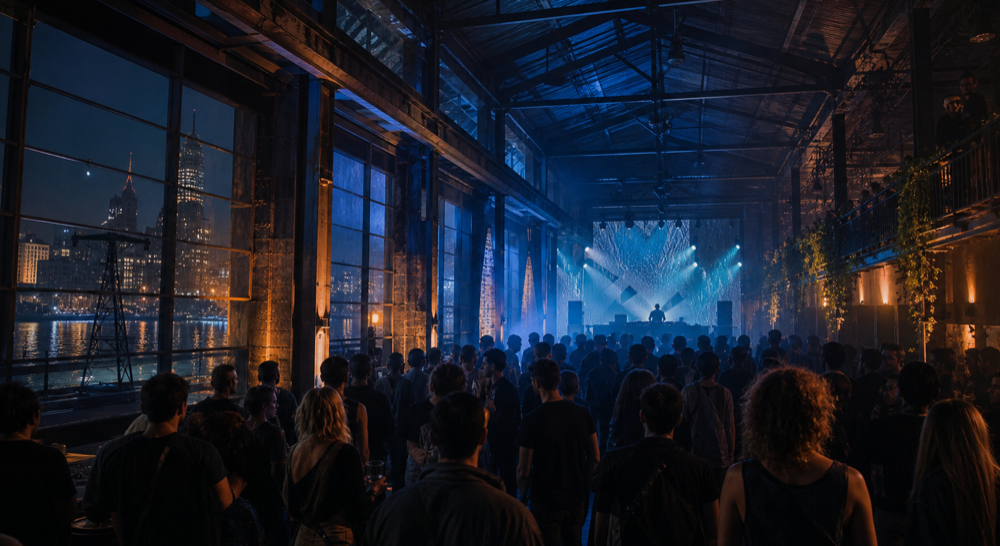
Original editorial artwork. It does not depict a real Amsterdam venue or VPORT production.
Amsterdam Dance Event Shows the Scale of the Scene
Amsterdam Dance Event will mark its 30th anniversary from October 21 through 25, 2026. ADE reported that its 2025 edition drew 600,000 visitors and nearly 3,500 artists across more than 1,200 events and initiatives in over 300 locations.
Those numbers matter because they describe a citywide network rather than a single festival site. During ADE, electronic music moves through clubs, concert halls, conference spaces, museums, and temporary venues. The character of each room becomes part of the program.
For spatial capture, that variety creates a useful question: what does a viewer need to see and hear to understand why one Amsterdam venue feels different from another?
The Industrial Landscape Is Part of the Performance
The NDSM Wharf is a former shipyard on the IJ in Amsterdam Noord. I amsterdam describes it as a cultural hotspot that hosts festivals, performances, exhibitions, dance parties, and other events in post-industrial surroundings.
That setting offers more than a dramatic background. High ceilings, exposed structure, long sightlines, and a visible relationship to the waterfront give the audience a strong sense of place. In a conventional concert edit, those details may appear only in an establishing shot. In a well-positioned 360-degree recording, they can remain present throughout the performance.
The same principle applies elsewhere in the city. ADE's history of the Gashouder describes a circular structure built in 1902 that became closely associated with Amsterdam's electronic music culture. Its geometry, scale, and industrial character influence how audiences experience events there.
Why the Room Matters in Immersive Concert Video
A flat concert video decides where the audience looks. It can cut from a close-up to a wide shot, then to the crowd. That control is useful, but it turns the venue into a sequence of selected views.
Spatial video uses a different grammar. A viewer may look toward the booth, follow lighting across the ceiling, or turn toward the audience. That freedom makes the room more important, not less.
Three qualities are especially valuable:
- Recognizable geometry: arches, trusses, balconies, and circular walls help a viewer read depth and orientation.
- Activity beyond the stage: audience movement and lighting in the periphery make the recording feel like an event rather than a performance isolated from its context.
- A coherent sound field: direct audio from the performance needs to work with ambient sound so that turning through the scene still feels natural.
The best camera position is rarely the place with the closest view of the artist. It is the place where the performance, audience, and architecture can all contribute without blocking one another.
Low Light Is a Creative and Technical Constraint
Amsterdam clubs and warehouse events often depend on darkness, haze, projection, and high-contrast lighting. Those conditions can be visually powerful and technically difficult. Bright fixtures can clip while faces and architectural detail disappear into shadow. Fast strobes and moving crowds can also expose weaknesses in capture and compression.
A production team has to decide what it is trying to preserve. If the priority is the stage screen, the crowd may disappear. If the exposure favors the audience, the lighting design may lose impact. Camera testing in the actual venue is more reliable than assuming a rig that worked elsewhere will produce the same result.
Audio planning is equally specific to the room. A direct board feed can preserve clarity, while ambient or spatial microphones retain audience reaction and reflections. The final mix needs both musical detail and a believable sense of place.
Access and Rights Cannot Be Assumed
Nightlife spaces are not public film sets. A professional immersive recording requires the venue's permission and agreements covering the performance, music, production design, and people who may appear in the image. Some events or venues may prohibit cameras entirely.
That restriction is not a production inconvenience to work around. It is part of the culture and rights framework a responsible team must respect. No article, ticket, or technical capability should be treated as evidence that a venue or promoter has approved a capture.
Is Amsterdam Event Content Available on VPORT?
This article does not announce Amsterdam venue, ADE, Awakenings, or DGTL content on VPORT. Availability should be confirmed only from VPORT's current public catalog or an official announcement from the relevant rights holder.
Amsterdam remains a strong creative reference for immersive concert production because its venues show how much the room contributes to the music. If spatial video is used there, the goal should be to preserve that relationship accurately and with permission.