
Amsterdam Club Spatial Audio: A Four-Position Room Test
Amsterdam club spatial audio starts with a deceptively simple question: where does this room sound like itself?
A clean feed from the mixing desk can preserve the music and still erase the venue. A room microphone can preserve atmosphere and still produce a vague, unstable sound field. The useful answer is not to choose one source. It is to test how the program, room, and audience relate at several positions before the recording plan is locked.
This guide uses a four-position room test for that decision. It is a production-planning method, not a claim about a particular Amsterdam venue or an announcement that its events are available on VPORT.
Editorial note: VPORT is not affiliated with Amsterdam Dance Event or any Amsterdam venue. No venue, event, recording, partnership, or catalog availability is implied here.
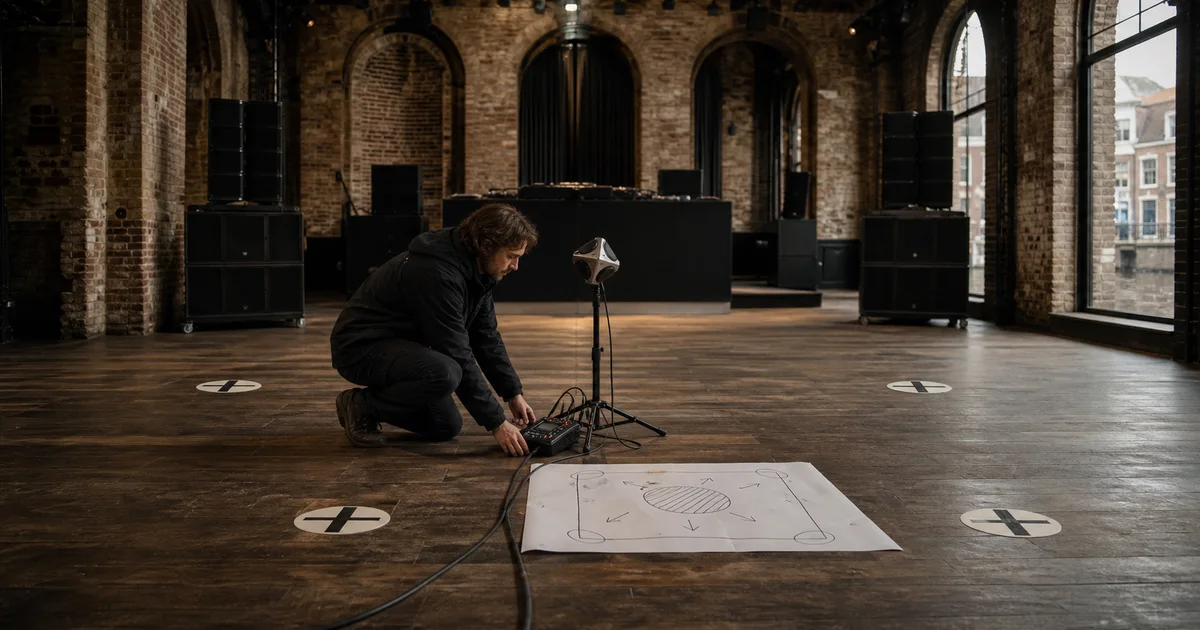
Original fictional editorial image. It does not show a real venue, event, recording session, or VPORT production.
Why One Listening Position Is Not Enough
I amsterdam's current club guide describes a scene that ranges from a subterranean listening bar to a modular warehouse and open-air dance floors. Those are not interchangeable acoustic settings. A location that gives the camera a strong view may sit in a bass null, beside a reflective wall, or too close to one loudspeaker array to represent the room fairly.
The four-position test turns that uncertainty into a comparison:
| Position | What to listen for | What can go wrong |
|---|---|---|
| Booth or front reference | Direct program sound and timing against the main PA | The room and audience may feel too distant |
| Center floor | Balance between PA, reflections, and crowd | Bodies, rigging, or lighting may block the capture position |
| Rear or side edge | Decay, width, and audience response | Reflections may blur direction or overpower the program |
| Transition point | How the sound changes near a stair, balcony, or room boundary | The position may exaggerate a feature most guests never hear |
These are diagnostic positions, not four microphones that must remain in the final setup. The goal is to discover which location gives the spatial bed a readable acoustic identity while the direct feed keeps the performance clear.
Step 1: Lock a Repeatable Reference
Use the same short, rights-cleared reference at all four positions. Keep the playback level and system configuration fixed. Record notes about the loudspeaker direction, major reflective surfaces, crowd zone, camera sightline, cable route, and any place the rig could interfere with guests or venue staff.
A soundcheck in an empty room is not a complete model of a busy night. It is still useful because it isolates placement differences. Mark the promising position, then repeat a short test under the actual operating conditions if the venue and rights holders authorize it.
The floor plan is part of the audio record. Draw the PA, booth, walls, openings, audience area, and all four test positions. A later editor should not have to infer why a reflection arrives from one side or why the crowd image rotates away from the camera view.
Step 2: Keep the Program and the Room Separate
A practical capture plan preserves two different sources:
- Program source: a clean feed from the venue's approved audio path.
- Spatial bed: a directional recording of the room, reflections, and audience around the selected perspective.
Keeping those elements separate gives the mix team control over clarity and atmosphere instead of forcing one microphone to do both jobs. Apple's current Immersive Video workflow overview describes a hybrid audio architecture that combines scene-based beds with discrete audio objects. The exact encoding and delivery path still needs to be tested for the target player.
An ambisonic microphone is one way to record the spatial bed, but it does not create a finished head-tracked mix by itself. Sennheiser's current AMBEO VR Mic documentation specifies four independently recorded capsules with matched gain. The A-format signals then require conversion and a compatible rendering workflow. That chain needs to be tested before the event, including orientation and channel labeling.
Step 3: Map Three Kinds of Direction
At each position, mark three directional layers on the floor plan:
- Program direction: where the main musical image appears to originate.
- Room direction: where early reflections and longer decay are most obvious.
- Audience direction: where reactions, movement, and nearby voices enter the sound field.
The strongest position is not necessarily the widest or loudest one. It is the position where those layers remain distinguishable and agree with what the viewer can see. If the booth is in front visually but the dominant music image pulls hard to one side, the result will feel unstable even when every channel is technically clean.
This is also where the test separates a venue-specific plan from a generic club recipe. A low ceiling, brick arch, concrete wall, open waterfront edge, or temporary partition changes which reflection matters and where a spatial bed can be placed safely. Record the actual geometry instead of assigning an Amsterdam-wide acoustic stereotype.
Step 4: Test the Render, Not Only the Recording
Head tracking is a playback behavior. It cannot be confirmed by looking at microphone waveforms or by hearing a fixed stereo fold-down.
Use the intended encoding and playback chain, then make three deliberate head turns: toward the booth, toward the main audience area, and back to the original view. Apple says head-tracked binaural rendering responds dynamically to viewer movement so audio remains spatially coherent with the visual environment. In a coherent test, the perceived booth and room do not rotate with the listener's head.
Check a conventional stereo or binaural output as well. Not every device, player, browser, or listening mode renders the same spatial metadata. The publishable mix needs an explicitly tested fallback rather than an assumption that one successful headset test proves every delivery path.
Production Approval Comes Before Placement
A useful floor plan is not production approval. Before recording, the production owner should document approval from the venue, event producer, and performer representative, along with the agreed technical access and safety plan. The organizations responsible for the event should decide what audience notices or agreements are needed for the planned recording and publication.
An event listing, ticket, or appearance in an Amsterdam nightlife guide does not authorize a recording. Confirm the production plan with the responsible organizations before the scout, and keep test recordings non-public until the approved release plan covers publication.
The Go or No-Go Worksheet
Before choosing the final position, the production team should be able to answer each question with evidence:
- Does the program feed remain clean and time-aligned with the room recording?
- Can the booth, crowd, and major reflections be located without visual conflict?
- Are microphone orientation, channel order, gain matching, and conversion documented?
- Does a head-tracked test keep the sound field anchored through deliberate head turns?
- Does the approved fallback mix remain intelligible without spatial rendering?
- Can the rig occupy the position without blocking guests, staff, exits, or sightlines?
- Has the production owner documented event and venue approval for the planned recording and publication?
If any answer is unknown, the scout has found work to do. That is a useful result. The point of the four-position test is not to prove that every Amsterdam room belongs in spatial audio. It is to identify the one perspective that can preserve this room honestly, safely, and with permission.
For the broader visual, audio, and rights context, read Amsterdam Electronic Music Venues: Why the Room Matters in Spatial Video. To see what is currently public, use VPORT's live catalog rather than treating this article as an availability announcement.