
Immersive Concerts in Tokyo: A Spatial Capture Planning Guide
Tokyo after dark offers dense streets, small rooms, large stages, careful lighting, and audiences gathered around many kinds of music. Those qualities can make the city compelling material for immersive concerts, but they do not make a production automatic. A credible spatial recording starts with a specific event, a suitable room, a clear technical plan, and permission from everyone responsible for the performance and venue.
This guide explains what a production team should verify before describing a Tokyo concert as a spatial experience. It does not announce a VPORT capture, partnership, or content release.
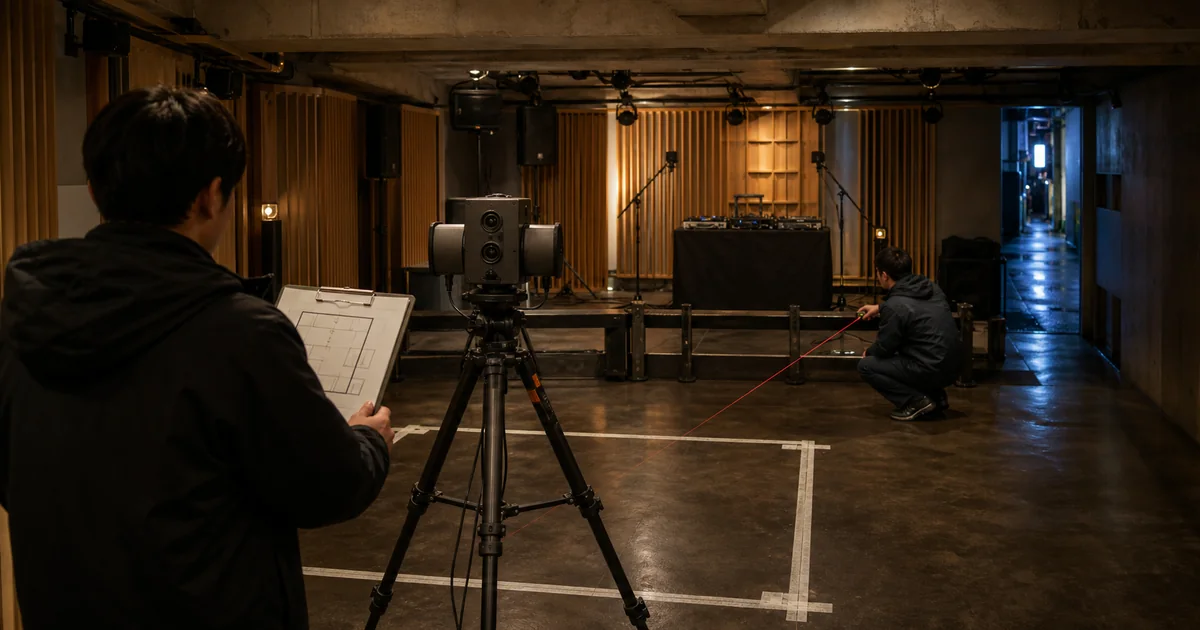
Original editorial artwork. The venue, crew, equipment, and survey are fictional and do not represent a real event, partnership, or VPORT production.
Start With the Event, Not the City Label
Tokyo is not one room or one sound. A production brief should identify the actual event, venue, performance format, audience layout, and intended release. Broad claims about "Tokyo club culture" are not enough to determine whether a room will work for spatial capture.
The Tokyo Metropolitan Government has publicly highlighted nighttime programming as part of the city's visitor experience, including its ongoing TOKYO Night & Light projection-mapping program. That is evidence of active nighttime cultural programming, not evidence that any particular club, festival, or performer is available for recording. Production teams still need to verify every event independently.
Before planning equipment, document:
- the event owner and venue contact;
- the performance schedule and changeover windows;
- the audience configuration and camera-safe areas;
- the lighting, sound, and power contacts;
- the intended devices and playback format; and
- the approvals required before recording or publication.
Choose the Capture Format Deliberately
"Spatial" can describe several different media formats. Apple documents spatial video as stereoscopic video with spatial metadata, while 180-degree, 360-degree, and wide-field-of-view video use different capture and playback workflows. A production team should choose the target format before selecting cameras or promising a viewing experience.
For a small-room performance, ordinary spatial video may preserve depth in a framed scene. A wide-field or 180-degree production can include more of the stage and audience but introduces different stitching, resolution, camera-placement, and viewer-comfort requirements. A 360-degree production adds coverage behind the camera and makes crew concealment more difficult.
Apple's current capture guidance for supported iPhone models recommends landscape orientation, a steady and level camera, even lighting, and subjects roughly 3 to 8 feet from the camera. Those recommendations are useful for personal spatial video, but a concert production may require professional stereo or immersive equipment, separate audio capture, and a workflow designed for the intended delivery platform.
Survey the Room Before Recording
A site survey should test the real room rather than rely on photographs or a floor plan. Walk the audience path, check sightlines at the expected crowd density, listen from the proposed camera position, and identify anything that can move during the performance.
Record the following in the survey:
- Camera position. Confirm a stable location that does not block exits, staff, performers, or the audience.
- Closest subject distance. Keep people and moving equipment out of uncomfortable near-field positions for stereo capture.
- Lighting range. Test the darkest cue, brightest cue, strobes, lasers, and rapidly changing LED content with the actual camera settings.
- Audio sources. Plan how the board feed, room microphones, crowd response, and timecode will be captured and synchronized.
- Crew visibility. Decide where operators, monitors, cables, and safety barriers can remain without distracting from the performance.
- Contingencies. Define what happens if the room layout, lineup, set time, or lighting plan changes.
Treat Audio as Its Own Production
A spatial image does not guarantee spatial audio. The production should specify the audio format, microphone layout, board-feed routing, monitoring, synchronization, and final mix separately from the camera plan.
Room microphones can preserve audience response and acoustic context, while the board feed can provide clarity and consistency. Neither is sufficient by itself for every release. The final balance depends on the room, the performance, and the playback format. Test the complete chain on the intended device before the event rather than assuming that a successful local recording will translate correctly after encoding and delivery.
Set Honest Viewer Expectations
Immersive media can preserve depth, direction, stage movement, audience response, and some characteristics of the room. It cannot reproduce every part of attending a live event. Headphones do not recreate the physical pressure of a venue sound system, and a headset does not reproduce temperature, smell, crowd contact, or the social context of being there.
The release description should say what was captured and how it can be viewed. Avoid promising that a recording is equivalent to attendance, that a device supports a feature without testing it, or that content is available before it appears in the public catalog.
Apple's official documentation is the appropriate starting point for current Vision Pro media-format support. VPORT's Vision Pro media-player guide explains the controls and viewing behavior documented for VPORT. Confirm the final encoded asset on the exact supported device and software version before publication.
Document Production Approval Before Recording
The production owner should document approval from the venue, event producer, and performer representative before recording or publication. The organizations responsible for the event should decide what notices or agreements are needed for audience participation and for any music or production design included in the recording.
Do not use a camera position, ticket, invitation, or press credential as a substitute for written production approval. If the recording plan cannot be explained clearly to the venue, performers, crew, and audience, it is not ready.
A Publication Gate for Tokyo Spatial Concerts
Before announcing or releasing a Tokyo spatial concert, confirm that:
- the organizations responsible for the event approved capture and publication;
- the published title and description identify the real format accurately;
- device and playback claims were tested on the final asset;
- visible people and sensitive information were handled according to the approved release plan;
- the page does not imply an affiliation or availability that has not been confirmed;
- the hero image and alt text match the actual production; and
- all event, support, and catalog links resolve at publication time.
Tokyo can be a strong setting for immersive music, but the city name is not the product. The production is the product: a specific performance, captured in a specific room, with technical and editorial choices that can withstand public scrutiny.
Creators and production teams can begin with the Creator Studio getting-started guide.
Sources: Tokyo Metropolitan Government on TOKYO Night & Light, Apple guidance for recording spatial video, and Apple guidance for 180-degree, 360-degree, and wide-field-of-view video.