
Barcelona Electronic Music: A 2026 Nightlife Guide for Spatial Video Fans
Barcelona's electronic-music map is useful because it puts very different room types in one city. Razzmatazz publishes club programs across several numbered rooms. Sala Apolo runs electronic nights through Nitsa and Astin in distinct halls. Macarena operates at a much smaller scale near La Rambla. The 2026 edition of Sónar added another comparison point by combining open-air and covered stages at Fira Gran Via.
For a fan, those differences shape the night. For a production team, they change the scouting questions: where can a camera stand, what does the microphone hear there, and what permissions are actually available? This is a public planning guide, not a concert listing or partnership announcement. VPORT has no confirmed production, catalogue title, venue relationship, or recording access tied to the places named here.
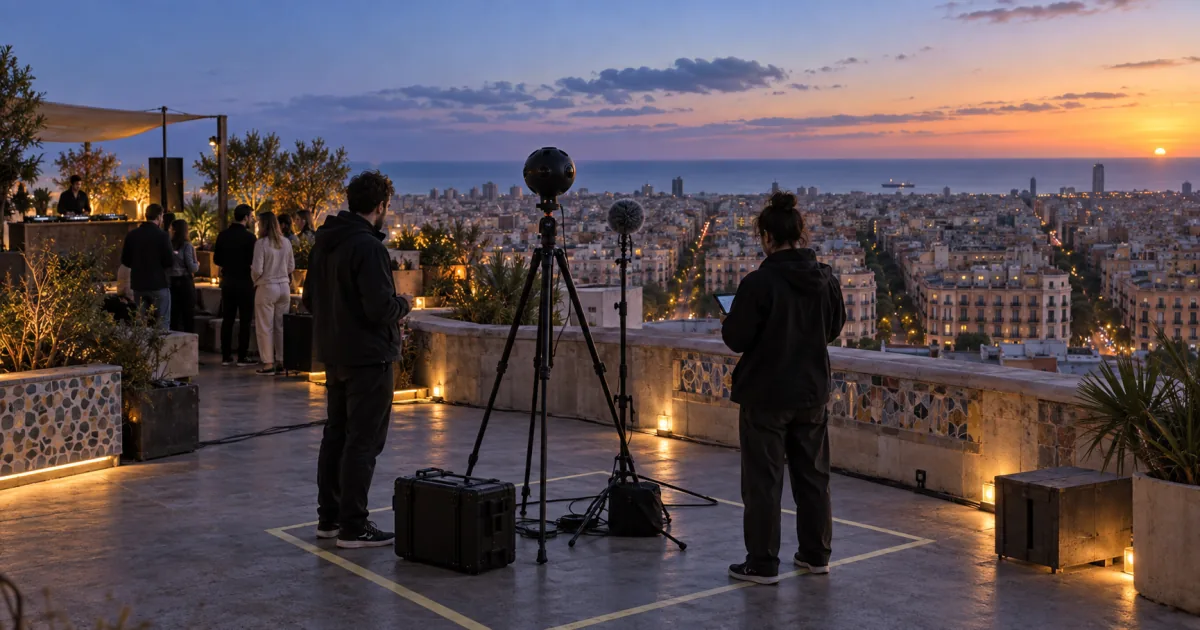
AI-generated editorial image of a fictional Barcelona-inspired production scout. It does not depict a real venue, event, artist, VPORT production, or partnership.
The Current 2026 Map
Start with official programs rather than a copied nightlife list:
- Razzmatazz publishes separate room and club schedules. Its official information page lists the main entrance on Carrer dels Almogàvers and another entrance for rooms 2 and 3 on Carrer de Pamplona.
- Sala Apolo describes Sala Apolo, La (2), and La (3) as distinct spaces. Its Nitsa page publishes the current electronic program and hours.
- Macarena Club publishes its daily program, hours, and address near La Rambla. Check the specific date because the lineup and admission conditions change.
- Sónar 2026 took place from June 18 to 20 at Fira Gran Via. The official festival guide described three open-air stages and three covered stages. That edition is now past, so it is context for the city's range, not a current ticket recommendation.
This mix matters because "Barcelona electronic music" is not one room or one production condition. A five-room club, a compact dance floor, and a temporary open-air stage need different plans.
Compare the Space Before the Lineup
| Space type | What a fan notices | What a spatial-video scout must verify |
|---|---|---|
| Multi-room club | Different programs and crowd movement between rooms | Which room is licensed, safe camera positions, cable routes, and whether one audio plan can cover more than one room |
| Compact club | Short sightlines and a close relationship between booth and floor | Minimum camera distance, protected equipment footprint, emergency egress, and whether the microphone position blocks movement |
| Open-air stage | A visible horizon, changing daylight, and less enclosure | Wind protection, weather cover, crowd barriers, sunset timing, and the permitted field of view |
These are scouting questions, not claims about access at any named venue. A public event page proves that an event is advertised. It does not grant filming, music, performer, crowd, or location rights.
Use Barcelona's Geography Deliberately
Barcelona can give a spatial production clear geographic cues without relying on a logo or a famous facade. From an authorized rooftop or elevated outdoor site, the chamfered blocks of the Eixample grid can create depth behind the performance. A Mediterranean horizon can provide a second reference point. In a multi-room venue, the useful story may instead be the transition from one acoustic volume to another.
The choice should follow the article's actual question. If the story is about open-air scale, preserve the horizon and changing light. If it is about a compact room, show the safe camera footprint and the short distance to the crowd. If it is about several rooms, document the corridor and the change in ceiling height instead of pretending one camera position represents the whole building.
Verify the Date, Then Verify the Rights
For a trip, use each venue's official calendar on the day you plan. For a production, add a written evidence pack:
- Venue authorization naming the room, date, and allowed equipment.
- Promoter and performer releases covering the intended distribution.
- Music rights for the recording and the final platform.
- A crowd notice and release process appropriate to the shoot.
- A technical scout covering camera safety, spatial audio, power, network, weather, and egress.
The companion music-rights checklist for spatial video explains why a ticket or public listing is not enough.
What the Viewer Should Be Able to Understand
A strong Barcelona spatial-video plan should make the setting legible: the scale of the room, the relationship between the camera and the performance, and the geographic cue that distinguishes the city. That is the practical difference from a generic dark-room image.
If you are comparing capture formats first, read the spatial video, 360 video, and VR guide. To see what is actually available on VPORT, browse the live catalogue in the product. Do not treat the venues in this guide as confirmed VPORT titles.