
Montreal Electronic Music: What an After-Hours Room Actually Is
Montreal electronic music rewards a little patience. A long DJ set can change gradually, giving a rhythm time to settle before the next turn. That is one reason an after-hours room deserves more than a listing of opening times: the duration is part of the experience.
Tourisme Montréal's nightlife guide, updated September 24, 2026, describes Stereo as an after-hours destination for extended house and techno sets and notes that it does not serve alcohol. Stereo's own ticketing page also identifies house and techno as its main musical focus. Those descriptions offer a starting point for understanding one room, not a timetable for every electronic night in the city.
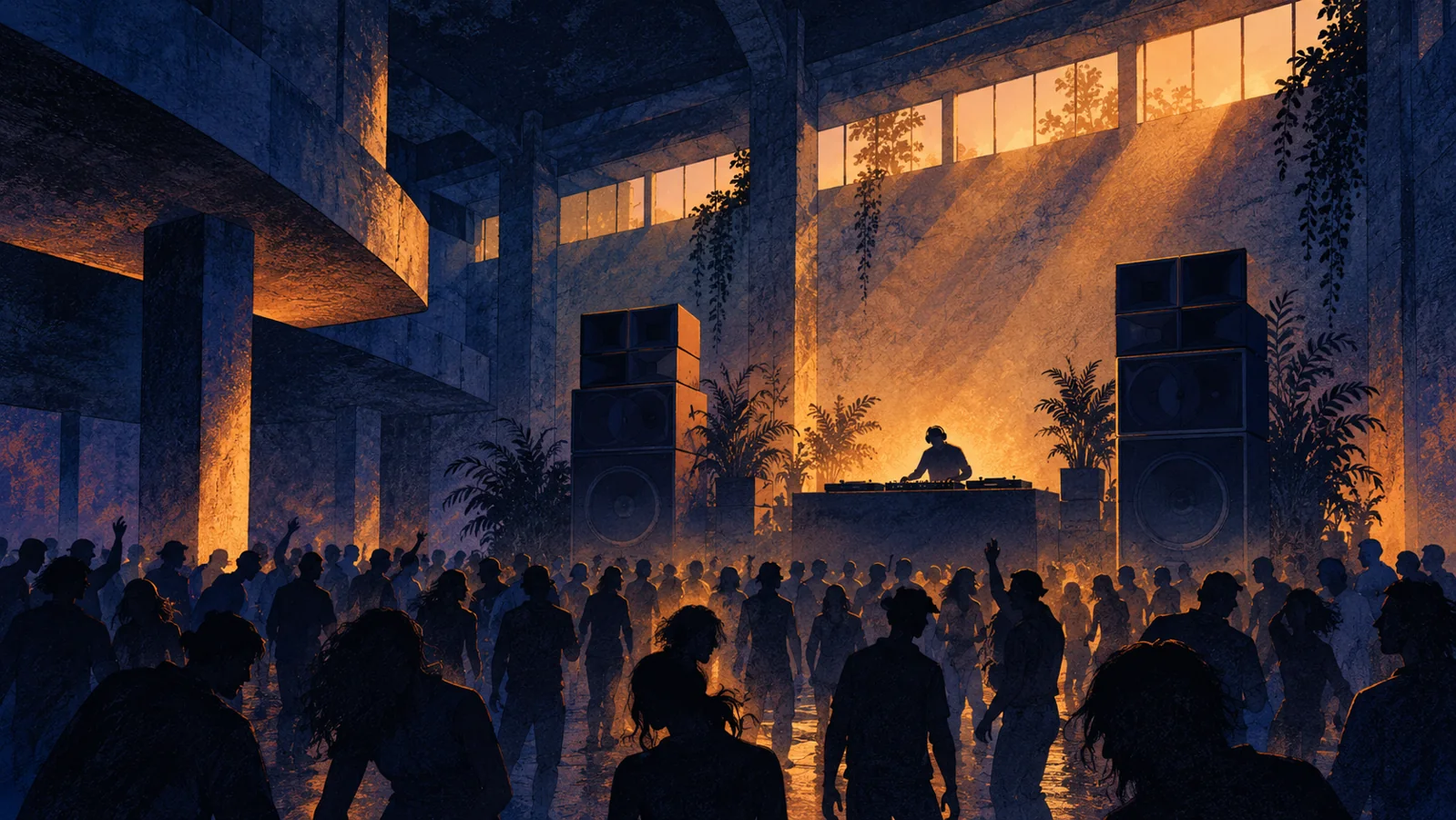
Original AI-generated editorial illustration of an imagined listening room, not a photograph of Stereo or another Montréal venue.
The city has more than one kind of electronic night
After-hours culture is one strand of a much broader scene. A small club, an outdoor afternoon programme and an audiovisual performance ask different things of their audience. They also make different promises about the experience: being able to dance for hours is not the same as attending a show with a fixed running time.
For an outdoor example, Piknic Électronik's official website lists its 2026 Montréal season at Parc Jean-Drapeau from May 17 to October 18. Its current programme is the place to check individual dates, artists and ticket details. A season range does not mean an event runs every day.
For a late indoor session, start with the venue's listing for that particular date. “After-hours” describes a format, not one universal closing time, alcohol policy or admission rule. Do not infer a venue's operating permission from whether it serves drinks. The published event details and the venue's answers are more useful to a visitor than a general claim about how late Montréal stays awake.
Our Vancouver guide approaches another city's nightlife through the same practical question: what does the specific room offer on the night you plan to go?
What a longer set changes for a listener
Time gives a DJ room to develop an idea. An opening passage can stay restrained, a transition can unfold slowly, and a familiar track can land differently after a long build. Those are possibilities of the format rather than guarantees about a particular artist or night.
Choose an arrival time around the experience you want, then check it against the actual door policy. Plan the journey home before leaving, include time for breaks, and keep hearing protection accessible. A marathon set is an invitation to listen at your own pace; it is not a test of how long you can stay on the floor.
The London clubs guide considers how a building's rooms shape listening. In an extended session, the changing pace of the music adds another dimension to that physical space.
Verify the night, not the reputation
Use these five questions on the event you are considering:
| Question | Where to check |
|---|---|
| Who is playing, and in which room? | The venue's or promoter's current event listing |
| When do doors open, and when does the public event end? | The listing, then the venue if the end time is unclear |
| What are the age, entry and re-entry rules? | The event's admission terms |
| Is alcohol served, and what facilities are available? | The venue's information for that room |
| Are photography or recording permitted? | The venue's published policy and written permission for any proposed production |
A ticket gives you admission under the event's terms. It does not grant permission to film performers, record music or publish an audience's image. A recording proposal needs a separate conversation about the venue, artists, music and people who may appear in it. Our music rights guide is a starting point for planning those clearances.
What a long room asks of a recording
For a crew with the required permissions, an extended session raises practical questions before it raises creative ones. Can the camera stay in a safe position throughout the night? Is there enough power and storage? Will the audio feed, camera clocks and monitoring remain reliable across the whole session?
A spatial or 360 recording can communicate some of the room's geometry, including the relationship between the booth and the floor. It cannot reproduce every physical sensation of being there. Low light, nearby movement and obstructed sightlines can compromise the image, while the bass felt through a floor is not something headset playback simply restores.
Test the proposed workflow in the conditions you expect to encounter, and plan breaks or recording segments with the venue. Decide what the format can preserve and what it will leave out. Our guide to spatial video, 360 video and VR explains the distinctions before you choose a capture format.
Montréal's after-hours culture is useful context for thinking about duration, attention and room design. The venues and events linked here are independent examples; this guide does not announce VPORT partnerships, recordings or Montréal catalogue availability. For product information, explore the VPORT creator documentation.