
Berlin Techno Clubs: A Spatial Video Fan Guide
Berlin's techno culture is larger than a list of club names. The German Commission for UNESCO describes it as a living cultural practice built around music, dance events, fashion, technology, and community. Its 2024 recognition belongs to Germany's nationwide inventory of intangible cultural heritage. It is not a UNESCO World Heritage designation for particular buildings.
The rooms still matter. A former power station, a compact basement, and an outdoor area produce different sightlines, movement patterns, and recording constraints. This guide helps fans read those differences and helps production teams identify the evidence they would need before proposing a spatial-video shoot. It does not claim that VPORT has content, a relationship, or recording access at any venue named here.
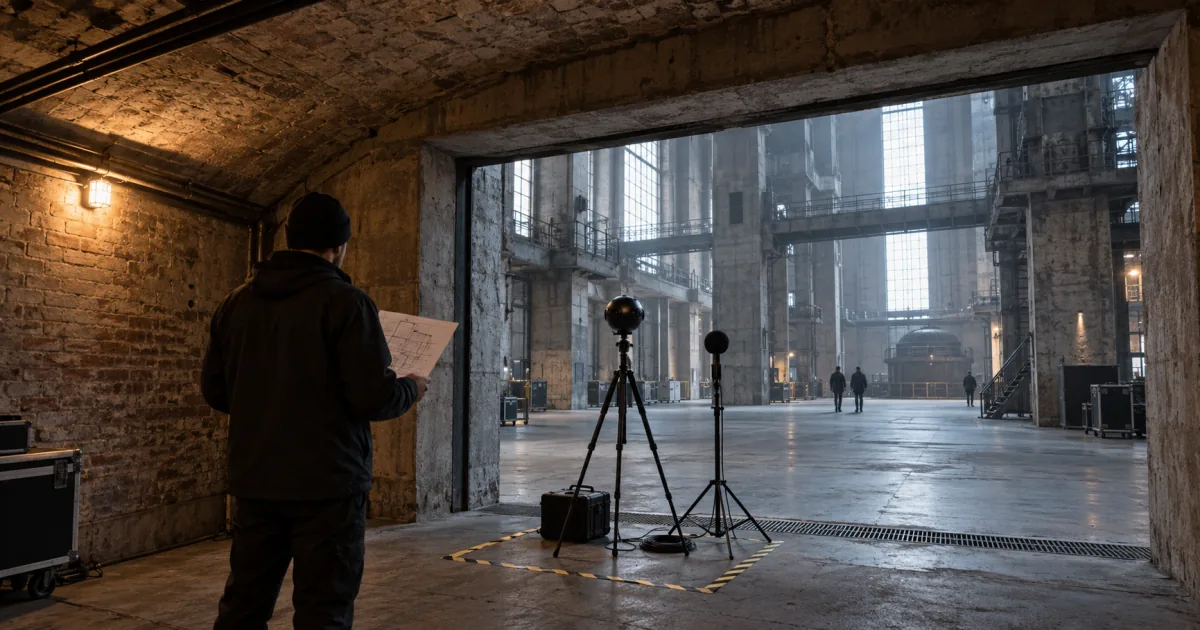
AI-generated editorial image of a fictional Berlin-inspired venue and survey. It does not depict a real club, event, artist, VPORT production, or partnership.
What the Heritage Recognition Means
The German Commission for UNESCO records Berlin technoculture in the national inventory under performing arts, social practices, festivals, and rituals. Its history page connects the scene to Detroit techno, Chicago house, electronic body music, and the spaces that became available around German reunification.
That recognition describes a community and cultural practice. It does not certify a venue, guarantee entry, or grant permission to record inside a club.
Read the Current Venue Evidence
Tresor and Kraftwerk: Tresor's official history dates the original club at Leipziger Strasse to March 1991 and documents its exchange with Detroit artists. An official Tresor release notes that the club moved in 2007 to the Kraftwerk complex on Köpenicker Strasse. Kraftwerk Berlin describes the building as a former power station with several large, flexible levels. Do not describe the current basement as the original 1991 bank vault.
Berghain and Panorama Bar: Use Berghain's own program for current events and conditions. Official event pages state a no-photo and no-video policy. That is a hard boundary for an ordinary visitor and a clear warning that any professional recording proposal needs explicit authorization before equipment enters the room.
Sisyphos: The official Sisyphos site is the current source for upcoming events and entry guidance. Treat older third-party descriptions of rooms, schedules, or weekend duration as background until the venue confirms them for the specific date.
Watergate: The former Kreuzberg club is not a current riverfront venue recommendation. Watergate's official 2026 event page described a September open-air event at SAGE Berlin and referred to its "final club nights." The brand may promote events, but the old club's windows, terrace, and address are not evidence for a current visit or shoot.
Match the Production Question to the Room
| Room condition | Spatial-video question | Evidence needed before production |
|---|---|---|
| Tall industrial volume | Can the image preserve vertical scale without putting the camera in a dangerous or unusable position? | Measured floor plan, rig height, sightline test, cable route, and venue approval |
| Compressed basement | Can viewers understand proximity without the rig blocking the floor or exits? | Minimum distances, protected footprint, egress review, and low-light camera test |
| Multiple rooms or levels | Is the story one continuous route or separate scenes with different sound fields? | Room-by-room access, transition plan, independent audio tests, and edit map |
| Outdoor program | How will daylight, weather, wind, and crowd barriers change the shot? | Date-specific site plan, weather cover, wind test, and permitted field of view |
Architecture can make spatial video more informative, but a famous room is not automatically recordable. A ticket proves admission under the venue's terms. It does not provide location, performer, music, or crowd rights.
How to Follow the Berlin Program
Start with each venue's official calendar. RA's Berlin listings can help compare dates, but cross-check the venue page before buying a ticket or planning travel. Entry rules, schedules, and lineups change.
For a production proposal, the companion Berlin venue verification guide gives a stricter checklist for identity, date, room, rights, and catalogue claims. A screenshot, old review, or familiar venue name is not enough.
What Spatial Video Can Preserve
A credible spatial recording can preserve relationships that flat coverage often reduces: camera distance from the booth, the height of an industrial hall, the boundary between a compressed floor and a larger room, and the direction of audience sound around the rig. It cannot reproduce the social rules of the room or replace being there.
The format choice still matters. The spatial video, 360 video, and VR comparison explains how a bounded stereoscopic view differs from spherical capture. The electronic music in VR guide covers the viewing side.
To see what is actually available on VPORT, use the live product catalogue. None of the clubs in this guide should be read as a confirmed VPORT title, partner, or production location.