
Music Rights for Spatial Video: A Clearance Map Before You Publish
A finished spatial concert video is not automatically ready to publish. The camera operator may own the footage file while other people still control the performance, the music, recognizable appearances, or the ways the recording may be distributed.
The useful question is not "Who owns the video?" It is "Which permissions does this exact release need?" This guide turns that question into a clearance map for promoters, venue teams, and independent producers.
This is a production checklist, not legal advice. Copyright, performer, privacy, and personality-rights rules vary by country and by the facts of a project. Use a qualified lawyer for the territories where you will record and distribute.
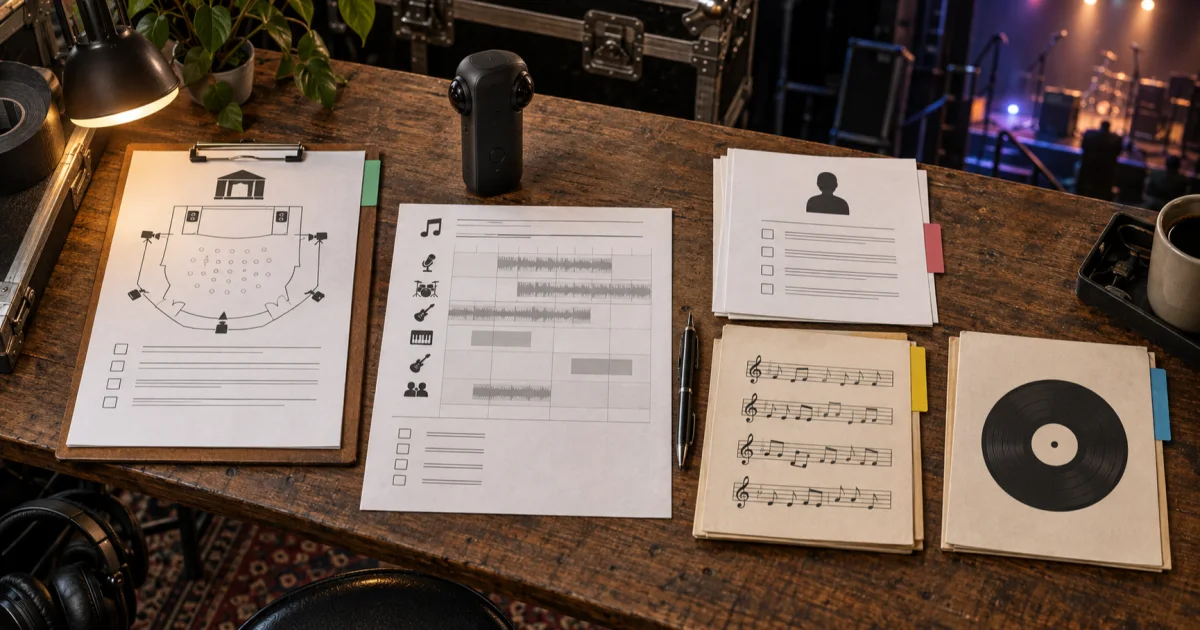
AI-generated editorial image. It depicts a fictional clearance workflow, not a VPORT production, contract, venue, or legal document.
Start With the Planned Use
Clearance depends on what you intend to do. Before contacting anyone, write down:
- whether the release is live, on demand, downloadable, or promotional
- the countries or regions where viewers can access it
- the release window and any archive period
- whether clips, trailers, stills, or paid ads will reuse the material
- whether you will edit, remix, subtitle, dub, or otherwise adapt it
- every platform and device category in scope
The World Intellectual Property Organization's rights-clearance guide notes that music licensors commonly ask how much music is used, how it appears, where the audiovisual work will circulate, and whether the music will also appear in promotion. "Permission to film" is therefore too vague for a distribution plan.
The Five Clearance Gates
Treat these as separate gates. A yes at one gate does not answer the others.
| Gate | What to verify | Evidence to retain |
|---|---|---|
| Location and event authority | The venue or event agreement permits the planned cameras, audio capture, placement, and commercial use. | Signed agreement or written authorization tied to the event and intended use. |
| Performers and people | Performers consent to recording and the planned release. Assess crew, guests, and audience members under applicable privacy and personality-rights rules. | Performer releases, participant notices or releases where appropriate, and counsel's documented risk decision. |
| Musical compositions | The songwriters or publishers controlling each composition authorize its use with the video where required. | Written licences identifying the work, use, term, territory, media, and promotional scope. |
| Recordings and soundtrack | The owner of each pre-existing master recording authorizes its use, and contracts identify who controls the new concert recording. | Master-use permissions plus performer, producer, label, or commissioning terms for the new recording. |
| Distribution | The final licence package covers the actual platform, monetization, region, window, edit, and marketing plan. | A clearance report linking every condition to the final cut and release settings. |
The distinction between composition and recording is fundamental. The U.S. Copyright Office describes them as separate works that are commonly owned and licensed separately. WIPO similarly explains that an audiovisual producer normally starts with the publisher for the composition and the record label or other owner for the recording.
That distinction changes with the material in front of the camera:
- A DJ set may capture many commercially released masters, each with an underlying composition.
- A live band performing its own material may create a new recorded performance, but the compositions and the new recording still need a documented chain of control.
- A cover performance may avoid use of a commercial master while still using a protected composition.
- A commissioned track may simplify clearance only if the commission agreement actually grants the intended audiovisual and distribution rights.
Do not assume an artist controls every needed right. Publishing, label, management, producer, featured-performer, or co-writer agreements may divide control.
Performer Consent Is Its Own Question
Performer permission should cover both fixation and the intended release. In the United States, 17 U.S.C. § 1101 addresses unauthorized fixation, transmission, and distribution of live musical performances. Other countries protect performers through their own copyright or related-rights systems.
A practical performer agreement should identify the event, recording formats, territories, release window, editing rights, promotional uses, compensation if any, credit, and approval process. It should also say who may grant downstream platform rights.
Crowd footage needs a separate assessment. A wide shot, a recognizable close-up, a minor in frame, and a sponsored testimonial do not carry the same risk. WIPO's filmmaker guide treats image, likeness, voice, and privacy as jurisdiction-specific issues and recommends written consent where possible. Entrance signage may be part of a plan, but it is not a universal replacement for releases or legal review.
A Venue Music Licence Does Not Finish the Job
A licence that lets a venue play music for an in-person audience does not necessarily authorize an audiovisual recording or its online distribution. WIPO distinguishes public-performance or communication rights from reproduction, synchronization, and adaptation rights. The exact bundle and terminology vary by territory.
Collective management organizations can be valuable for identifying songwriters, publishers, and other rightsholders. They do not always control every permission required for a video. Ask what the organization can license for the intended use, and document what remains outside its mandate.
Avoid three common shortcuts:
- "The venue already pays a music licence." Confirm whether that licence reaches recording and the planned distribution. Do not assume it does.
- "The DJ said yes." The DJ's consent may not include publisher, co-writer, label, or master rights.
- "It is only a short clip." Duration can affect a negotiation, but it does not create a universal safe-use threshold.
Copyright exceptions also vary. WIPO warns that commercial audiovisual uses often require authorization and that fair use is not a worldwide rule. A producer relying on an exception should obtain territory-specific legal advice and record the reasoning.
Build the Cue Sheet While You Edit
A cue sheet is the working index for the music in the production. WIPO recommends recording the music title, duration, type of use, entitled parties, ownership shares, and production-company information.
For a concert or DJ set, maintain one row per musical use and add the details your licensors request:
- track title, mix or version, and featured artist
- writer, publisher, master owner, and relevant identifiers such as ISWC or ISRC when known
- first and last timecode plus total duration used
- whether the use is a live performance, captured master, background use, trailer, or other category
- requested territory, term, media, monetization, and promotional use
- contact, request date, licence status, conditions, and expiry
- the final-cut version where the cue appears
A set list is a useful starting point, not a finished cue sheet. Compare it with the recorded audio. IDs, remixes, edits, walk-in music, and tracks captured between performers can change the clearance list.
When a Right Cannot Be Cleared
An unanswered email is not permission. Mark the item unresolved and change the release plan. Depending on the contract and creative context, options may include removing the affected passage, substituting cleared music, muting audio, narrowing a trailer, limiting a territory or window, or holding the release.
Check the revised cut again. Removing one track can expose another background recording, recognizable artwork, screen content, or person that still needs review. Keep the final clearance report aligned with the final exported file, not an earlier edit.
What VPORT Requires From a Creator
VPORT's current public Content Creator Terms state that a creator entity is responsible for its uploaded content and must have the necessary rights, consents, licences, and permissions. The terms also make the creator responsible for third-party licence conditions and related royalty or fee obligations.
That is a submission requirement, not a promise that any particular recording will be accepted, published, monetized, or cleared by VPORT. The Creator Studio getting-started guide likewise tells creators to upload only content they own or are authorized to distribute.
Before uploading, retain the signed documents, cue sheet, clearance report, and final-cut reference in a place your production and legal teams can retrieve. Recheck the current platform terms and the actual distribution agreement for the project.
Pre-Publish Readback
Ask one person who did not build the clearance file to read it back against the final release:
- Does every person granting a right have authority to grant it?
- Are all compositions, recordings, and identifiable performances accounted for?
- Do territory, term, media, monetization, editing, and promotion match the release settings?
- Are cue-sheet credits and contractual notices complete?
- Are audience, artwork, trademarks, screens, and privacy issues documented?
- Does the report point to the exact final cut?
If any answer is uncertain, pause publication and resolve that gap. Rights clearance is not one signature. It is a chain of evidence connecting the event, the people, the music, and the exact way viewers will receive the work.