
Vancouver Electronic Music: A Scene Built Around Last Call
Fortune Sound Club's current event page lists weekly nights in Vancouver's Chinatown from 10pm to 3am. The City of Vancouver, meanwhile, says liquor-primary venues are eligible to apply for different closing times depending on their location. That distinction is the useful starting point for understanding Vancouver electronic music: the city sets a ceiling, but the venue's approved hours and published event schedule determine the night in front of you.
Most city guides begin with genre labels. This guide begins with a clock, then asks what that clock changes for a fan, a promoter, and a spatial-video crew.
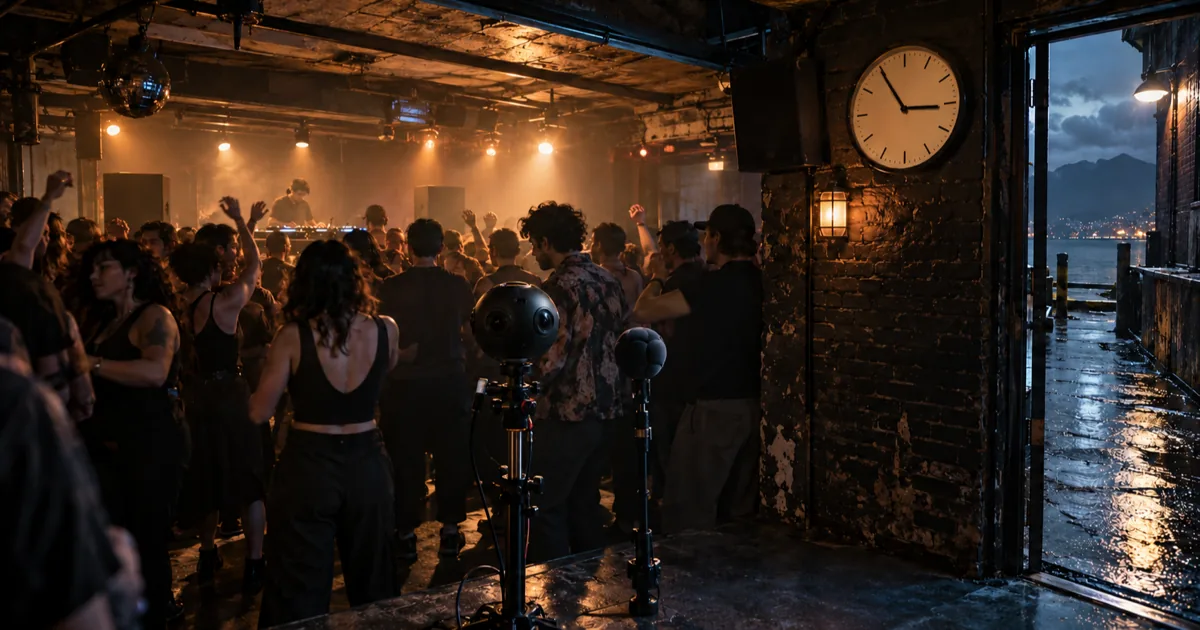
AI-generated editorial image of a fictional Vancouver club and capture setup. It does not depict Fortune Sound Club, another real venue, an event, an artist, a VPORT production, or a partnership.
"No Fun City" is history, not a current rulebook
Vancouver has carried the "No Fun City" nickname for years. It is tempting to turn that label into a permanent explanation for every room and every night, but the policy has changed.
The City's current liquor-serving establishments guidance records 2 important shifts. In 2021, Council allowed limited exceptions to existing moratoria and distancing policy. In 2023, Council removed liquor-establishment distance requirements citywide and lifted moratoria on new establishments and seat expansions in the Granville Entertainment District and several downtown areas.
Those dates matter. Older restrictions are part of the history of Vancouver nightlife, but they should not be described as if they still close the door on every new venue. The current system still involves municipal and provincial review, including location, capacity, hours, neighbourhood views, noise, traffic, and community impact. It is a regulated scene, not a frozen one.
That is also why a durable Vancouver electronic music guide should avoid unsupported claims about a single citywide sound. Policy can shape when and where events operate. It does not prove that every local house or techno artist writes, programs, or performs in the same way.
The 2025 hours change created 3 different clocks
On 22 July 2025, Vancouver City Council approved an update to liquor-serving hours. The City's current guidance says the change took effect in September 2025 under Licence By-law No. 4450.
For liquor-primary venues, the published eligibility now depends on location:
- Downtown venues can apply to close at 4am nightly.
- Venues in the City's Outside Downtown-A area can apply to close at 3am on Friday and Saturday, and 2am from Sunday through Thursday.
- Venues in the Outside Downtown-B area can apply to close at 3am nightly.
The words can apply do the work. These are not automatic closing times for every bar, club, or event. The Province's Liquor and Cannabis Regulation Branch makes licensing decisions, while the City provides input and may require public consultation. An official venue page can therefore show a 3am finish even when a broader policy page describes a 4am ceiling elsewhere.
For fans comparing Vancouver clubs in 2026, verify the specific event and venue instead of assuming that "4am Downtown" applies everywhere. For a production crew, use the approved event schedule as the working boundary and treat any later access for soundcheck, strike, or load-out as a separate written arrangement.
A clock is a production constraint, not a sonic stereotype
A shorter operating window can change the choices available to a promoter. It may affect doors, set length, changeovers, the peak period, and how much time remains to clear the room. What it does not do is prove a particular musical style.
The practical questions are concrete:
| Question | Evidence to confirm | Why it matters for capture |
|---|---|---|
| When do doors open and the public event end? | Official venue or organizer listing | Defines the usable audience window |
| What hours are actually approved for this event? | Venue confirmation and applicable licence conditions | Prevents planning from a citywide maximum |
| When can the crew enter and when must it leave? | Written production schedule | Protects setup, soundcheck, and strike time |
| Does the set cross midnight or a date boundary? | Final run of show | Keeps file naming, releases, and metadata accurate |
| Will house lights or room state change before close? | Venue walkthrough and lighting cue sheet | Avoids losing the final minutes to an unplanned visual change |
This is the honest connection between last call and a recording plan. The clock shapes the available production window. The artist and promoter still shape the music.
Time zones add a different constraint for remote viewers. An Ibiza night can land in the middle of a Vancouver workday, which is why our guide to on-demand electronic music separates a convenient replay from a live broadcast. That scheduling problem is observable. It does not require inventing a Vancouver-wide genre rule.
The room is evidence worth preserving
The City lists "spaces and places" among the priorities in its Vancouver Music Strategy. Its cultural-space guidance also describes an Arts Event Licence for temporary music, dance, and multimedia events in studios, warehouses, galleries, shops, and other unconventional spaces.
That does not mean every warehouse is a public venue or every event is authorized. It does show why venue status and room type must be verified separately. A permanent club, a temporary licensed event, and an unpermitted party are not interchangeable production locations.
Spatial capture is useful here for a limited reason. A correctly placed rig can preserve sightline, crowd distance, ceiling height, and the relationship between the booth and the floor. Those are the features that let a viewer understand a room as more than a soundtrack.
The limitations belong in the plan too. Bass felt through a floor does not automatically survive into headset playback. A spherical camera can show more of a room while making lighting, stitching, safe placement, and performer proximity harder. An ambisonic microphone can record a directional room bed, but it does not remove the need for a clean program feed, synchronization, monitoring, and a tested render.
Our creator guide for artists and venues covers the broader production path. VPORT's public visionOS media-player guide describes multiple framing options, but a feature description is not proof that a particular Vancouver event has been recorded or is available in the catalogue.
How to read a Vancouver event before you go
Use a 5-part check instead of relying on a city stereotype:
- Open the venue or organizer's official listing and confirm the date, address, doors, age policy, and scheduled end.
- Treat the City's hours as eligibility limits, not as the venue's actual closing time.
- Confirm accessibility, ticket terms, and any re-entry rule with the venue.
- If you are filming, obtain written venue, performer, and rights approvals before bringing a rig.
- If you are watching remotely, verify that the specific event and format are publicly listed instead of assuming catalogue availability.
Vancouver electronic music is not a single room or curfew. The useful thread is the decision chain: city policy sets possible hours, a venue operates under specific approvals, an event publishes its own schedule, and a capture plan has to fit each layer. That is more precise than "No Fun City," and much more useful when the clock approaches 3am.