vport

5 posts tagged with "Culture"

Music culture, community, and the social dimension of electronic music

View All Tags

Drum and Bass in the Spatial Era: Why the Genre Was Built for Vision Pro

· 7 min read

A drum and bass set does not reach you as one wall of sound. It reaches you in layers that sit at different distances. The sub is under the floor, felt before it is heard. The breakbeat is at chest height and moving. The pad behind it reads like it is coming from somewhere past the back wall. Producers have been placing those elements in space since the mid-1990s, using reverb tails and stereo width as a substitute for a room they could not actually build. Which is why drum and bass spatial audio is barely a conversion job. The spatial information was already in the track.

Stand in Room One at fabric in London, or on the floor at Rampage inside Antwerp's Sportpaleis, and the genre's design logic is visible in the architecture itself. Sub bass gets its own cabinets near the ground. The mids and highs fire from above the crowd. The room is not a neutral container for the music. It is part of the arrangement, and for 30 years it was the only place the arrangement fully existed.
Which Room Holds Your First Hour? A London Listening Guide

· 7 min read
VPORT Team

You are standing in a corridor in Farringdon with your coat still over your arm, and there is a decision in front of you that the flyer did not prepare you for. More than one room is running. You can stand in exactly one of them. Whatever you pick shapes the next hour more than the lineup does.

Most guides to a London club night tell you who is playing. Almost none tell you how to choose where to stand, which is the part you actually have to do, in the dark, with a bassline pulling at you from a doorway you cannot see down.

This is a guide to that decision, and it is not tied to any one night.

Indoor Electronic Music: How the Room Changes the Set

· 7 min read
VPORT Team

Amsterdam Dance Event's official 2026 information lists October 21 to 25. Its many participating festival venues make a useful, dated example for thinking about indoor listening, not proof that every city's calendar moves inside at the same time. A kick drum outdoors and the same kick inside a room can feel different: hard room surfaces can increase reverberation, while absorptive treatment on walls and ceilings can reduce reflections; ceiling height, room treatment and where you stand all shape what reaches your ears.

If you spend the summer in front of open-air stages and then walk into a basement in late October, the music has not changed. The room has. This is a short guide to what actually changes for a listener when electronic music moves indoors, and what to ask about a specific night before you commit to it.

London Electronic Music Clubs: What Three Rooms Teach Spatial Video

· 6 min read

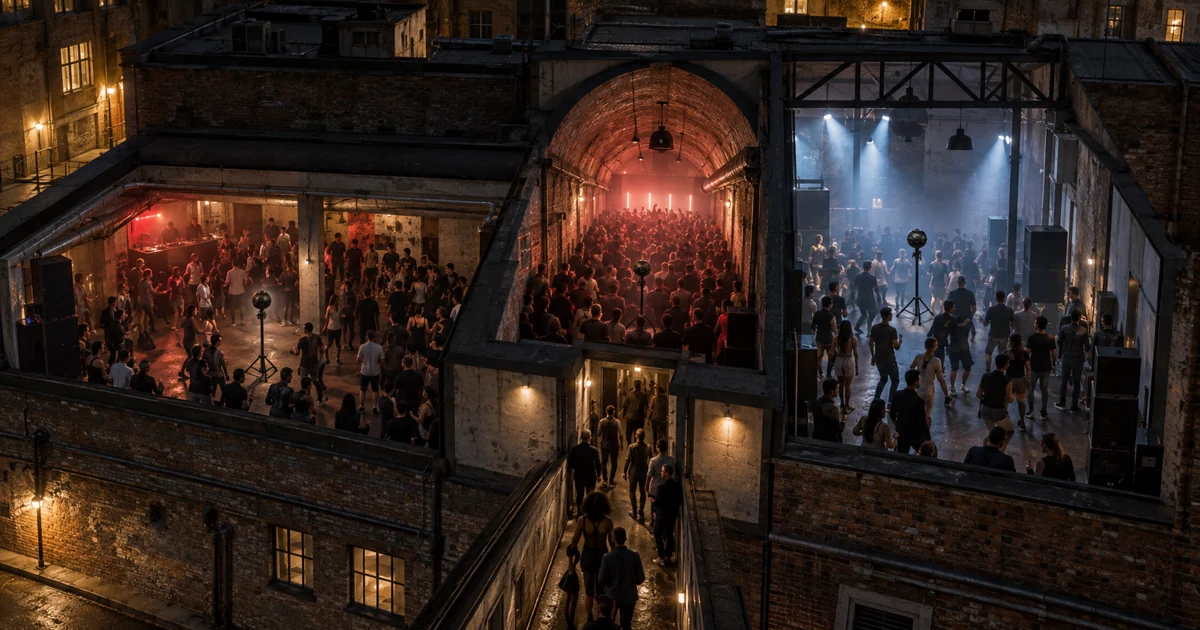
fabric's current accessibility guide describes a historic, multi-level building with three main rooms, corridors, stairs, narrow routes, low light and high crowd density. Room One contains the main dancefloor. Room Two is reached by a steep ramp. Room Three is reached by stairs and has no lift access. For a capture crew, that is not one club with three playlists. It is three routing, sightline and equipment-placement problems under one roof.

Room One adds a physical variable. fabric says its haptic floor, rooted in the original Bodysonic system installed when the venue opened in 1999, now uses 36 moving-magnet units to turn low frequencies into tactile feedback. A microphone can record the sound in the room, but it cannot reproduce what that floor delivers through a viewer's feet. That gap is exactly why the room matters as much as the camera.

Cutaway of a fictional three-room London club showing a low basement, a narrow brick vault, a tall warehouse room, three spatial-camera positions and the corridor between them

AI-generated editorial image of a fictional multi-room venue. It does not depict fabric, another real London venue, an event, an artist, a VPORT production or a product interface.

Berlin Techno Clubs: A Spatial Video Fan Guide

· 5 min read
CEO

Berlin's techno culture is larger than a list of club names. The German Commission for UNESCO describes it as a living cultural practice built around music, dance events, fashion, technology, and community. Its 2024 recognition belongs to Germany's nationwide inventory of intangible cultural heritage. It is not a UNESCO World Heritage designation for particular buildings.

The rooms still matter. A former power station, a compact basement, and an outdoor area produce different sightlines, movement patterns, and recording constraints. This guide helps fans read those differences and helps production teams identify the evidence they would need before proposing a spatial-video shoot. It does not claim that VPORT has content, a relationship, or recording access at any venue named here.