
Lisbon Electronic Music: The Scene That Europe Keeps Discovering
One of Lisbon's clearest examples of architecture changing use sits in the eastern wing of Terreiro do Paço. Beatport's venue record dates Ministerium's opening to December 2012 in facilities previously occupied by the Ministry of Finance. The current Lisbon tourism listing describes a restaurant, club and event operation at that address.
That is the useful thread in the Lisbon electronic music scene. A former government wing and a former riverfront auto workshop became nightlife spaces, and each layout creates different questions for anyone planning a spatial recording.
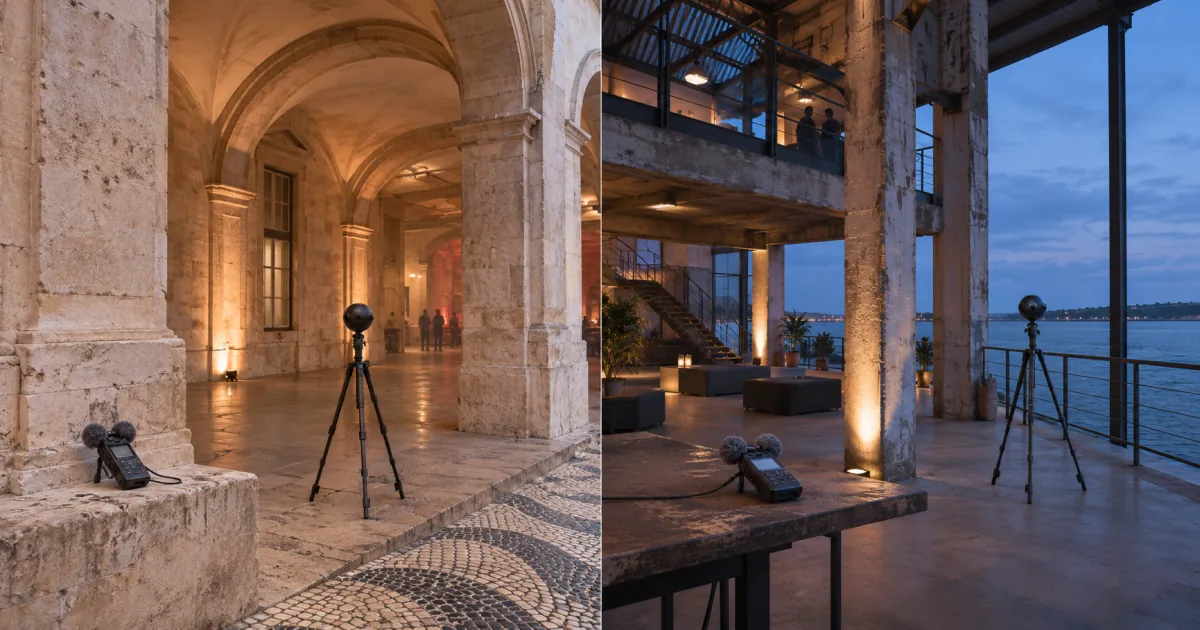
Original AI-generated editorial image of two fictional Lisbon-inspired spaces and capture setups. It does not depict Ministerium, Lux Frágil, Temple Club, another real venue, an event, an artist, a VPORT production or a partnership.
How Lisbon Clubs Reused Existing Buildings
Start at the river, because that is where one of the city's documented conversions happened.
Lux Frágil opened on 29 September 1998 in a 1910 building at Cais do Trigo that had previously housed an auto workshop. The historical account describes windows facing the river and an exterior area. The club's current site still publishes its own programme, so check the specific calendar rather than assuming one permanent sound or schedule.
The editorial point is reuse, not that every Lisbon club follows one blueprint. Lux adapted a former auto workshop by the river; Ministerium opened in a former government wing. Neither building was designed for a modern spatial-video crew, so access, sightlines, power, rigging and acoustics have to be verified in the exact room.
Compare that with our Berlin guide, which follows a different history of industrial reuse. Lisbon's examples connect a port building and a former administrative wing. That distinction is specific enough to be useful without turning two venues into a claim about every room in either city.
The Venues Shaping the Scene
These venue and event records are useful starting points, but each needs a current calendar check before a visit.
Lux Frágil, Santa Apolónia. The documented combination of river-facing windows and an exterior area means the venue includes materially different views and lighting conditions. Verify which part of the building a specific event uses before planning around the venue's reputation.
Ministerium, Terreiro do Paço. Beatport's venue record dates the opening to December 2012 and lists house and techno events. The current Lisbon tourism listing describes a restaurant, club and event operation at the eastern-wing address. Those sources support the location and uses; they do not substitute for an event-specific technical specification.
Temple Club, Santos. It occupies the former Europa Sunrise space. In an October 2026 interview, operator Oscar Rosmano describes the responsibility of preserving that electronic-music use while giving Temple its own identity. Treat that as the operator's perspective, then check Temple's current event listing for the night itself.
Then the calendar. The official Lisbon tourism listing for LISB-ON #JARDIMSONORO shows programming on Friday 3 and Saturday 4 July 2026 at Jardim Keil do Amaral. A separate Beatport event record lists the daily window as 16:00 to 04:00, which explains its 5 July end date. This was a 2-day programme running past midnight, not a third festival day.
In 2026 the city also added an industry layer. An official Beato Innovation District listing dates the Lisbon Dance Summit from 29 April to 2 May and describes talks, masterclasses, panels and festival programming. The summit's own site now says "see you in 2027", so the 2026 edition belongs in this guide as a dated event, not a permanent weekly institution.
What Makes Lisbon Different From Berlin and Ibiza
Here is the part that does not transfer from any other city on this list.
Research summarized by INET-md describes batida as music created by young people of African descent, identifies Quinta do Mocho as a major production centre and connects the work to Afro-diasporic rhythms. That evidence makes batida a Lisbon-rooted part of the city's electronic-music identity without reducing it to a marketing label.
That is the part of the guide that cannot be explained through buildings alone. The history of batida keeps the people and neighbourhoods that produced the sound central, rather than presenting Lisbon only through riverside venues and visiting lineups. Our 2026 Ibiza guide follows a different event calendar; it is not a template for Lisbon's local history.
Now the complication, because "Europe keeps discovering Lisbon" is a view from outside. In the Temple Club interview, Rosmano says Lisbon nightlife changed after Covid, clubs closed and some districts lost part of their previous role. That is one current operator's assessment, not a complete census of the city, but it is a useful warning against treating international attention as proof of a growing venue count.
We wrote about that tension in general terms in our piece on preserving nightlife culture. For Lisbon, the evidence supports a narrower conclusion: current events and new industry programming coexist with an operator's account of closures and contraction.
The Room Aesthetic in Spatial Video
The documented room types create different capture problems, which should be tested rather than inferred from a venue name.
Ministerium's former government-wing setting creates different scouting questions from Lux's 1910 former auto-workshop building. A flat frame aimed only at a booth can omit the architecture that explains the room. That is why our London clubs guide spends its time on what a building's layout does to a night: read the exact room before choosing the format.
Light is the second problem. A terrace facing the river can move from dark water and city light toward dawn. Any capture plan for that setting needs exposure tests across the expected window; a 360 rig also has no safe "behind camera" position for an operator during the take.
Format choice comes before rig choice. Our guide to checking a concert video's format sets out which capture suits which room, and a tall stone interior is a strong argument for making that decision during the scout.
Rights come before any of it. A ticket admits you under the event's terms. It does not license filming the performers, recording the music, or publishing images of a crowd. Our music rights guide covers what a recording plan has to clear first, and the creator documentation is where the production side starts.
To be clear about what this post is: a cultural guide. VPORT does not have a Lisbon catalogue, and nothing above announces one. The venues and events named here are independent and have no affiliation with us. We are describing the capture questions these room types raise, not claiming we have filmed in them.
Finding Lisbon Nights on VPORT
The access problem in Lisbon is ordinary but real. A particular night still requires the right date, room, admission, travel plan and event terms, while older venue summaries can outlive the schedule they describe.
VPORT provides another route to recordings that creators have actually published. It has a public U.S. listing for Apple Vision Pro, a public Meta Quest listing and browser access. Storefront, account, region, event and playback-mode availability remain specific to the person and recording. The current pricing page lists Free events plus paid tiers at 3, 5 and 8 cents per watched minute, with $5, $10 and $20 wallet top-ups.
Lisbon is the city in this series where reuse provides the clearest editorial thread. A former government wing and a former riverfront auto workshop are not neutral containers, but their acoustics, power and production access still need to be measured rather than assumed from history.
If a Friday in Santa Apolónia is not a trip you can make, browse the current VPORT listings without reading this guide as a promise of a Lisbon set. Confirm the listed venue, format, availability and price before starting playback.