
How Much Do VR Concerts Cost in 2026?
A 90 minute melodic techno set from a Berlin basement is sitting in front of you. Long build, the kind that takes twenty minutes to land before the sub arrives. Then the access sheet slides up with the event name, the runtime, a price per minute, and your current balance. That is the exact second most people ask the question in the title.
So here is the straight answer before the explanation. VPORT's current public pricing page lists paid events at 3, 5 or 8 cents per minute depending on the event tier, with $5, $10 and $20 wallet top-ups. At those published rates, that 90 minute set would cost $2.70 at Basic, $4.50 at Premium or $7.20 at Platinum. There is no monthly subscription charge.
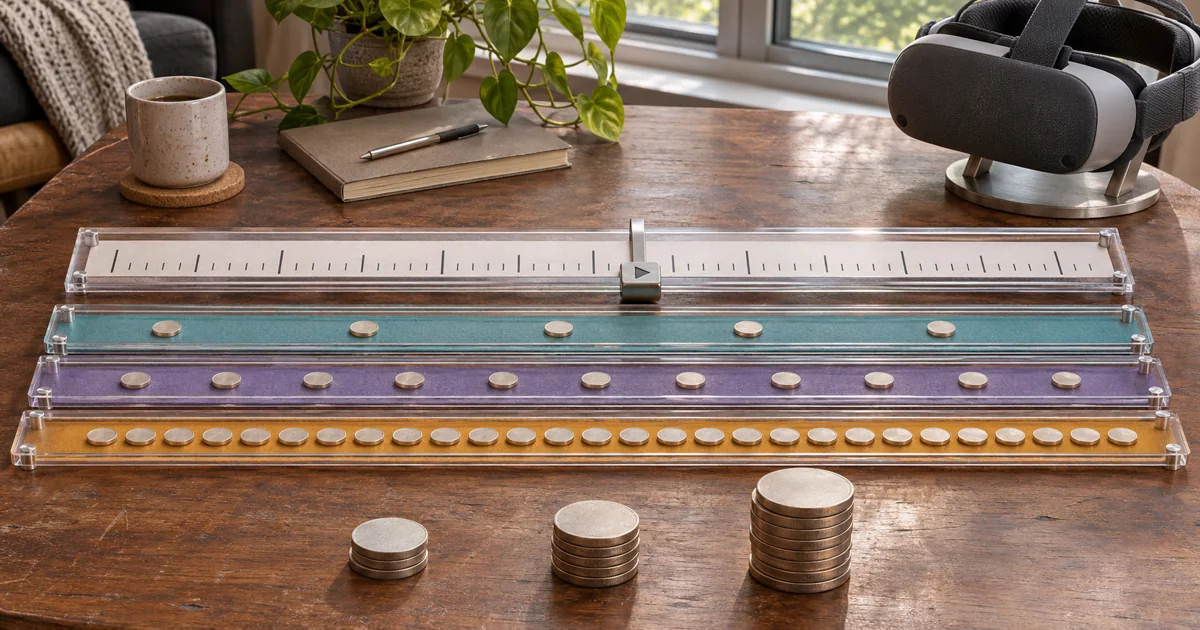
AI-generated editorial explanation of pay-per-minute pricing. The tactile timeline and tokens are not a VPORT interface, transaction record or product screenshot.
Pay-Per-Minute vs. Subscription: How Virtual Concert Pricing Splits
Three pricing shapes exist in this category and they behave completely differently once your habits are irregular.
A subscription charges a flat fee on a date, whether you listened or not. Everyone understands it because music streaming trained us on it. It is genuinely the cheapest option for someone consuming constantly, and it is the worst option for someone who disappears for five weeks and then teleports into four sets in one weekend.
A ticket charges once per event. One price, one show, same amount whether you stay for the closing hour or leave after the opener. It is the model physical venues run on, and it imports badly into a format where nobody is counting your chair.
Pay-per-minute charges for attendance. The bill tracks what you actually did. Nothing accrues in a dead week, and a 20 minute dip into a set costs 20 minutes.
VPORT runs the third one. That matters for anyone searching for a virtual concert subscription cost, because the current VPORT price is not a monthly fee. The public pricing page says there is nothing to renew or cancel: you add wallet credit when you want it and use that balance on the paid events you choose.
The reason the per-minute model earns a look at all is the scale difference between remote viewing and venue capacity. Tomorrowland generated 233 million livestream views in 2026 and issued 400,000 physical tickets, according to IQ Magazine. Those are different metrics, not unique viewers compared with attendees, so they should not be read as a count of people who failed to get tickets. They do show why remote concert access can reach far beyond a festival site. We broke the economics of that gap down further in the economics of electronic music festivals.
What VPORT Credits Actually Buy You
VPORT credit is a prepaid wallet balance used for paid events. The current public pricing page lists a $10 top-up as $10 of wallet credit, so the examples below use the published dollar balance and event rates directly. Rates, packages and catalog availability can change; check the event and purchase screen before paying.
Every paid event carries one of three content tiers, and the tier sets the per-minute rate:
| Tier | Rate | 90 minute set |
|---|---|---|
| Basic | 3¢ per minute | $2.70 |
| Premium | 5¢ per minute | $4.50 |
| Platinum | 8¢ per minute | $7.20 |
The price is displayed on the event before playback starts, so the spatial video concert price is never a surprise you discover in a statement later.
Two practical notes. Package amounts come from the active catalog and can change. Current web promotions are applied through a VPORT promotion link rather than a general manual-code box. Read the Credit page for what is live today instead of treating a number in a blog post, including this one, as permanent. The full mechanics are documented in Credit & Payments and the cross-platform Credit & Billing Hub.
Costs to Verify Before Creating an Account on Any Platform
This part is platform-agnostic. Run it against us, run it against anyone else. Six questions, and the answers change what you actually pay by a lot.
1. What is the unit of billing? Per minute, per event, or per month. Everything else follows from this.
2. Does pause count? On VPORT usage is calculated from recorded active Play time at the event's displayed rate, rounded to the nearest minute. Pause and buffering are recorded separately from active play. Walking away from a paused set is not billed as attendance.
3. Is there a free preview? On VPORT there is no universal free first-30-seconds, so review the event price before you press play. Any platform that cannot answer this plainly is a platform where you will find out the answer on your statement.
4. What determines creator earnings? Do not infer one universal payout percentage from a viewer price. VPORT's current creator earnings FAQ says the applicable creator agreement governs revenue share, deductions and other commercial terms. Viewer spending, unused wallet balance and promotional credit are not interchangeable with creator earnings.
5. Which payment rail, and can you audit it? VPORT's public payment disclosures identify Stripe on the web, Apple in-app purchase on Apple Vision Pro and Meta platform purchases on Quest. Payment History separates purchases, usage and adjustments, and every row shows a starting balance, the amount and an ending balance. A platform that bills by the minute and then will not show you the minutes is asking for more trust than it earned.
6. Does a better format cost more? On VPORT the per-minute rate is attached to the event, not to your device or how the footage is presented to you. An 8K 360 capture on an Insta360 Pro 2 rig bills at its tier, the same tier it bills at anywhere else.
Budgeting a Month of VR Concerts on $5, $10, and $20
Here is what each top-up buys in minutes, which is the only honest way to compare per-minute pricing to a flat fee.
| Top-up | Basic (3¢) | Premium (5¢) | Platinum (8¢) |
|---|---|---|---|
| $5 | 166 min | 100 min | 62 min |
| $10 | 333 min | 200 min | 125 min |
| $20 | 666 min | 400 min | 250 min |
Translated into habits:
$5 is a sampler month. 166 Basic minutes is most of a month at an hour a week. Or it is one long Platinum set, 62 minutes, start to finish, and that is a legitimate way to spend it.
$10 covers several full sets, depending on tier. 333 Basic minutes is five and a half hours. At Premium, the same top-up covers 200 minutes, or three 60-minute sets with 20 minutes left. At Platinum it covers 125 minutes.
$20 is a deep month, and it depends entirely on tier. A Basic-only viewer gets about 11 hours out of it. Somebody living on Platinum captures burns the same $20 in roughly 4 hours. Same money, very different ceiling, and the tier mix is the variable people underestimate.
One planning note on the catalog. Availability varies by event, account, device and region, and VPORT's public creator page says live and on-demand workflows depend on the event setup, footage, rights and publishing configuration. Budget from the event that is actually available to your account rather than assuming a fixed catalog. If you are new to the format, the first VR concert guide covers the setup side before you spend anything.
Why the Per-Minute Model Fits Irregular Viewing
With a ticket, you pay once for the event. With a subscription, you pay for a period of access. With VPORT's per-minute model, your wallet usage follows recorded active play time at the displayed event rate. That creates a precise viewing record, but the creator's share still comes from the applicable agreement rather than a universal percentage promised by this article.
That measurement model can represent the 20 minute build, the deck change at 1:47 and the closing track nobody expected instead of reducing the whole set to a single click. It is the same long-form advantage we discussed in why on-demand beats live for electronic music.
The model has a real cost and it would be dishonest to skip it. A heavy month costs more than a light one. Fifteen hours at the currently published Platinum rate would total $72, while an account that watches nothing has no monthly subscription charge. Whether that trade works depends on your actual viewing pattern.
Check the event's current rate, then pay for the recorded active play time you use: portal.thevport.com/signup.