
Melbourne Electronic Music: The Scene Built on Warehouse Logic
Revolver Upstairs at 229 Chapel Street in Prahran publishes its trading hours like this: Friday 5pm to midday, Saturday 5pm to Monday morning, Sunday 24 hours to Monday morning.
A venue that writes its weekend as one block instead of three nights is telling you about its licence, not its lineup. And that is the right place to start with Melbourne electronic music, because the paperwork and the building can explain more than the booking does. The adaptive-reuse rooms in this guide are buildings that already existed, doing a second job.
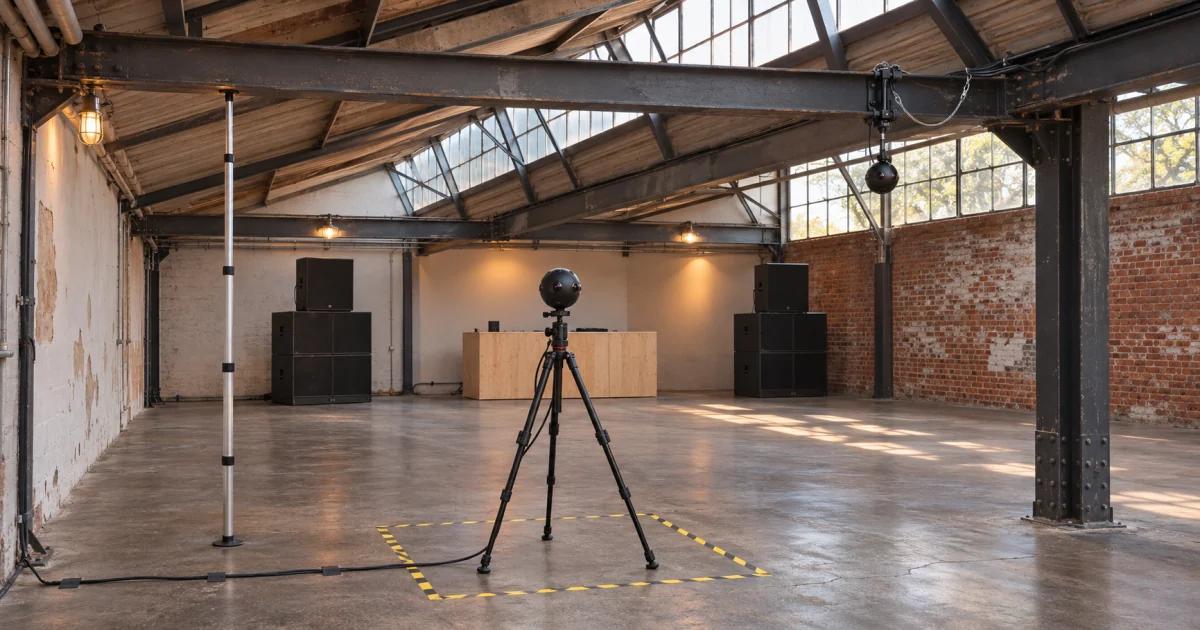
Original AI-generated editorial image of a fictional warehouse capture survey. It does not depict Second Story Studios, another real Melbourne venue, an event, an artist, a VPORT production or a partnership.
Melbourne Electronic Music by the Numbers: One Venue per 9,503 People
The claim Melbourne makes about itself is a ratio, and it comes with a methodology. The Melbourne Live Music Census, run by Music Victoria and the City of Melbourne with RMIT, Collarts and the councils of Yarra and Port Phillip, counted one live music venue for every 9,503 residents. The comparison set in the same census: London at 1 per 34,350, New York at 1 per 18,554, Los Angeles at 1 per 19,607.
Two other figures from that census matter more than the headline. Around 112,000 people were in a Melbourne music venue on a given Saturday evening, and live music was worth $1.4 billion in 2017, up 16% on 2012. The census reported 2017 data across a five-year window, so treat the exact ratio and economic figures as historical rather than current measurements.
That density is why this city reads differently from the others in this series. Our London clubs guide is organised around a handful of large rooms whose layouts define the night. Melbourne has the opposite problem. Too many doors, no obvious one.
Melbourne Techno Clubs 2026: Where the Programming Actually Sits
Resident Advisor's Melbourne guide is the most useful starting map, and what it shows is a scene sorted by suburb rather than by a club quarter.
In the CBD: Miscellania is a loft-style room with a rooftop terrace, Solace sits on Croft Alley programming techno, house and tech house, Killing Time leans minimal and house, and Angel Music Bar runs house, tech house and disco. In Collingwood: Collingwood Basement works techno, house and minimal below street level, and New Guernica occupies a multi-level space it moved into in 2021, having opened in the CBD in 2001 as Club F4. In Prahran: OneSixOne is a multi-room venue and one of the city's longest-running, a few minutes from Revolver on the same strip. Further out, Tender in Brunswick programmes ambient, experimental and downtempo, and High Note in Northcote runs electronica, funk, soul and downtempo.
Read that list as a snapshot. Melbourne calendars turn over fast and one-off bookings move between rooms, so check current listings the week you travel.
The geography is more durable than the list. Prahran sits south of the river, Collingwood north-east of the centre, and the night you get depends on which way you went. Our Montreal guide covers a city where the scene reorganises itself after last call. Melbourne's version of that split is spatial, not temporal.
Why Melbourne's Scene Runs on Warehouse Logic
The clearest single document about this city's rooms is a venue hire listing, not a lineup.
A Creative Spaces listing for Second Story Studios at 222 Johnston Street in Collingwood specifies a saw-tooth building converted to warehouse-style event space, 425 square metres across the site, 450 standing or 250 seated, polished concrete floors, loading points around the ceiling perimeter, a QSC system, a bar on a 1am liquor licence, and 3.15 metres to the underside of the steel girders.
That last number is the thesis. 3.15 metres is the headroom a factory needed above a work floor, not the headroom a lighting designer would ask for. The listing is one concrete example of what adaptive reuse gives a production and what it takes away. It does not publish load ratings for the ceiling points or an acoustic assessment, so those details still need venue and qualified technical confirmation before a shoot.
Which is where the pressure comes from, and where Melbourne is doing something about it. Victoria introduced the agent of change principle in 2014, assigning noise-attenuation responsibility to the use or development that arrives or expands second. On 26 October 2026, Amendment VC305 came into operation, adding a Live Music Overlay that councils can use to identify venues and precincts. Yarra says it has identified five precincts, including Johnston Street and Collingwood Yards, and is progressing a separate local amendment to designate them.
The Victorian state election is scheduled for 28 November 2026. Music Victoria records Labor campaign commitments that include live music precincts, stronger venue protections, a permanent Live Music Desk and a new Live Gigs Fund. Those are campaign commitments, not law.
This belongs in a music post because it decides which buildings survive. Our piece on preserving nightlife culture argues that a scene is its rooms, and Melbourne is that argument being tested in planning law.
Southern Hemisphere, Spatial Video: What Changes
Three things change when the city you are filming is at 37 degrees south.
The calendar inverts. Melbourne's outdoor season peaks across the Northern Hemisphere's winter, and the anchor event lands on New Year. Beyond The Valley runs its 11th edition at Barunah Plains in regional Victoria from 28 December 2026 to 1 January 2027. Our São Paulo guide and Buenos Aires guide hit the same inversion from South America: a city whose best week is the week the rest of the circuit is indoors.
The clock inverts with it. Melbourne runs on AEDT through the summer, which is UTC+11. At the end of a Saturday, midnight in Collingwood is 1pm Saturday in London and 8am Saturday in New York while those cities are on standard time. That is a real barrier for anything time-bound and no barrier at all for anything on demand. Our piece on why on-demand beats live for electronic music works through what that does to a listener in the wrong time zone.
Then the ceiling. Go back to 3.15 metres. A 360 rig on a stand sits near head height, which in that room means the girders and the ceiling occupy a large share of a sphere for the entire set. An overhead position could buy a different picture, not a better one: it reads the floor plan and loses the eye line that makes a warehouse feel like a warehouse. Any use of the listed ceiling loading points would require venue approval, confirmed load ratings and a qualified rigger. Our guide to warehouse club nights in 360 covers the same visual tradeoff, and our format checklist sets out which capture suits which room. In a low converted factory, the format decision does more work than the rig does.
One more thing, because it is the part that stops shoots rather than complicating them. A ticket admits you under an event's terms. It does not grant permission to film performers, record the music or publish images of a crowd. Our music rights guide covers what a recording plan has to clear first, and the creator documentation is where to start on how VPORT handles creators, venues and events.
To be clear about what this post is: a cultural guide. VPORT does not have a Melbourne catalogue, and nothing here announces one. Every venue, festival and council named above is independent and has no affiliation with us. We are describing why these rooms suit immersive capture, not claiming we have filmed in them.
Where to Start Before Melbourne Shows Up on VPORT
The access problem in one line: the historical census describes dense local access, but those doors still depend on being in Melbourne.
That gap is what we build for. VPORT has public listings for Apple Vision Pro and Meta Quest, with browser playback on the web. Availability and windowed, spatial, 180-degree or 360-degree playback depend on region, device and the footage published for a specific event. The public pricing page lists free events, paid rates from 3 cents to 8 cents per minute and wallet top-ups at $5, $10 and $20.
Melbourne is the city in this series where the building explains the production constraints most directly. A saw-tooth factory with 3.15 metres of headroom was never designed for immersive capture, which is why a shoot plan has to start with the room dimensions and verified rigging limits.
If a flight to Victoria is not happening this summer, start a bundle at VPORT and teleport into a room instead.