
Los Angeles Electronic Music: A City Without a Club Quarter
Los Angeles electronic music does not fit inside one compact club quarter. The current addresses alone explain the route: 1720 lists 1720 E 16th Street, Catch One lists 4067 W Pico Boulevard, and Exchange LA lists 618 S Spring Street. These are not adjacent doors on a single nightlife strip.
That geography is the first thing worth understanding about the city's scene, and it is the thing most city guides skip. The sound here is not concentrated in a district, so the night has to be assembled rather than wandered into.
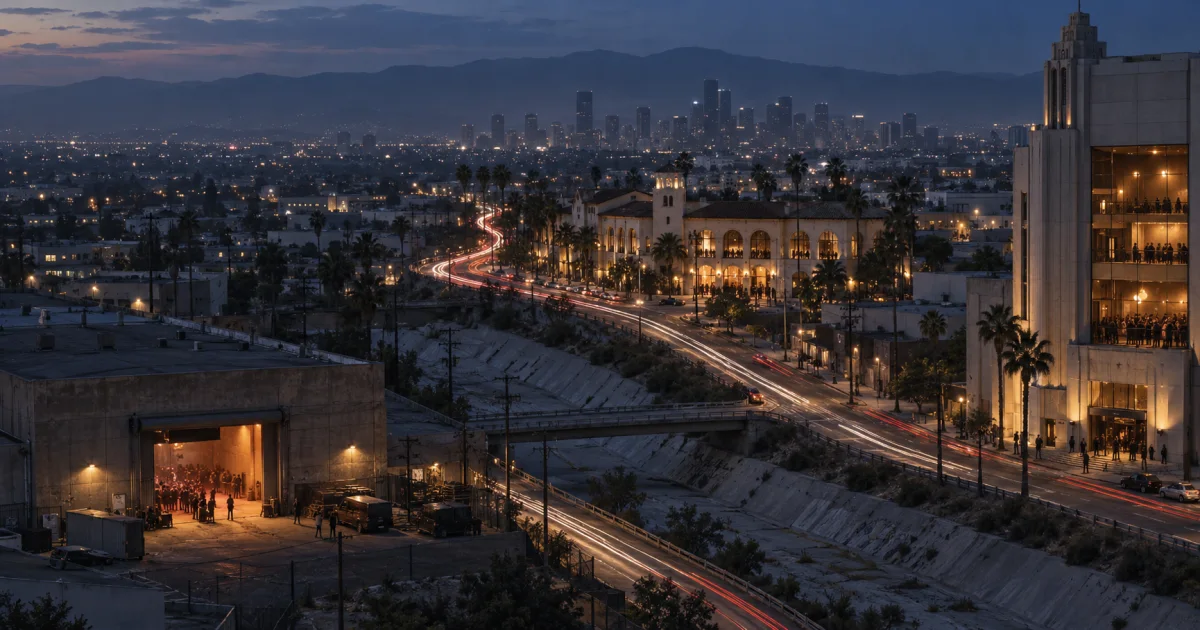
AI-generated editorial illustration of a fictional Los Angeles-inspired route and three contrasting room types. It does not depict 1720, Catch One, Exchange LA, a real event, or a VPORT production.
The distance is part of the format
A night in a compact entertainment district can be improvised. You buy one ticket, and the building or the street may give you options. Our London clubs guide looks at how a single venue's rooms can hold an entire evening without anyone leaving the address.
The Los Angeles examples in this guide are spread across different addresses, so a second stop is a decision with travel time attached, not an automatic walk. A plan built around one room, one promoter, and a realistic way home is more reliable than assuming another venue will be nearby.
That makes research more useful than instinct. Two rooms can be running completely different programmes on the same Saturday, and there is no single strip where you can read the whole night from the queues outside. The event listing is the map.
Three venue formats
The standing-room venue. 1720's official information page describes most shows as general admission and standing room, says events are all ages unless noted otherwise, and makes photography and taping rules subject to the performing artist. That makes it a useful example of why an event-specific page is stronger evidence than a venue's general reputation. It is a ticketed venue at a published address, not proof of what an underground warehouse event will be like.
The historic multi-room venue. Catch One's current FAQ says the venue has five event spaces that can host multiple events at once. The Los Angeles Conservancy's history records that Jewel Thais-Williams founded Jewel's Catch One in 1973, operated it until 2015, and built a nationally significant gathering place for the Black LGBTQ+ community. The building is now a Los Angeles Historic-Cultural Monument. That history matters, but it does not tell you which room, promoter, age rule, or camera policy applies to the event you are considering.
The downtown landmark venue. Exchange LA says its four-story venue occupies a historic building that once housed the Los Angeles Stock Exchange. The Los Angeles Conservancy dates the Classical Moderne building to 1931 and notes that the exchange later became part of the Pacific Stock Exchange before leaving in 1986. Multiple levels create a different relationship between the floor, booth, and audience than a single flat room, but the exact sightline still depends on where a ticket places you.
None of these three is the "real" scene. They are distinct formats, and choosing between them is closer to choosing a kind of evening than choosing a genre.
The outdoor half of the calendar
The city's electronic calendar also runs outward into daytime and open-air events. That makes a club-only search incomplete, but it does not make any one promoter's calendar a complete map of the scene.
Insomniac publishes a current calendar for its own events. Use it alongside official venue calendars, not as a substitute for them, and confirm the exact date, address, age rule, and entry policy on the event page before travelling.
Our Vancouver guide and Montreal guide cover two other North American scenes we have written about. The contrast is useful because geography changes how a night must be planned even when some of the music overlaps.
What to check before you go
A reputation tells you very little about a specific night. For the event you are actually considering:
- Who is programming the room that night, and whether it is the venue or an outside promoter
- Door time and the published end time, which vary widely between rooms here
- Age and re-entry rules, which differ by venue and sometimes by event
- Parking or transit for that exact address, planned before you leave rather than on arrival
- The venue's photography and recording policy
The last one matters more than most visitors expect. Venue rules are only one layer of a production plan; permission from the venue, performers, and relevant rights holders may also be required. Obtain written clearance before recording or publishing, and use our music rights guide as a starting checklist rather than legal advice.
What a spread-out city asks of a recording
For a crew that has the permissions in hand, this city raises a specific problem: the rooms vary enormously, so a workflow proven in one is not proven in the next.
A large hard-surfaced room may offer rig distance while creating strong reflections and difficult lighting contrast. A historic multi-room or balcony venue may offer more viewpoints while complicating approved tripod positions, sightlines, and egress. Treat those as hypotheses to test on site, not conclusions to draw from venue photographs.
A spatial or 360 capture can carry a real amount of what a room is doing, particularly the geometry: the distance from the booth to the floor, and how close the crowd actually stands. It does not carry everything. Bass through a concrete floor is not something headset playback restores, and low light with heavy movement is where image quality degrades first. Our guide to spatial video, 360 and VR sets out the differences between the formats before a crew commits to one, and the warehouse capture piece goes further into that specific room type.
Test in the conditions you expect, not in a rehearsal space. Agree the rig position with the venue in writing, and decide in advance which parts of the night the format is going to leave out.
This is a useful case study in how physical distance shapes a music scene. The venues and events linked here are independent examples, and this guide does not announce VPORT partnerships, recordings, or Los Angeles catalogue availability. If you are planning a permitted capture, read the creator documentation and confirm the current public workflow before committing a crew.