
Detroit Electronic Music: The City Where Techno Was Born
Hart Plaza is a 14-acre concrete civic site on the Detroit River. The City of Detroit dates its opening to 1975 and credits the design to sculptor Isamu Noguchi. The plaza joined the National Register of Historic Places in 2024; its federal registration material documents a 1974–1979 buildout and the exceptional-significance case for a property then under 50 years old.
Chicago's landmark is the building where a genre got its name. Detroit's is a public square, and once a year the city hands it over to the music it invented.
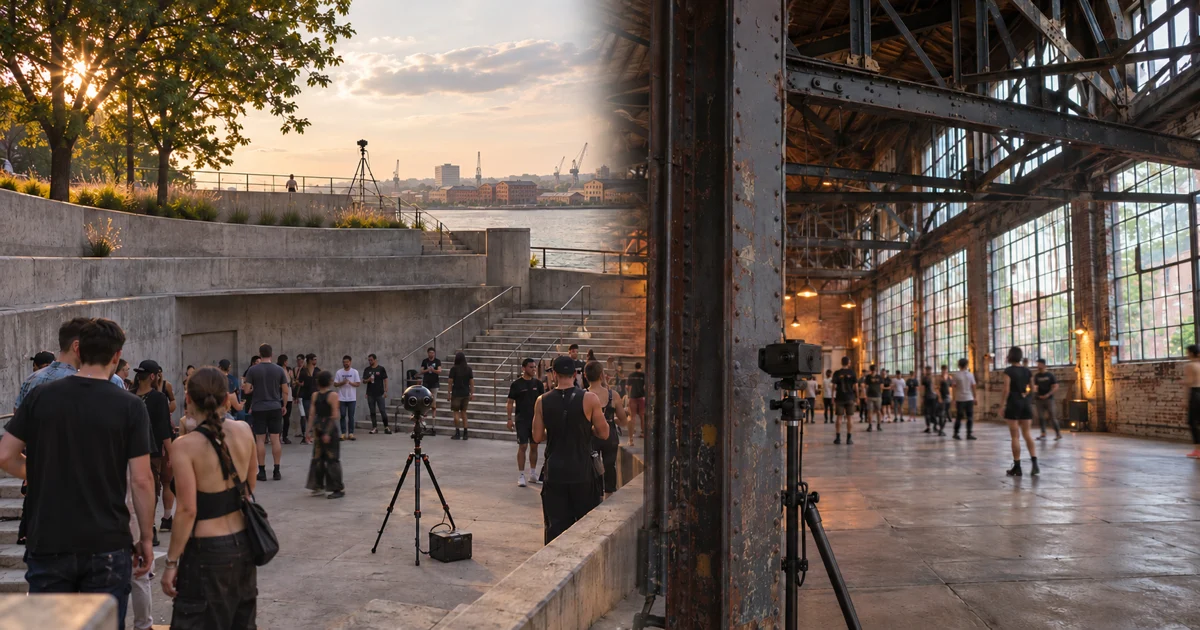
Original AI-generated editorial image of two fictional Detroit-inspired spaces and capture setups. It does not depict Hart Plaza, Movement, Lincoln Factory, Marble Bar, another real venue, an event, an artist, a VPORT production or a partnership.
Detroit Electronic Music History: Where Techno Actually Started
Detroit techno emerged in the early 1980s through basement studios, local clubs and parties in and around the city. The Detroit Historical Society traces the scene from early records and small rooms to European audiences, while the National Park Service describes techno as a Detroit-born electronic dance genre that reached global popularity within a decade. Synthesizers and drum machines were central tools, but the local spaces and distribution networks were also part of how the sound moved.
What makes Detroit unusual in this series is that the city government says so out loud. The city's listing for the 2026 festival calls it "an annual celebration of the Techno music that started here in Detroit." Not a genre the city hosts. One it started.
That claim gets institutional backup in an odd place. Exhibit 3000 sits at 3000 East Grand Boulevard and is dedicated to Detroit techno history. A record store operates in the same building. Museum tours are by appointment, so confirm current availability before planning a visit.
Compare that with our Berlin guide, where the German Commission for UNESCO put the local scene in a national inventory and traced the lineage back to Detroit techno and Chicago house. Berlin was recognised for carrying the music. Detroit and Chicago were the two cities it was carried from. Our Chicago post covers the other half of that pair, about 280 miles west.
Movement Detroit 2026: What Happens at Hart Plaza Each May
Movement takes the plaza over Memorial Day weekend. The 2026 edition ran May 23 to 25, during Paxahau's 20th year as the festival's producer. That is the point in the calendar when the Detroit techno festival circuit and the international touring circuit land in the same square.
The site is the thing worth understanding before you plan a trip around it. Hart Plaza is not a field with a stage at one end. Noguchi built it on multiple levels, and the festival maps stages onto that geometry rather than flattening it. Movement's own venue guide places its main stage in the amphitheatre and its Underground Stage below the plaza's main level. For capture planning, those height changes force a real tradeoff: a low position can preserve the crowd's perspective, while an elevated position shows the layout but puts the camera farther from the floor.
That is also why the festival reads differently from the ticketed park events in other cities. Our São Paulo guide describes a scene organised around sessions that start at 5am, and our Montreal guide one organised around what happens after last call. Detroit's anchor event is a multi-stage festival on a riverfront civic square, in a city where the music is treated as local heritage rather than imported product. After-parties extend the weekend into rooms across the city.
The Club Calendar: Lincoln Factory, Marble Bar and One-Off Rooms
Outside of May, check current calendars instead of treating any short venue list as permanent.
Lincoln Factory is at 1331 Holden Street in the Dreamtroit complex, an adaptive-reuse project at the former Lincoln Motor Company site. Its industrial shell is the point: tall windows, steel structure and a room that reads at warehouse scale. Some events have offered combined access with Marble Bar, but that is event-specific rather than a standing rule. Read the current ticket terms before assuming one ticket covers both venues.
Marble Bar maintains its own calendar. If you have one night in Detroit and no festival to anchor it, compare the two listings before choosing the room.
Beyond those rooms, one-off bookings can appear late and move between spaces. This is the part of the Detroit electronic music scene most likely to have changed by the time you read about it. Check current venue and event listings the week you travel, not the month before.
One structural note that transfers from elsewhere in this series. Our London listening guide works through what a building's layout does to a night, and Detroit is the clearest case in the set. A converted assembly plant and a small bar are different nights at the same BPM. The booking tells you less than the floor plan does.
Why Detroit Rooms Are Hard to Film
Many long-form club sets offer fewer conventional stage cues than an arena show. The production is the crowd, the ceiling and where the sub sits. One flat camera angle gets you the booth and loses the night.
Hart Plaza in May is the larger version of the problem. A 360 rig placed low in the amphitheatre is inside the crowd, which is honest to the experience but leaves fewer clean cutaway options. An elevated camera preserves the site's levels but increases distance from the floor. The best plan may use both perspectives rather than pretending one position can explain the whole room.
Format choice comes before rig choice here. Our guide to checking a concert video's format sets out which capture suits which room, and a dark converted plant is where that decision does the most work.
Then there is the paperwork, which is the part that actually stops shoots. Do not assume an admission ticket also grants permission to film performers, record the music or publish images of a crowd. Our music rights guide covers what a recording plan has to clear before anyone presses record. For how VPORT handles creators, venues and events on the production side, the creator documentation is the place to start.
To be clear about what this post is and is not: VPORT does not have a Detroit catalogue, and nothing here announces one. The venues and festival named above are independent and have no affiliation with us. We are describing why the city is worth the format, not claiming we have already filmed in it.
These Are the Sets Worth Teleporting To
Here is the access problem in one line. The music that shaped dance floors around the world has its home weekend on a riverfront square in Michigan for three days a year, while much of the club calendar happens in event-night rooms you have to travel to.
That gap is what VPORT is designed for. VPORT has a public U.S. listing for Apple Vision Pro and a Meta Quest listing released October 4, 2026, alongside browser access. Catalogue and playback modes remain event-, account- and region-specific. The current pricing page lists Free events plus paid tiers at 3, 5 and 8 cents per watched minute, with $5, $10 and $20 wallet bundles. At those published rates, 60 paid minutes cost $1.80 to $4.80 before any replayed minutes.
Detroit's cultural claim is formal, while some of the institutions preserving it remain small and appointment-based. That contrast is part of the story.
If a flight to Hart Plaza is not one you can make, browse VPORT's current catalogue without reading this article as a promise of a Detroit set. Confirm the event, format and price shown to your account before playback.