
New York Electronic Music Clubs: Bossa Nova and the Rooms Shaping the City
Bossa Nova Civic Club is a club at 1271 Myrtle Avenue, under the elevated M train in Bushwick. It is a compact storefront room rather than a purpose-built hall. Nothing about it is grand.
It remains one of the defining addresses in conversations about New York electronic music clubs. That is the thing to understand about this city: much of its scene runs through compact rooms rather than purpose-built dance-music venues.
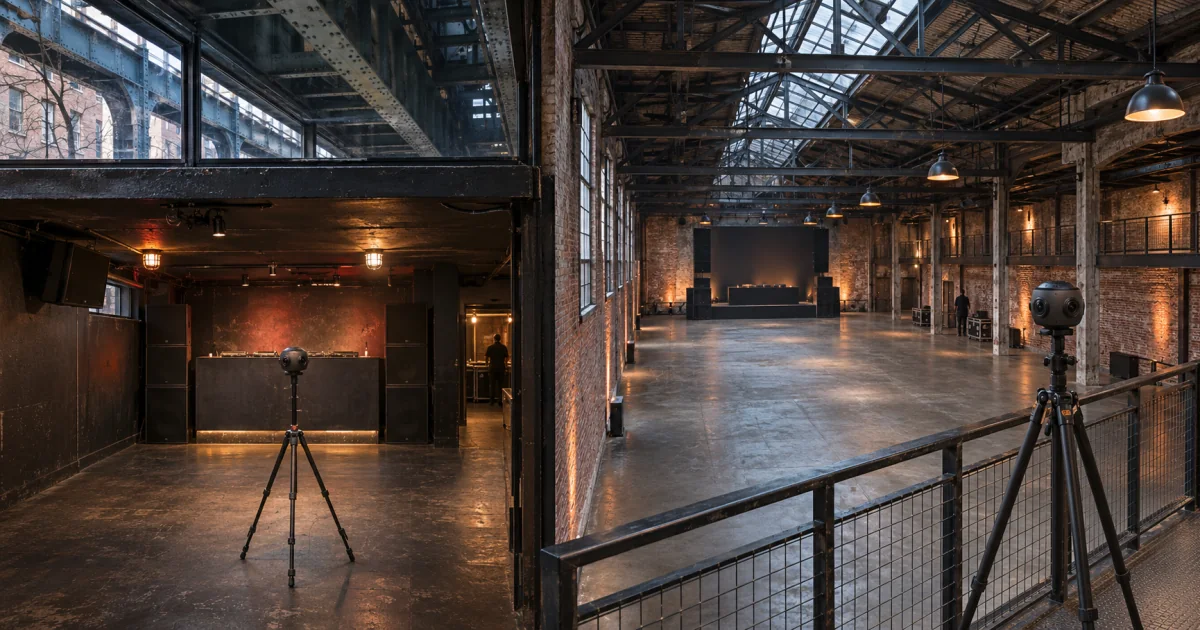
Original AI-generated editorial illustration of two fictional New York-inspired rooms and capture setups. It does not depict Bossa Nova Civic Club, Brooklyn Pacha, another real venue, an event, an artist, a VPORT production, or a partnership.
Bossa Nova Civic Club and Why It Matters in Bushwick
The room shows how much of New York's electronic music identity can form inside a small neighborhood venue rather than a purpose-built district. Along the Myrtle Avenue corridor and the blocks around it, Bossa Nova became one of the addresses that drew listeners beyond the immediate neighborhood.
The fragility is part of the story. In January 2022 a fire broke out in the apartment above the club. The room remained closed until reopening that October. The closure showed how much a neighborhood scene can depend on one small room.
Compare that with our Chicago guide, where the building that named house music carries city landmark status and the Department of Cultural Affairs runs a free 4-day festival around the genre. Chicago has formalized parts of its house-music history through public recognition and programming. In New York, this guide focuses on independently operated rooms whose schedules and operating details should be confirmed on their official calendars.
The Brooklyn Rooms, and the Part of the Scene That Is Actually in Queens
"Brooklyn club scene" is the search term, and it is slightly wrong. The map crosses the Newtown Creek.
Good Room sits at 98 Meserole Avenue in Greenpoint. Its own venue page describes a club built by music lovers with a d&b audiotechnik sound system. It is the most conventional dance club on this list, in the sense that dancing is the premise.
Public Records at 233 Butler Street in Gowanus works the other end of the range. Its campus combines a Sound Room with a restaurant and music lounge, listening lounge, cafe, and outdoor nursery. Read the calendar and the room name before assuming what kind of night a listing represents.
Elsewhere in Bushwick is the multi-room option, with three stories of dance floors and stages. House of Yes, also in Bushwick, programs performance, dance, and art around the music, which is a specific taste and worth knowing in advance.
And then Nowadays, which is at 56-06 Cooper Avenue in Ridgewood, Queens. Indoor room, outdoor yard, daytime sessions as well as late ones. Plenty of people who describe their weekend as Brooklyn nightlife spent it in Queens.
Layout does more work here than a lineup alone can explain. Our London clubs guide makes the case at length, and it transfers directly: a compact room and a converted warehouse are different nights even with the same genre on the flyer.
Pacha Takes the Mirage Site: What Changed in 2026
The large-format end of the city collapsed and then got rebuilt by somebody else, and that happened inside 18 months.
Avant Gardner, the East Williamsburg complex that housed the Brooklyn Mirage, filed for Chapter 11 in August 2025 with $155.3 million in funded debt obligations after the rebuilt outdoor venue failed to pass inspection and missed the 2025 season. In February 2026, FIVE Holdings, the parent company of Pacha, assumed full operational management of the Mirage and the Great Hall, and reopened the outdoor room as Pacha New York on a June to October season. It was the brand's first presence in the city since Pacha NYC closed in Hell's Kitchen in 2016.
The indoor half landed this month. On November 6 and 7, the former Great Hall opened as Brooklyn Pacha, with the official calendar extending into February 2027.
The same complex now combines Pacha New York's seasonal outdoor program with an indoor calendar that continues through winter.
None of that replaces a compact storefront. It does mean the New York techno scene in 2026 again has both intimate rooms and a large indoor venue.
Why a New York Room Is a Hard Case for One Camera
The rooms in this guide do not share one geometry. A compact club, a multi-room arts space, and an industrial hall create different sightlines, crowd movement, lighting, and audio problems.
That is why one fixed camera position cannot be treated as a universal plan. A position that covers a booth can miss the crowd behind it; a position that works in a narrow room can leave a larger hall without useful depth. Scout the actual room, mark sightlines, and test exposure and audio before deciding how many positions the recording needs.
Format choice comes before rig choice, and our guide to checking a concert video's format sets out which capture suits which room. A small dark club is the case where that decision carries the most weight.
The other constraint is permission, and it is the one people skip. Before recording or publishing, confirm the event terms and secure the licenses, performer permissions, and audience notices the project requires. Our music rights guide covers what a capture plan has to clear first, and the creator documentation is where VPORT's own publishing workflow starts.
To be explicit about what this post is: VPORT has no New York catalogue, and nothing here announces one. Every venue named above is independent and has no affiliation with us. We are describing why the format suits the city, not claiming we have already filmed in it.
Following New York Electronic Music Without a Flight
Here is the access problem in one line. Venue schedules, ticket rules, travel, and room capacity limit who can attend a particular night.
VPORT provides another way to hear concert recordings that creators have actually published. Available recordings can play on Apple Vision Pro and Meta Quest, where the Meta Horizon Store listing notes that content varies by event and region. Current VPORT pricing ranges from free to 8 cents per minute, with $5, $10, and $20 wallet top-ups. Those prices describe available VPORT content, not any New York venue named in this guide. Our Berlin fan guide and our Montreal guide cover cities organized around very different hours.
New York's scene spans a storefront on Myrtle Avenue and a large indoor hall a short trip away, but neither format makes every night accessible to everyone who wants in.
Browse the current VPORT catalogue, then confirm the listed venue, format, availability, and price before starting playback.