
Indoor Electronic Music: How the Room Changes the Set
Amsterdam Dance Event's official 2026 information lists October 21 to 25. Its many participating festival venues make a useful, dated example for thinking about indoor listening, not proof that every city's calendar moves inside at the same time. A kick drum outdoors and the same kick inside a room can feel different: hard room surfaces can increase reverberation, while absorptive treatment on walls and ceilings can reduce reflections; ceiling height, room treatment and where you stand all shape what reaches your ears.
If you spend the summer in front of open-air stages and then walk into a basement in late October, the music has not changed. The room has. This is a short guide to what actually changes for a listener when electronic music moves indoors, and what to ask about a specific night before you commit to it.
The indoor season is a programme decision, not a weather report
It is tempting to write October as the month the whole scene files indoors. It is not true, and the places where it is least true are the ones worth knowing about.
Plenty of cities never had an outdoor season to leave. Our Berlin venue guide focuses on spaces and architecture rather than a seasonal handoff, while the Vancouver guide looks at how local closing times shape a night. The southern hemisphere is heading the other way entirely in October. And in cities that do run both indoor and outdoor programmes, the formats can overlap: the 2026 edition of Sónar in Barcelona programmed three open-air and three indoor stages on the same site, which we covered in the Barcelona city guide.
So the honest version is narrower and more useful. Specific programmes concentrate indoors in autumn, and ADE is one published example with many participating festival events and venues. Our Amsterdam venue piece looks more closely at that network. The question to carry into the season is not "has the scene moved inside" but "which room is this particular night in."
What a ceiling does to a set
Four aspects of the experience are worth checking. Their effect depends on the venue and the event.
Decay. Enclosed rooms add reflections and can produce uneven bass at different positions on the floor. Hard surfaces can lengthen reverberation, while absorption and sound-system tuning can reduce it. Outdoors, nearby buildings, barriers and the ground still affect sound. A ceiling changes the possibilities; it does not guarantee a particular sound.
Proximity. Some open-air stages separate the audience from the booth with a barrier, production space or photo pit. Some smaller club rooms put the booth at the edge of the floor, while others use a raised stage or a separate booth. Check the layout rather than assuming the format from the venue category.
Sightlines. A field gives you a horizon and a sense of your own scale inside a crowd. A room takes the horizon away and replaces it with walls, a ceiling height, and whoever is directly in front of you. Multi-room venues go further, because the night splits: two people at the same event can spend it in different rooms and come home having heard almost nothing in common. That is the argument we made at length about London's three-room clubs.
Darkness. Outdoor sets can run through sunset or daylight. An enclosed room can give the production more control over light from the start, although windows, house lighting and venue rules still shape the result.
None of this makes one better. A field at golden hour is its own event. An indoor room can make room geometry, reflections and crowd movement more noticeable, but the result depends on the specific space and its production.
Longer arcs, and how a room can support them
Festival and club timetables can both be tightly scheduled. A festival stage may use shorter changeovers and overlapping programmes, while an indoor promoter may choose a longer set or an all-night sequence. Neither format guarantees a particular arc.
An indoor bill can also be built around a longer sequence. A promoter might give one artist several hours, or programme an opening set, a peak and a comedown for the people who stay. That sustained arc is one possible product of club programming, and much of it disappears when a set is reduced to a 60-second vertical video. We wrote about the case for treating these nights as first-class material in Beyond the Festival.
When rights, venue rules and production conditions permit a recording, a continuous capture from an intentional point of view can preserve more of that arc than a short clip. It can show how the room fills and how the crowd's movement changes over time. It still cannot reproduce the room's physical sound pressure or guarantee that the resulting video is available on any platform.
Questions to ask about a particular night
A listing cannot tell you everything about a room. Five questions help before you buy:
- Which room? On a multi-room bill, find out which space the artist you care about is in, and whether that room is the main floor or a side space with its own programme and its own crowd.
- What is the shape of the bill? One long set and a rotation of six 90-minute slots are different nights. A detailed listing may tell you, so read the times rather than only the names.
- When is the artist scheduled? Door time is not programme time. Check the published timetable when one exists, and do not infer the peak hour from the closing time.
- How close can you get to the booth? Capacity alone does not answer this. Look for a room plan or recent venue information showing barriers, stage height and audience areas.
- What does the venue publish about access and sound safety? Look for stairs, lifts, step-free routes, accessible facilities, quiet areas and hearing protection on the venue's information page. The WHO safe-listening standard for venues and events recommends measures including sound monitoring, hearing protection and quiet zones. If essential details are missing, ask the venue directly.
That last one matters more than it sounds. The venue's own current accessibility and practical information is the best starting point, but contact the venue when a requirement is essential and the published detail is incomplete.
Where this leaves the rest of us
Some indoor nights trade capacity for intimacy. A room that gives 400 people proximity gives it to 400 people, while a larger room may make a different tradeoff.
For a recording, the useful question is what it preserves. A considered point of view can show the sightlines and movement of a crowd; a continuous recording can retain the shape of a set. Neither guarantees the sound or physical feeling of standing in that room. A floor that carries bass through your feet is doing something a headset cannot reproduce. Our promoter guide to filming a club night explains production considerations, and browsing and discovery explains how to inspect content listed on VPORT. A listing should be checked for its own format and availability. This guide does not announce any indoor event on VPORT.
The season has turned in some cities and not in others. Either way, a useful starting point is the room itself: its programme, layout and practical access information.
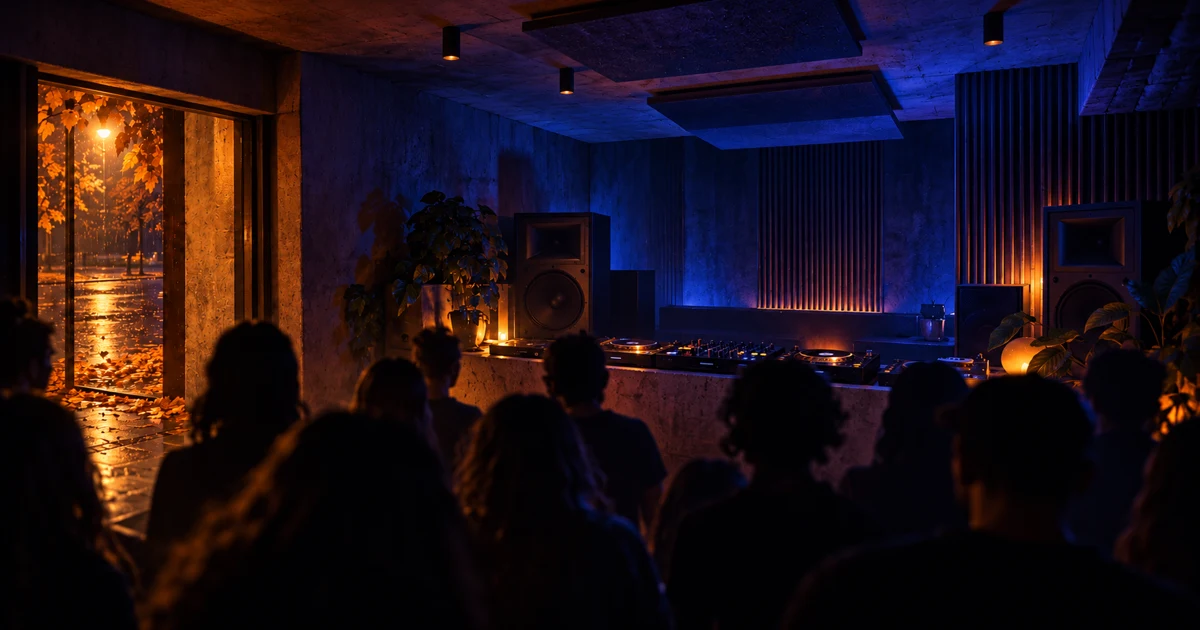
Image disclosure: Original AI-generated editorial image of a fictional indoor listening room. It does not depict a real venue, event, artist, VPORT production or partnership.
Editorial note: VPORT is not affiliated with Amsterdam Dance Event, Sónar, or any event, venue, or programme named or described here. This article announces no capture, partnership, catalogue availability, or content release.