
Paris Electronic Music: The Scene That Runs on Its Own Terms
Port de la Rapée is a stretch of quay on the right bank of the Seine, east of Gare de Lyon. Concrete operated on a barge there from 2012 until July 2019. Resident Advisor's closure report dates the final session from Friday 19 July to Sunday 21 July.
The useful lesson is not that one closed club defines Paris. It is that the city's electronic-music calendar has long moved among very different rooms, from a barge to a former freight site, a top-floor exhibition venue and central clubs.
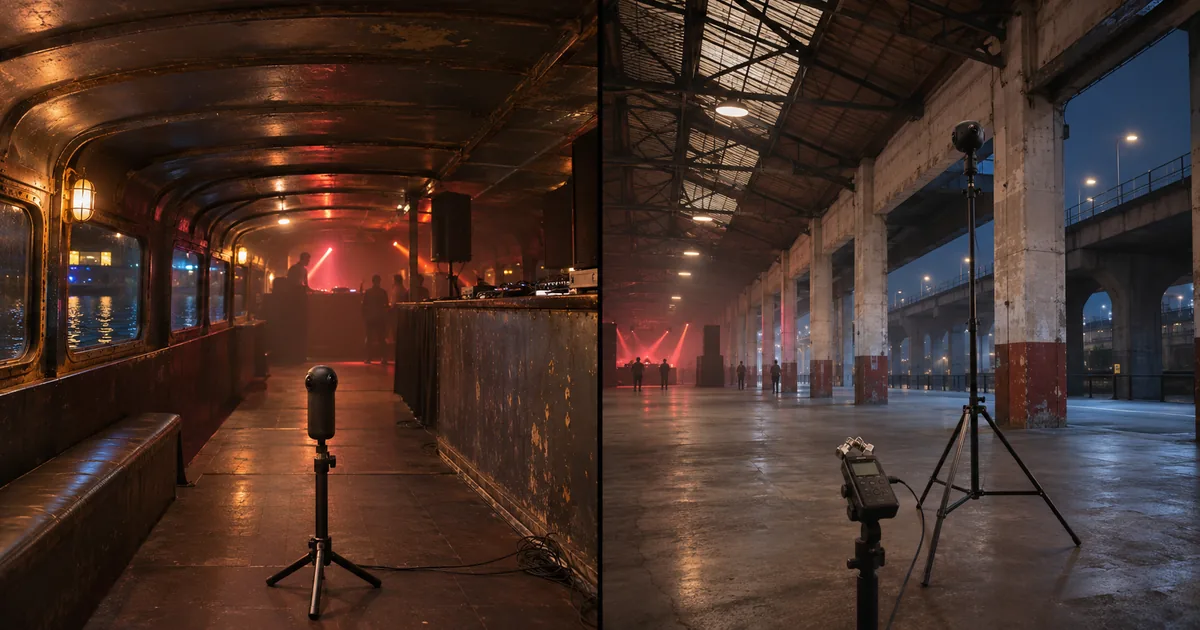
Original AI-generated editorial image of two fictional Paris-inspired spaces and capture setups. It does not depict Concrete, La Station - Gare des Mines, T7, another real venue, an event, an artist, a VPORT production or a partnership.
Why Paris Built Its Scene at the Edges
Start with density. The City of Paris nightlife overview describes recurring conflicts between nightlife and residents in what it calls Europe's densest city. That does not give every venue one closing time, but it does explain why noise, crowd movement and location remain part of the city's nightlife policy.
The current map is distributed rather than confined to one district. This guide includes a central basement club, a former freight site near the Boulevard Périphérique, a venue atop an exhibition pavilion and a multi-room cultural venue in Pigalle. The pattern is an editorial reading of the current listings, not a claim that every Paris club moved to the edge.
That is a different route through the series. Our Berlin guide covers a club culture entered in Germany's national inventory of intangible cultural heritage. Our Detroit guide covers a city whose government publicly identifies techno as locally born. Paris is better understood through current venue calendars and the way its rooms change over time than through an equivalent civic label.
The Rooms Worth Knowing in 2026
The Paris techno clubs worth tracking sort by arrondissement and by what the building used to be.
Rex Club at 5 Boulevard Poissonnière is the central, long-running reference point. The club dates its electronic-music history to 1988 and says it completed a major refit in summer 2023. Check its current calendar before planning a night.
Then the edges, with a temporary-site warning attached. La Station - Gare des Mines still publishes event listings tagged “nord” and gives 29 avenue de la Porte d'Aubervilliers as its address. However, the venue's own project page says its nearly 3-year renovation break began on 31 October 2026 while the team looks for a temporary site. Verify the location on the specific event listing before planning a visit; the Gare des Mines address is not an evergreen recommendation.
T7 describes itself as a rooftop club with a panoramic view and publishes event-specific tickets. Those details matter more to capture planning than assigning the room one permanent genre.
Closer in, Badaboum is at 2 rue des Taillandiers in the 11th near Bastille. Its current site publishes the address and calendar; a November 2026 tourism-office listing says the venue is relaunching around house music from 20 November. La Machine du Moulin Rouge in Pigalle mixes club nights, concerts and other cultural programming across its spaces. Read both current calendars rather than freezing either venue to one sound.
One habit transfers from our London clubs guide: read the room's own calendar for the specific night, not the venue's reputation. A venue can change direction or host different promoters across one season. The current listing is more useful than an old genre label.
It is worth knowing what is gone, too, since the search results will send you there. Social Club at 142 rue Montmartre played its last night in May 2016. Concrete left the quay in 2019, and its successor Dehors Brut closed permanently in 2020. All three still appear in older Paris recommendations, but none is a current venue.
Why Paris Sets Suit Spatial Video
These rooms do not share one physical layout. A central club, former freight site, top-floor pavilion and multi-room cultural venue create different sightlines, crowd movement, lighting and audio conditions.
That variation is the argument for scouting before choosing a capture plan. A camera position that works in a narrow room may flatten a larger hall; a high position that explains a room can pull the viewer away from the floor. Our piece on Afro house and tech house in immersive video makes the related case that a recording format changes how listeners read the space around a set.
To be clear about scope: this guide does not announce a Paris catalogue, a collaboration with any named venue or a VPORT filming project in the city. It describes public venue information and the capture questions those room types raise.
Recording in Paris: What These Rooms Require
If you are planning a capture here, the constraints follow from the buildings.
Do not infer acoustics, available power or rigging from a building category. Request the venue's current technical specification, scout the exact room and test the intended positions. Plan audio, power, storage and battery before doors; each of those constraints can change the viable camera placement.
Format choice comes before rig choice. Our guide to checking a concert video's format sets out which capture suits which room, and a reverberant hall with no fixed sightline is exactly the case where that decision does the most work.
Then the paperwork, which catches people. Do not treat an admission ticket as production permission. Confirm the event terms and obtain the venue, performer, music and audience permissions the project requires. The French data-protection authority's image guidance notes that recognizable people can have consent and removal rights; obtain qualified legal review for the planned capture and publication. Our music rights guide covers the clearance categories to discuss before anyone presses record. For VPORT's creator, venue and event workflow, start with the creator documentation.
Following Paris Electronic Music Without Being There
Here is the access problem in one line. A particular Paris night still requires the right date, room, admission and travel plan in a city where the calendar can change faster than a guide.
VPORT provides another route to recordings that creators have actually published. It has a public U.S. listing for Apple Vision Pro, a public Meta Quest listing and browser access. Storefront, account, region, event and playback-mode availability remain specific to the person and recording. The current pricing page lists Free events plus paid tiers at 3, 5 and 8 cents per watched minute, with $5, $10 and $20 wallet top-ups. At those published rates, 60 paid minutes cost $1.80 to $4.80 before any replayed minutes. Our Miami guide and Chicago guide cover scenes organized around different calendars and institutions.
The barge and the Montmartre room closed, La Station began its announced renovation break, and the current calendar spans rooms with very different layouts. That is why a Paris guide needs dates, current listings and room-specific capture planning instead of one permanent venue hierarchy.
If a late-night trip across Paris is not one you can make, browse the current VPORT catalogue without reading this guide as a promise of a Paris set. Confirm the listed venue, format, availability and price before starting playback.