vport

The VPORT Blog

Your Room Is the Asset: The Business Case for Filming Your Nights in Spatial Video
· 7 min read
CEO

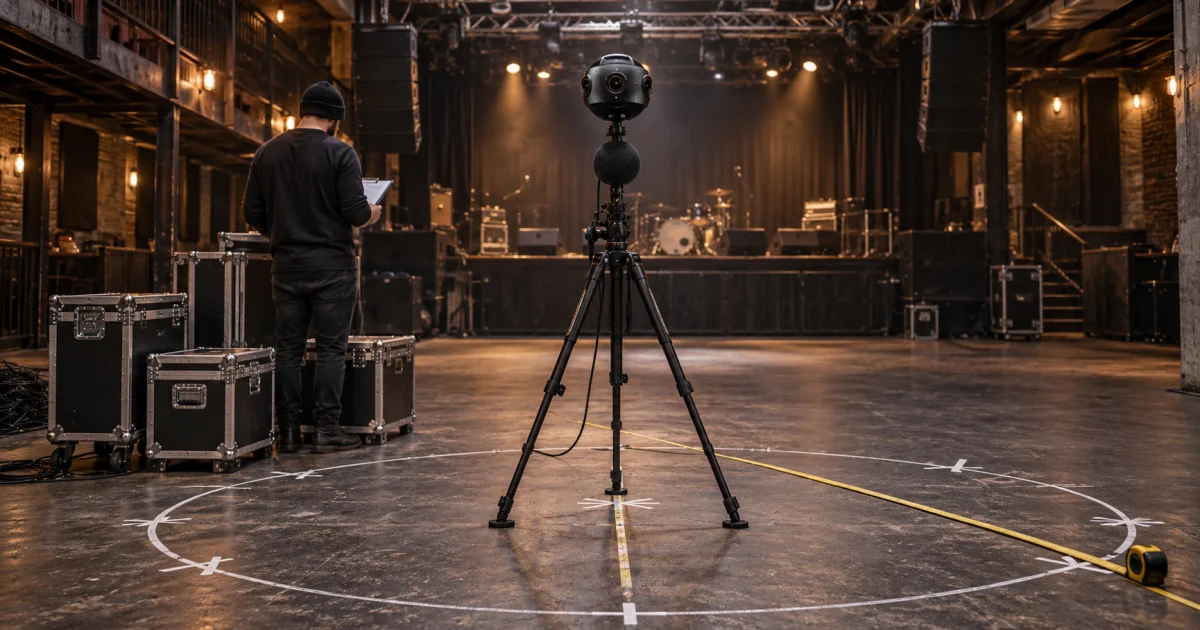
An unbranded stereoscopic 360 camera and ambisonic microphone positioned on a measured capture circle in an empty fictional music venue

AI-generated editorial image of a fictional venue capture workflow. It does not depict a real venue, event, artist, VPORT production, or partnership.

Last call lands at 4am. The lights come up on 600 people who have been inside a 3 hour closing set, and 20 minutes later the room is a floor covered in cups. Whatever happened in there now exists as maybe 40 vertical phone clips, shot at chest height, audio clipped into distortion. The promoter paid the booking, the rider, the security, the sound engineer. What they own the next morning is a bank transfer and a hangover.

That is the part of this business I keep coming back to. A venue builds a night for months. It runs once. Then it is gone, and the only durable record belongs to whoever held their phone up. Spatial video changes what a room walks away with, and the argument for it is not a romantic one. It is an asset argument.
How to Watch Your First Concert on Apple Vision Pro: The 2026 Beginner's Guide

· 17 min read
CPO

The first sixty seconds inside a VPORT show will ruin flat video for you forever. That is not hyperbole. It is a warning. You put on Apple Vision Pro, you open the app, you tap a show - and then you are standing inside the room. The bass is in your chest. The lights are above you. And there is no screen. There is just... the venue.

The Set Is the Album: Why On-Demand VR Concerts Beat Live for Electronic Music

· 7 min read
CEO

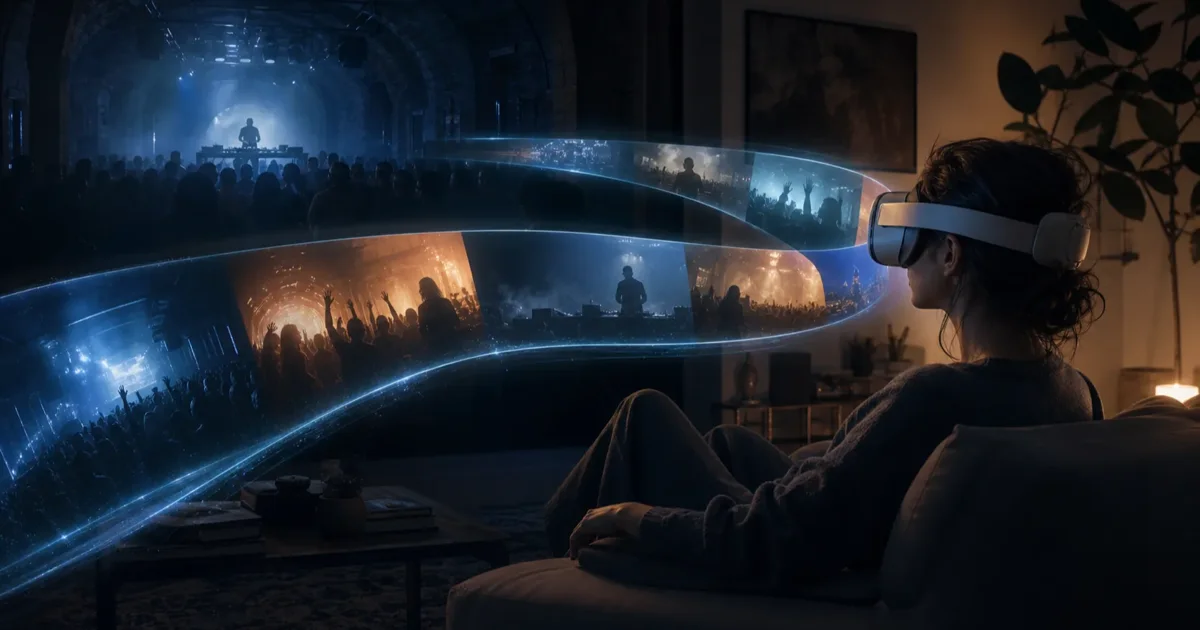
A fictional underground electronic set preserved as a replayable visual timeline for a headset listener at home

Original AI-generated editorial image of a fictional home listening scene. It does not depict a real venue, event, artist, VPORT production, or partnership.

Somewhere around the fourth hour, a good techno set stops being a sequence of tracks. The kick has been running so long your body has filed it under weather. A hi-hat opens half a step. Two hundred people who have not looked at a phone since 1am feel the room tilt before they hear why. That moment is not a song. It is the payoff of three hours of setup, and it lands only because of everything stacked underneath it.

Now try to deliver that live to someone in Los Angeles. It is 7pm on a Friday there. The buffer stutters at the exact bar the build resolves. The bitrate collapses into the strobe and the picture turns to porridge. They catch nineteen minutes and go make dinner.

This is the case for on demand VR concerts, and it is not a consolation prize for platforms that cannot do live yet. For electronic music, the recorded set is the better product.

After the Festival: The Room That Sold Out Without You

· 6 min read
CEO

On Friday July 31, an open-air electronic music event runs at Burgess Park in south London. Its ticketing page listed entry from £50 and the Friday date as sold out. The Saturday session at the same site was still on sale when we checked on Monday July 27, and the official event pages did not announce a livestream for either day.

That is the whole story, and it is a more interesting one than it looks. A field in Southwark has a fence around it, the fence has a number attached to it, and once that number is reached the event is complete. Everyone who wanted in and did not move fast enough is holding a browser tab and a sold out sign.

Amsterdam Electronic Music Venues: Why the Room Matters in Spatial Video

· 5 min read
CEO

Amsterdam's electronic music identity is tied to its rooms. A circular former gasworks, an industrial shipyard, a basement under a waterfront tower, and temporary spaces across the city can each make the same track feel different.

That is why Amsterdam is an interesting subject for spatial video. The format can preserve more than a view of the performer. It can record how architecture, lighting, audience movement, and sound work together inside a venue.

Awakenings Festival 2026: What Outdoor Techno Teaches Us About Spatial Video

· 5 min read
CEO

Awakenings Festival 2026 took place in Hilvarenbeek from July 10 through 12. The official event page listed the three-day festival as sold out and published a program spread across multiple outdoor areas.

That combination makes Awakenings a useful case study for spatial video. An open field, a large crowd, daylight, multiple stages, and architecture built to be seen from many angles all create information that a single camera frame cannot fully preserve.

Beyond the Festival: Why Club Nights and Warehouse Sets Belong in 360

· 5 min read
CEO

Picture a converted warehouse late at night. The room is compact, the lighting is minimal, and the DJ is close to the dance floor. It is a different experience from watching a distant festival stage. That physical density and directness deserve a larger place in the conversation about virtual reality music events.

We have been thinking about this for a while at VPORT. Early conversations around spatial video and 360 concerts often focused on festivals, and the reasons make sense. Festivals are visible. They have recognizable names. The main stage provides a clear camera position and a sightline that translates to a headset without much explanation. Clubs offer another side of electronic music: smaller rooms, longer-form programming, local scenes, and the relationship between a venue and the people who return to it.

Built for Presence: Afro House and Tech House in Immersive Video

· 6 min read
CEO

Picture a fictional open-air room at blue hour. The booth is visible, but it is not the only thing worth watching. A percussion pattern moves through the mix while the crowd forms smaller scenes across the floor. The interesting question for an immersive recording is not whether one genre is "better for VR." It is which details make a particular set feel like itself, and whether the production preserves them.

Afro house and tech house can both reward wide room coverage, long-form editing, and spatially authored sound. They do not reward those choices in exactly the same way. Their labels also cover broad, changing scenes, so this is a production guide rather than a claim that every track or event follows one formula.

Spatial Video Concerts: Spatial Video vs 360 vs VR

· 5 min read
CEO

It is 1am in a fictional basement venue. The lights are low, the booth is close, and the crowd extends behind the camera. If you want to preserve that room, should you shoot spatial video, 360 video, or VR?

The question sounds simple because those terms are often used as substitutes. They are not. They describe different parts of the experience, and they can overlap in the same piece of media.